FROM the morale sweets handed round in freezing-cold Estonia to the ration-pack curry munched in an OP in Kenya, the well-worn saying that ‘an army marches on its stomach’ is as true today as it has ever been.
But growing understanding of nutritional science and human performance has put operational ration packs under the microscope of defence boffins. And their findings suggest these food parcels have the potential to unlock an impressive new level of human advantage which could boost fighting power.
In a piece of world-leading research that has turned the heads of partner nations including the US Army, UK defence nutritionists at the Institute of Naval Medicine (INM) have designed a next-generation feeding system.
Not only is the rapid insertion ration (RIR) lighter and more compact as you might expect in an age of dispersed fighting and drone resupply, but it is seriously smart on the nutritional content front.
With items that are colour-coded according to the functional benefits they bring (long-range or fast fuels, for example), the products are fortified with various ingredients to support soldiers when they need it most.
Collagen, proteins and vitamins, to name a few, help with things like injury repair, bone strength, immunity and mood. And the supplies can be deployed in different combinations to match any particular operational requirement – slow releasing carbs for long-term patrols, for example, or quick energy bursts for night attacks.
The study was led by the research and experimentation branch of Defence Support.
Known as the Future Defence Deployed Nutrition project, its findings are part of a bigger idea the scientists have put forward around leveraging nutrition as a capability.
Programme lead Dr Jo Fallowfield told Soldier the RIR had been trialled by various UK high-readiness units over the last four years, with feedback positive and evidence suggesting this could deliver strategic benefits on the battlefield.
Putting together the prototype had, she said, required moving away from an energy-provision mindset to one that embraces “all the different functional characteristics of food”.
“Tasty food is way more important than just fuel,” the expert added.
“We wanted to think much more scientifically about how we enhance the performance of our soldiers.
“At the moment, when you open the operational ration pack you find breakfast, a main meal and an assortment of snacks. But we wanted to include components that deliver strategic effects – products for bursts of energy, for example, or hydration. It was about thinking differently about composition and trying to get away from ‘it’s this time of day, so I need to eat a meal’.
“We parked that because, as we know, when on ops you don’t follow the normal 24-hour clock.
“The whole point was to work with the most nutritionally challenging model – very high readiness forces on complex tasks – and come up with a solution, then seeing what we can pull through to other operational arms so we do the best for everybody.
“But food is also a key part of morale and a little piece of home, so it needed to taste good.”
After examining current ORPs, her team drew up a list of all possible nutritional ‘superpowers’ that could be used to support land forces – for example, bovine collagen to help with muscle repair, antioxidants to mitigate tissue effects of thermal stress or antimicrobials to cut infection risk.
Trying to incorporate these benefits into a ration pack weighing no more than 8kg and that lasts for seven days, they then scoured commercial off-the-shelf products to see what could meet this criteria.
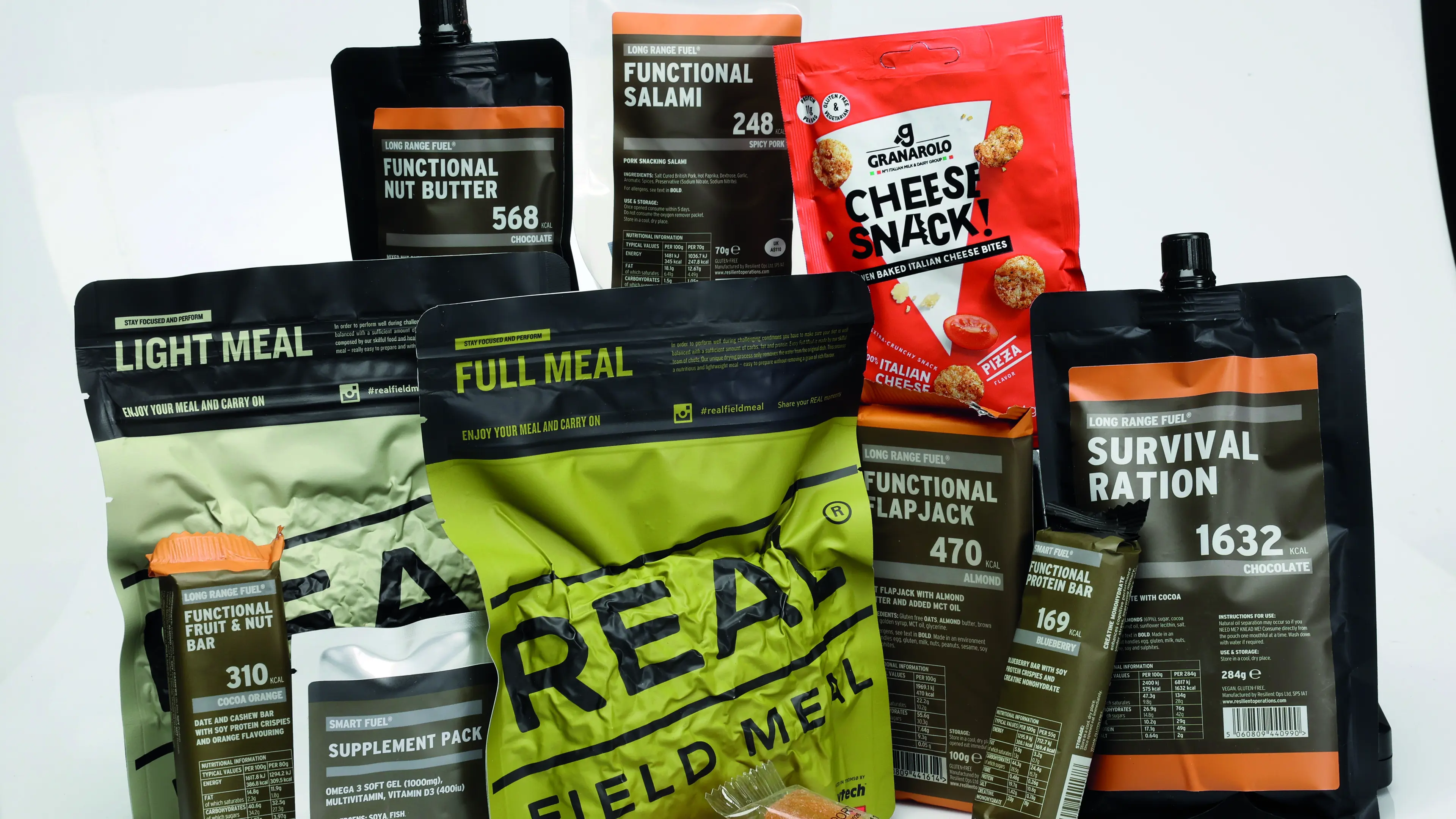
Working closely with a team of military chefs and scientists, they went about compiling the RIR, a commercial example of which can be seen below.
It contains a higher number of calories than the current ORP but in fewer items of better quality, with less refined sugar and more complex carbs.
However, recognising that rapid sugar boosts can be vital on ops – not to mention good for morale – there are still plenty of tasty treats to be found inside this version, including fudge fortified with collagen and a chocolate bar developed by a military chef/chocolatier with vitamin D and calcium to support stronger bones.
The UK Commando Force has understood the need for a smaller and more nutritiously dense ration for quite some time, and has been closely involved with the project from the start.
Lt Col Bernie Manning (RM), one of the senior officers supporting the work, explained how commandos had been quick to see the benefits of the RIR when they tested it during long-range patrols and on mountain leader training in Norway last year.
“It’s lighter, has lots to it, and is more intelligent in terms of how it can be used,” he explained. “Whether it tastes good is arguably the most important feedback, though, and the comments we had from the field were that, yes, it does.
“Clearly, some real consideration has gone into this. There are some really interesting ideas of flavours, too,
which is great to see.
“The lads were encouraged that people are thinking about this stuff and how it can contribute to their health and endurance when it counts, to deliver operations.
“And importantly, they said they still found them palatable 14 weeks in. For anyone sat cold and wet, and unsure when a deployment will end, morale can often come from the ration packs.”