
When the smoke of conflict began to clear in Europe in 1945, attention turned to a Japanese enemy that had resolutely refused to give up despite suffering huge losses.
With an unconditional surrender signed by the German high command, British, Commonwealth, American and Chinese troops were still fighting in Burma, now called Myanmar, finally arriving at the capital Rangoon in May.
Meanwhile, the US had been spearheading a campaign across the Pacific in a war of attrition against the Imperial Japanese Forces.
Battling from island to island towards the enemy homeland, the troops faced a foe for whom defeat meant dishonour – and who would fight for every inch of ground.
The battle for the atoll of Tarawa in November 1943 had shown the suicidal zeal of the enemy early in the campaign. A three-day encounter across a territory of 31 square kilometres left 1,000 US marines dead and another 2,000 wounded.
Of the 3,000 defenders, only 17 were left alive to be taken prisoner. Assaults on Saipan, Iwo Jima and Okinawa in 1945 saw the pattern replicated on a far larger scale.
Now, as a long summer ended and the allies stood in the foothills of the Land of the Rising Sun, commanders faced the prospect of conducting a full-on invasion of the Japanese home islands.
Operation Downfall, as the action was dubbed, would see 767,000 personnel attack.
In response, the Japanese leadership had drawn up a defensive plan called Ketsu Go, Operation Decisive, that would use three million men to inflict mass casualties.
The waiting troops – oblivious to the fact that the dropping of two atomic bombs on Hiroshima and Nagasaki would bring the war to a sudden conclusion – stood ready for the final assault…
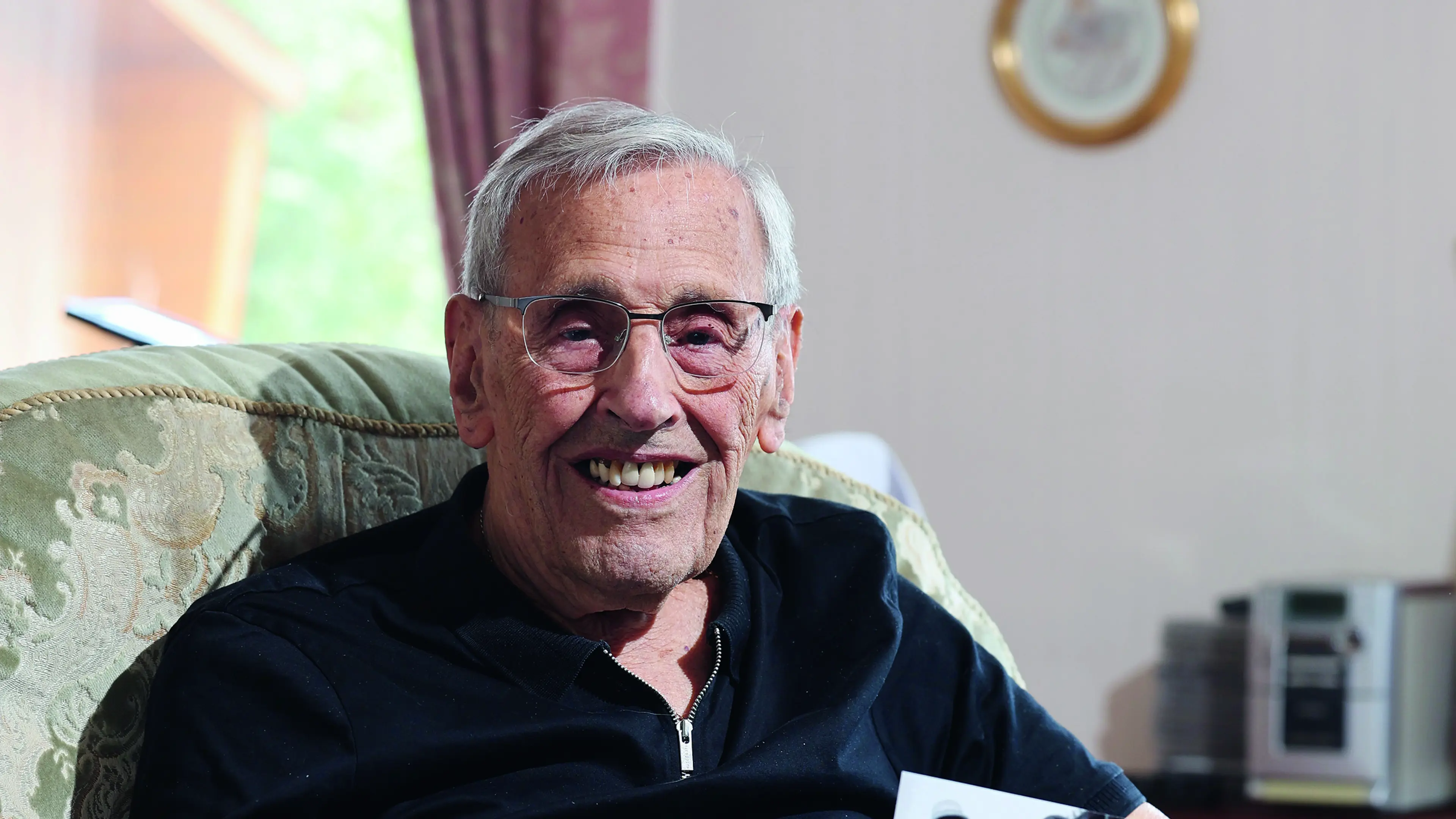
The son of a London publican, (ex-WO1) Don Poole served in India during 1945. He was an ammunition examiner – broadly the equivalent of a modern ammunition technical officer – in the Royal Army Ordnance Corps. He married wife Beryl in December 1950 and the couple had a son and daughter. He served in various civvy jobs, including running his own domestic appliance business, until he retired. Aged 101, he lives independently at his home in Hertfordshire.
"The Japanese were an awful enemy – in their code it was death before dishonour; they did not surrender. Had the war not been ended by the atom bombs, an invasion of their home islands would have cost hundreds of thousands of lives. Even after the war there were some of their units operating in India, where I was then based, which would not give up. Fighting went on well into 1946.
What is there to say about me? I was called up to join the army in late 1942 and specialised in ordnance. I went on an extensive course in Hampshire covering everything from small arms to mortar bombs, big calibre shells and mines. It was our job to deal with all types of stuff – to make safe anything that might be lying around.
But this was not my first experience of military life – in 1940 I joined the Home Guard, lying about my age to get in. The unit was local to me – my dad owned a pub, which was called The Three Brewers, opposite the tube station in Islington. Our unit went out and helped during the German air raids.
I was promoted to WO1 in India after going through the ranks quite quickly. We did all kinds of jobs, one of which was disposing of Japanese ordnance. Most of it, such as the mortar kit, was manufactured along the same lines as our own and so quite similar. But they did have a 75mm field gun, which was a bit of a beast. By this stage in the war, however, the Japanese had a shortage of good quality explosives and they had often been badly stored. This meant they deteriorated quickly and could be dangerous. There was one incident at the depot, where some ammunition went up during a fire.
We did mark the end of hostilities in the mess. The soldiers all got around a piano and we started singing. There were bottles of lager, although as I remember it was possibly a candidate for the worst beer in the entire world. We started with nostalgic tunes, The White Cliffs of Dover and We’ll Meet Again. Then, after a few beers, the songs had changed to stuff unsuitable for this magazine.
My brother-in-law had a harder war than me. He was taken prisoner by the Japanese in Singapore. He was a big lad – six foot and 16 stone. He weighed just eight stone when he was repatriated; he was only in his 40s when he died. The unit I was with was small and they were good lads all of them; I’m sure it’s similar today. One difference I suppose is that tours are six months these days; we were away for a few years. My demobilisation finally came in 1947."
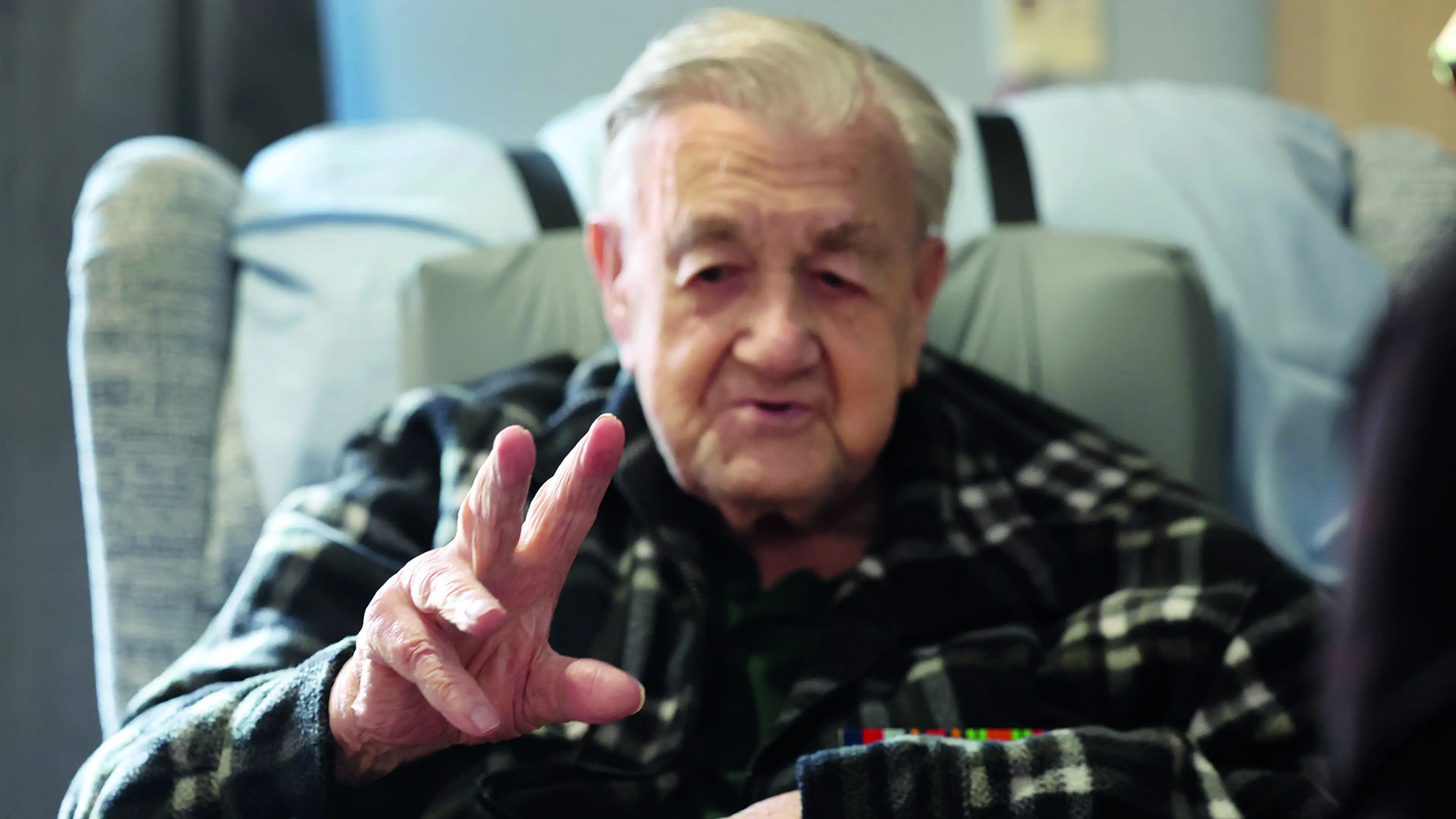
When war broke out in 1939, (ex-Cpl) George Durrant was living with his parents in Battersea. A talented athlete who ran for the renowned Belgrave Harriers, he enlisted in 1942 at the age of 18 and was sent to Catterick to train as a tank driver. However, poor eyesight meant he was downgraded to supply trucks, which didn’t appeal. When a notice came around asking for volunteers for ‘a special job abroad’ in the Intelligence Corps, he jumped at the chance. Now 101, he married his wife Eileen Mary in 1953, had two daughters, and still lives in the house he’s owned since 1956 in a leafy side-street in Crawley, Surrey.
"We departed Liverpool docks in February 1944, heading for Burma via India. My new job was to be part of a special wireless section providing protection against inadvertent leaks that were giving the Japanese vital clues to the whereabouts of Allied troops.
When we crossed into Burma the thing that really hit me was the intense heat and humidity of the jungle. I’d never experienced anything like it before – and haven’t since. We had to travel to a base near a place called Pegu in a lorry convoy – a journey that was long and dangerous. Unfortunately, the truck in front of us got too close to the edge of the mountain road and toppled off into the jungle below. It rolled over and over and I saw lots of bodies tumbling out. But when you’re in a convoy in a war zone you’re not allowed to stop, so we just carried on.
I remember arriving at one village and we were all hoping to drink some lovely fresh water, but the Japanese had poured oil on it. That’s what they did, it was war.
We eventually got to Pegu and the troops there – mainly Gurkhas – were not that disciplined on the radio. There were lots of leaks of useful information and the enemy was cashing in. We had to clamp down on our people for their own good.
But that wasn’t the only hazard we faced. The snakes were awful. You had to check your shoes every morning because they loved curling up in your boots at night and if they bit you it was often fatal. Scorpions were also common, although less deadly, but I got stung by one once and the pain was incredible, lasting 12 hours.
The Japanese often shot at our camp from the jungle and I was involved in returning fire on several occasions. They were good fighters, but so were we. You were always aware their snipers were around but you learned to live with the risk somehow. You sort of accepted your fate – you couldn’t change anything after all. I lost a couple of friends while I was based there and it’s something that never leaves you.
When we were told about the atomic bombs being dropped and the Japanese surrender, the overwhelming feeling among us was sheer relief and happiness. Mind you, some Japanese units refused to surrender and were a major hazard for months beyond VJ Day.
Before I was sent home in 1947 to return to my job as an engineer, I was posted to Karachi and put in charge of a depot’s postal office. I’ve never been so popular! And it was a certainly a nice cushy job to finish my time in the army with."
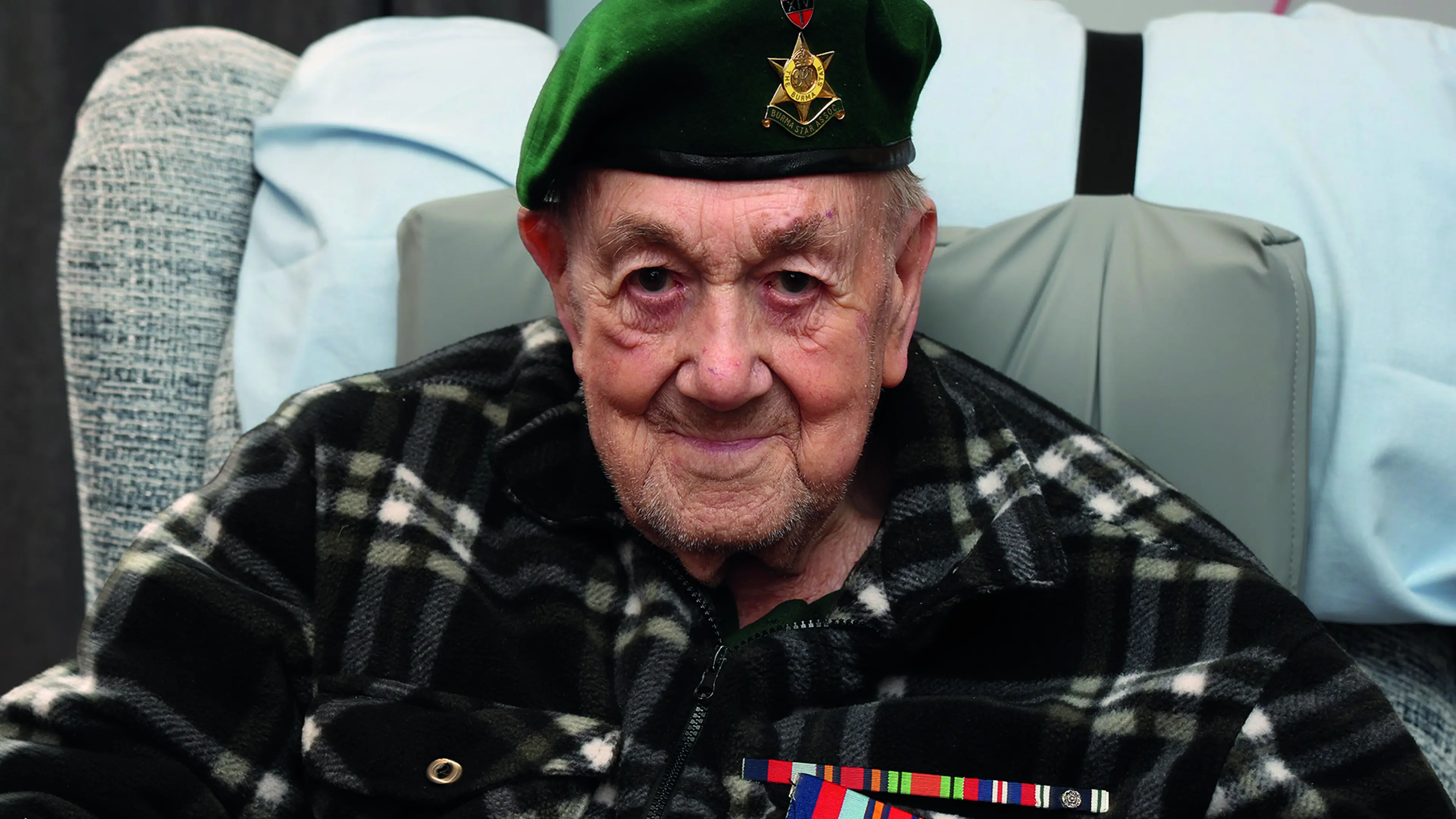
A lorry driver living with his widowed mother in West London when he was called up in 1944, (ex-Pte) Vic Stone served in Burma from early 1945 until 1947, working as a coxswain on boats supplying front-line troops by river. Despite settling down to marry his wife Sheila in 1953 and having four children, his deployment to the Far East with the Royal Army Service Corps gave him a taste for adventure and he later volunteered for the Royal Fleet Auxiliary. Aged 99, he now lives close to one of his daughters in Gillingham, Kent.
"I was stationed at Kalewa with 856 Motor Boat Company and our job was to take essential supplies of food, water and ammunition to the fighting troops trying to recapture Mandalay.
I crewed with two other soldiers and a few Indian personnel. We each carried a .303 Lee Enfield and each boat had a Bren gun. We’d been trained in all aspects of boat handling back in the UK, but not much could prepare us for the task given to us out there.
Two large barges carrying 100 tons of supplies were lashed each side of our motorboat and we had to tow them more than 200 miles along the Chindwin and Irrawaddy rivers, negotiating strong currents and dangerous shallows.
Navigating the Chindwin was particularly perilous as many parts were uncharted and we sometimes relied on bamboo poles with a weighted base to gauge the depth. Even so, there were many groundings and on one occasion we had to enlist the local villagers to help heave us off a sandbank.
It was a unique operation so we improvised along the way to try and improve our methods. The manoeuvrability of the ‘tows’, as we called them, was always difficult because of their size and weight. We found some success in mounting outboard engines to each of the barge’s outside rear corners enabling us to move the 200-ton beast around a bit more easily against the strong river currents and tides, but each leg was still a huge undertaking.
After we delivered each barge, we towed empty ones back to Kalewa for reloading. Each round trip took about two weeks and was hard going because our motorboats were harbour launches by design and lacked proper cover from the scorching sun or any facilities. There weren’t even any toilets on board – as a large group of military nurses found to their dismay when we took them up river to a field hospital.
Maybe it was my age, but being killed rarely, if ever, crossed my mind. It seemed like one big adventure to me at the time – even though I knew how vital our role was. We had a visit from the legendary Lt Gen Sir William Slim, who first of all ensured we were kitted out with bush hats rather than berets to protect our heads from the sun. Then he took time to explain the importance of our job in the campaign to recapture Mandalay. I found him a very likeable, down-to-earth man and was proud to be part of his 14th Army.
After I returned to the UK one thing that struck me was the casual attitude from people we’d been fighting for. When I stepped ashore at Southampton customs and excise officers swooped on us, wanting to know if we had anything in our bags that we shouldn’t have. They counted the number of cigarettes I had and told me I was over the limit. Luckily, they let me off the fine. Then, when I returned to work lorry driving, all my colleagues who hadn’t been called up had to say to me was, ‘how did you enjoy your holiday, then?’. That stuck in the throat."
