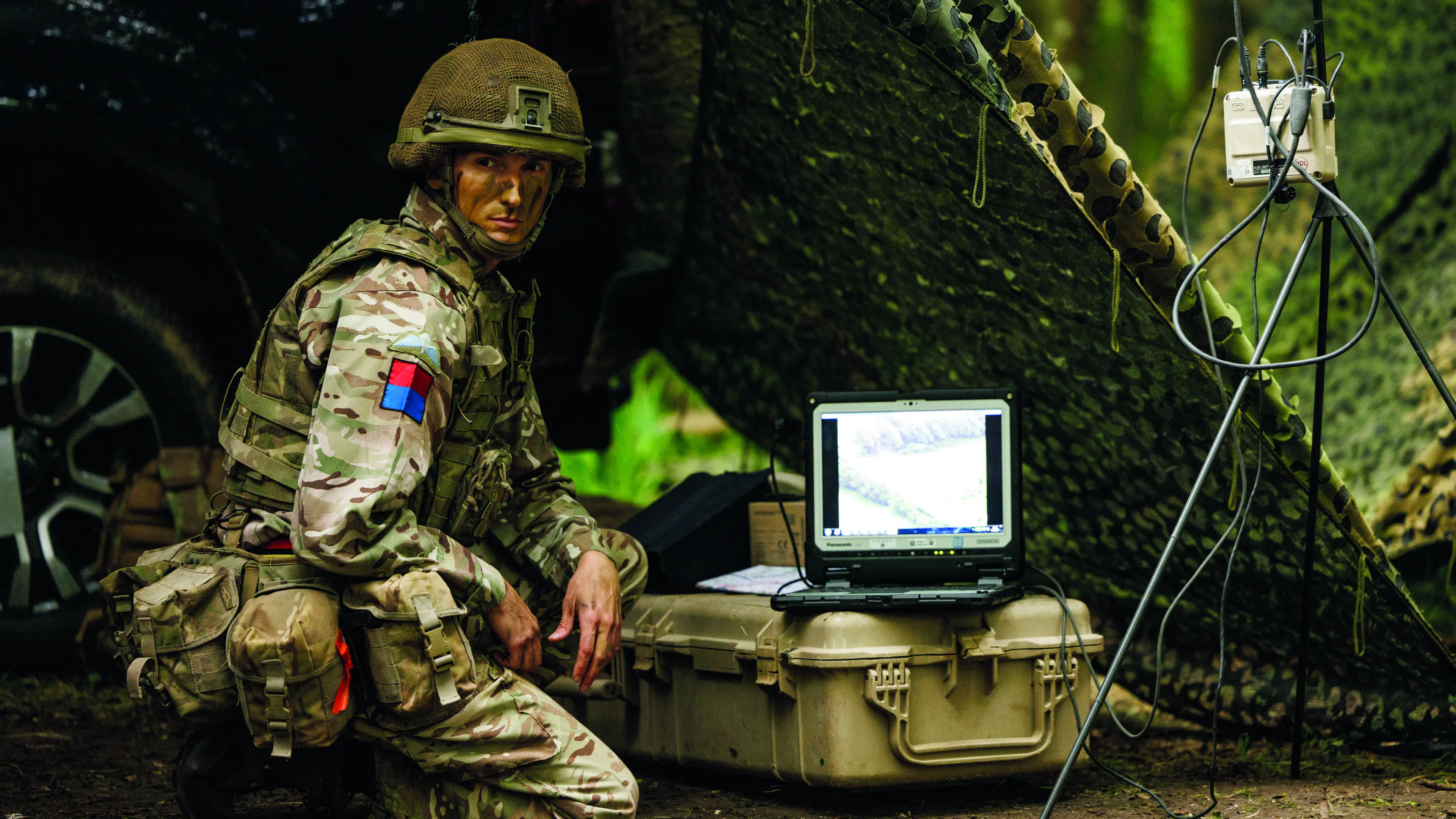
If soldiers aren’t already hearing the word ‘Asgard’ being bandied about in briefings, they soon will.
It’s the name of what is arguably the most important transformation in the army’s capability since the introduction of the Mark 1 tank during the First World War.
The hand of Asgard will soon be felt during every major operation or exercise – by front-line combat units, those in second echelon support roles and even HQs many miles from the action.
Essentially a new data network, the project was first announced late last year. And it has progressed at an unprecedented pace, with contracts awarded in January 2025 and a basic version deployed for evaluation on Exercise Hedgehog in Estonia in May.
Asgard is still being refined by a team of army and defence scientists in partnership with 27 industry partners. Their goal is to create a world-leading reconnaissance and strike framework made up of cutting-edge software and artificial intelligence capabilities.
It provides improved targeting precision and shorter decision-making cycles. This will increase lethality in line with the chief of the general staff’s vision. The system will, in time, link together functions such as deep strike weapon systems, surveillance, reconnaissance, intelligence and communications tools and combat support functions, even reaching down to the soldiers’ situational awareness equipment, now called the dismounted data system (DDS).
This means that personnel, whether they are fighting in streets or forests, can call upon any munition from any system within the brigade almost instantaneously. Over time, Asgard will form the army’s part of the UK armed forces’ digital targeting web, linking all three services together to create, potentially, one fighting entity.
That is due for delivery by 2027, backed by more than £1 billion of funding announced in the Strategic Defence Review.
It all sounds very impressive and incredibly high-tech, but exactly how will Asgard impact troops on the ground?
Soldier spoke to 4th Light Brigade commander Brig Oliver Dobson to find out what units got from testing a prototype Asgard system in Estonia.
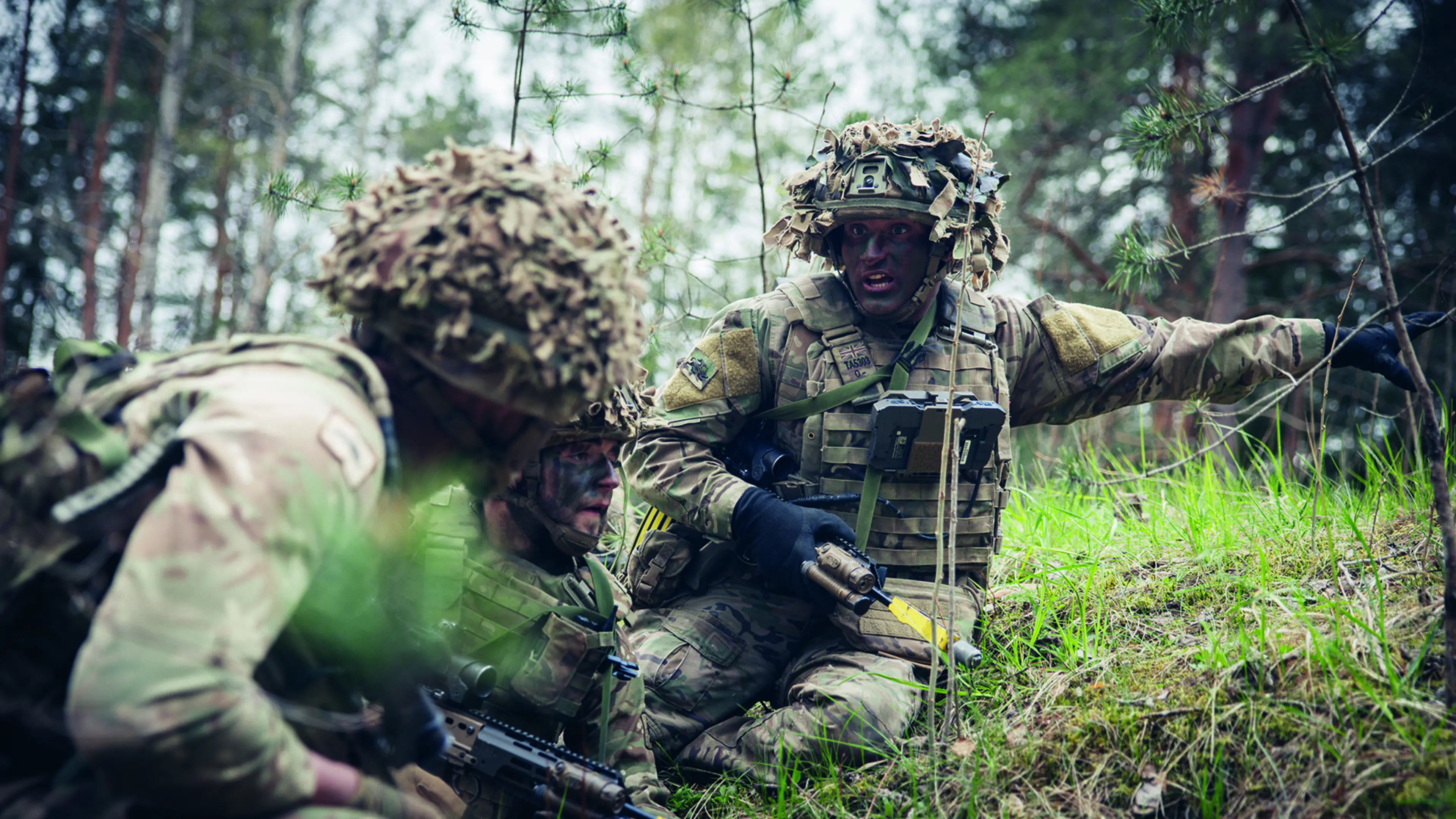
“Asgard allows formations to be much more agile than they once were,” says the senior officer. “In Estonia, data that came in from our long-range surveillance assets was processed so quickly I could change the battle plan very late on.
“With our old system, I simply wouldn’t have had the ability to communicate all the changes to a light brigade moving around on foot.
“The DDS, viewed on the Atak chest-mounted device, allowed me to send a new set of orders to the COs very quickly.
“We had chat groups where everyone was able to see the direction I was giving, and could start thinking about the challenges ahead and anticipate what was going to be required.
“We found that generated a much faster tempo in practice, and that produced a decisive edge.
“On Hedgehog my light role brigade fought against a multinational armoured infantry brigade and won, and I don’t think we could have done so without Asgard.
“We were outnumbered and in previous years we would’ve been overwhelmed by their armoured vehicles very quickly.”
Brig Dobson continues: “The mesh radios we used made a huge difference as they can leapfrog messages from radio to radio, across vast distances.
“They can carry any IP traffic including video, audio and data across the network and are used in conjunction with the DDS.
“They are low powered so the signature is small, which makes them difficult to detect.”
During the Estonia package, a large vehicle went off the road and became stuck in a ditch.
The officer explains how, previously, that information would have been sent through the command chain up to the brigade HQ and then down the logistic chain to the vehicle recovery team – a process that can take hours.
“In this instance, the driver took a photo of the stricken platform and put it straight into the vehicle recovery chat group where one of the experienced NCOs saw it and knew that two recovery vehicles would be required,” Brig Dobson says.
“He could see the enemy position and our forward line of troops so he could plot a safe route – which he published on the comms system so everyone else could see – and launched the recovery without an extensive planning process.
“Loads of friction stemming from going up and down chains of command, as well as airtime, were reduced and the vehicle was up and running again in a fraction of the time it would have taken previously.”
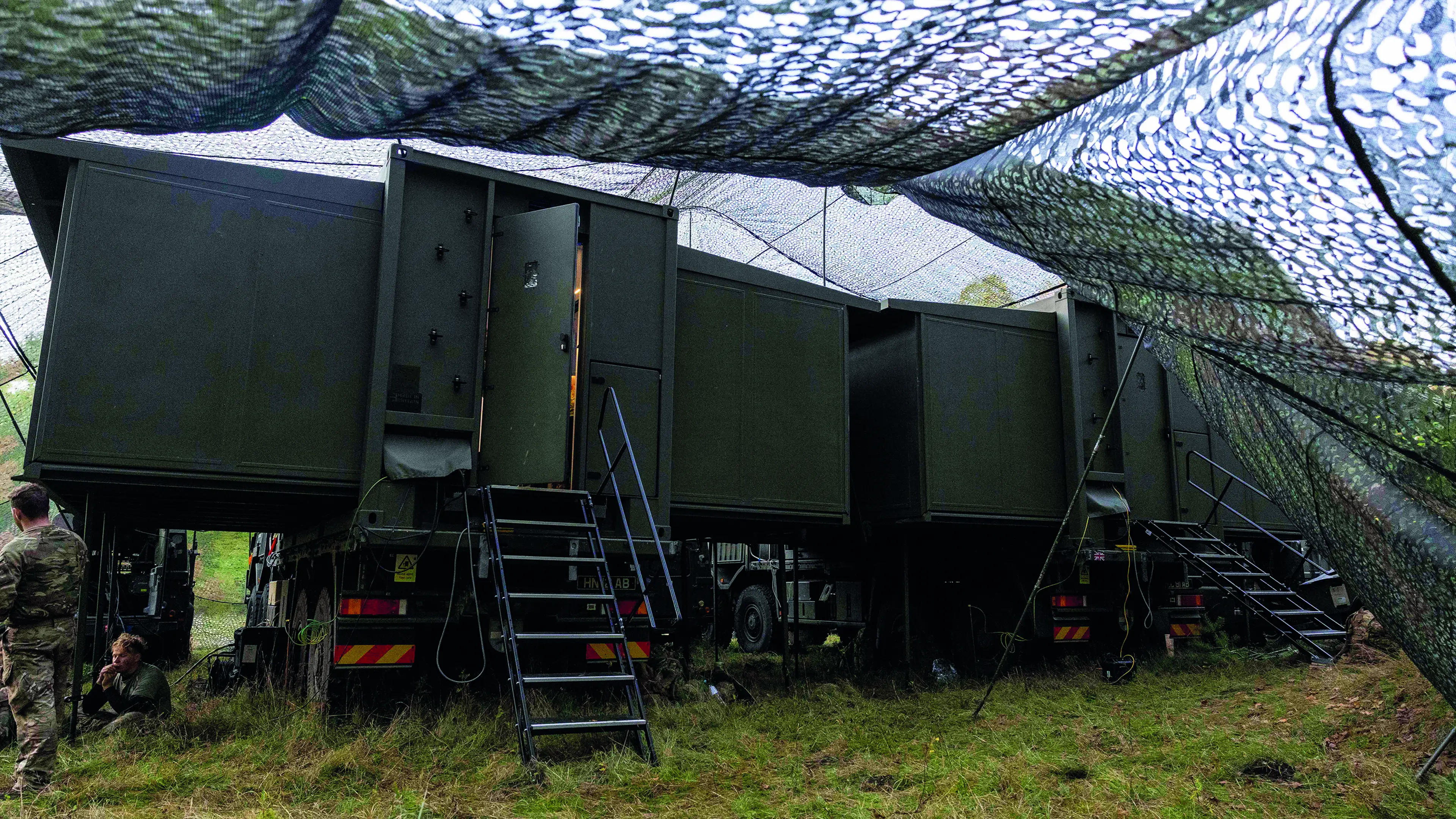
The brigadier says: “A piece of kit called Scytale made a big difference here, turning Bowman radio communications into encrypted messages sent over the internet.
“Without the constraints of having to operate within a specific range, we could position our headquarters further away from the battle, whether they were company or brigade facilities.
“With greater survivability we were allowed to focus more on decision-making.
“Having the data network to communicate with also meant we could reduce our electromagnetic signature to a very low level when our sensors detected a threat in the area. In Estonia we had a scout battalion looking for our HQ for five days, but they couldn’t find us.”
“The personal technology is very intuitive to use,” adds the commander.
“In Estonia I checked the server one evening and 150 of my people were up playing around with their dismounted data systems, working out how to do different things.
“The troops had two-and-a-half days’ training on it beforehand and they were experts on it because, like most of that generation, they are digital natives.
“Is there a danger of personnel getting cognitive overload with all this tech? No, that’s a common misconception.
“What overloads soldiers is all the noise in their ears, 80 per cent of which is probably not relevant to them. “Now they only have the remaining 20 per cent of rich information they need to know and it’s on screen for when it’s convenient to absorb.
“If anything, this system reduces their cognitive burden. It gives them relevant information and allows them to be less distracted and focus more on the battle-winning decisions they have to make.
“Also, personnel don’t need to learn to be experts in lots of systems, just the DDS, because pretty much everything they need works through that.”
Brig Dobson comments: “I can kill a tank two-to-three kilometres away at the moment with my javelin missile capability. But we had the recently procured Modini Dart jet-powered one-way attack drones, which fly at 250mph and can strike up to 250km away, so soldiers on the front line were able to identify an enemy asset using a recon drone or ground sensor and, without any chatter, pass that information up to divisional HQs immediately for them to target.
“The next stage of this project will see us use a shorter-range effector such as the Helsing HX-2 drone that has onboard AI allowing it to identify and engage targets up to 100km away even when it’s denied a signal or data connection.
“It will be operated at brigade level so the kill chain will be shortened because we won’t be depending on divisional HQs. “But when the Asgard network is complete, we won’t even be thinking about the ownership of effectors.
“The one I control, the HX-2 for example, might be fired at another commander’s targets because their sensors might have picked up an enemy I can’t see but I hold the most appropriate weapon. The new decision support software understands all this.”
Thanks to Asgard’s combination of linked sensors and weapons and the dismounted data system, soldiers at section level can sense and strike much further out as well as appreciate what’s going on in the periphery. Brig Dobson adds: “They now have an appreciation of the bigger picture and are no longer limited to a drinking-straw view of the battle.
“Great shared situational awareness among everyone is hugely beneficial because it means they can offer up battle-winning solutions you might not know you’ve got as a commander.”
The officer continues: “Knowing where everyone was in real time meant I could more finely balance the risk of any decision because I could judge how long it would take for force elements to reach the positions we wanted them in.
“My situational awareness was enhanced but without the need for constant radio communications back and forth. I could make a decision and act on it almost instantaneously.”
“Battlegroups usually get sight of the combat estimate when it’s complete,” the brigadier explains. “And then they backbrief to make sure I agree with their deductions.
“But under the new system I could see the cursors of the plans officers from the battlegroups hovering over my screen as I was writing my intent.
“This was a much more collaborative process and we were able to produce better plans more quickly. “It requires a level of humility in that other people are looking at the estimate from their perspective and you need to consider their advice and guidance.
“Some commanders might feel this will diminish their authority, but they shouldn’t because it enhances their ability to deliver the best plan for keeping their soldiers alive and defeating the enemy.”
“To be receiving data and digital-driven solutions through Asgard to address the scale and complexity of the tasks we face will be momentous for our people,” Maj Gen Mike Keating, Chief of Staff for the Allied Rapid Reaction Corps, told Soldier.
“We face a challenge that is quite extraordinary. Think about 21 different armies in Nato facing a common threat and then translating the objective into 21 different languages and cohering that into a single outcome quick enough to deliver an advantage.
“Having Asgard means Nato forces will be more connected than ever before and, not surprisingly, there is huge interest in it from the member countries.
“As we bring everyone into the Asgard network, having many different languages becomes almost irrelevant.
“Creating a common digital environment is effectively diminishing that barrier, lowering the cognitive burden of understanding each other and at a Nato level that makes Asgard an incredibly powerful tool.”