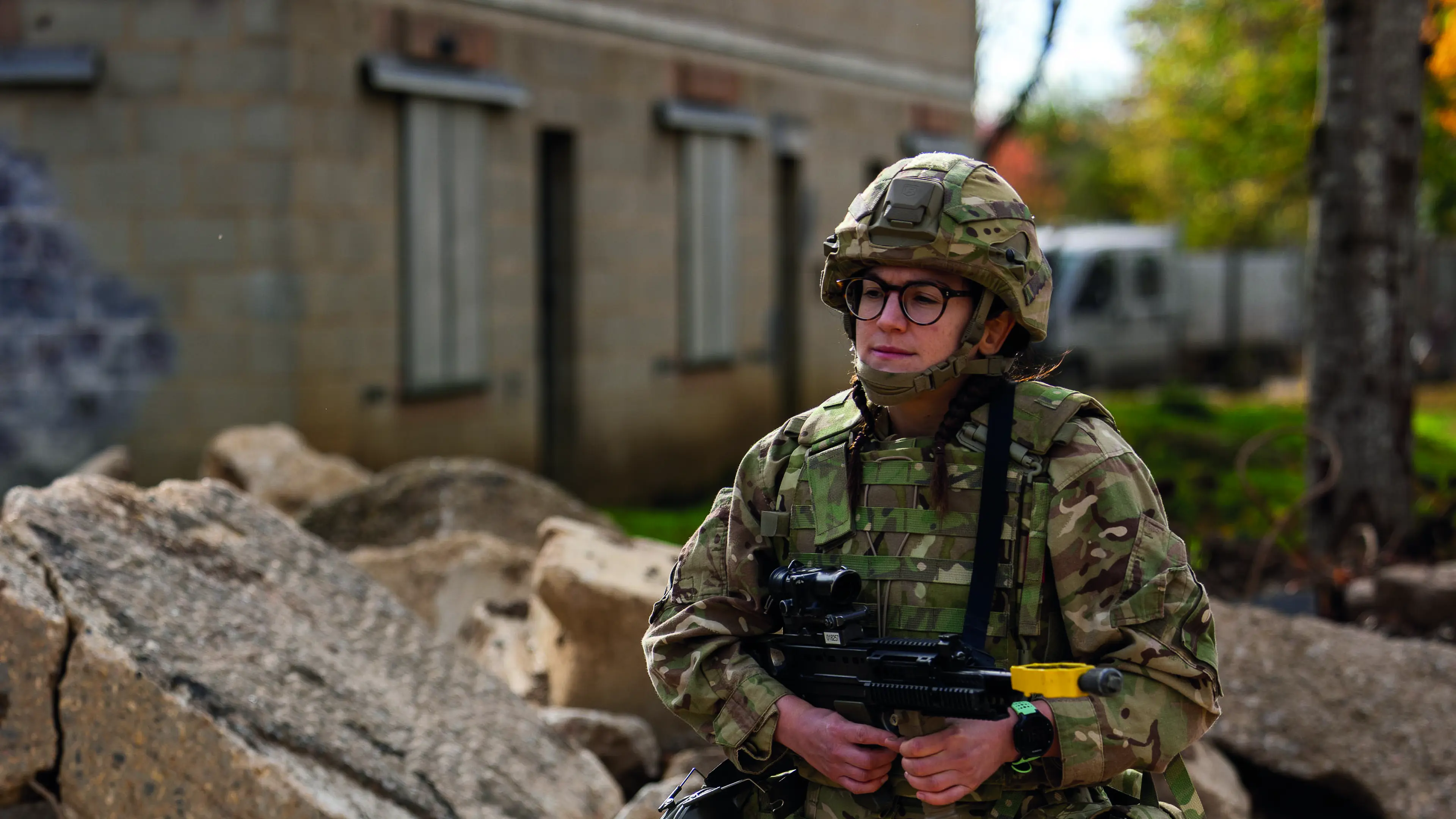
Lessons from contemporary operations were at the fore as reservists from 215 (Scottish) Multirole Medical Regiment tested their skills on Ex Paeion Cyclone.
The two-week programme saw 83 personnel from the unit – along with counterparts from 2nd Medical Group, Joint Hospital Group and 30th (US) Medical Brigade – travel south for their annual continuous training, the main focus of which involved establishing a role two hospital at Copehill Down village.
This included emergency, surgical, intensive care and general ward beds and allowed them to treat a high number of casualties in what has become a familiar scenario on current exercises – troops performing a front-line screen against an invading, peer-on-peer enemy.
A full range of specialities were deployed – from combat medical technicians to consultants – and commanding officer Lt Col Gareth Cole told Soldier they embraced a new way of working in an urban environment. This primarily saw the hospital split into separate departments across different buildings, instead of being housed under one roof.
“It was about reducing signatures, maximising survivability and thinking about how we deploy medical care and treatments,” he explained.
“We are now starting to operate in spaces that are no longer defined as secure, so our ability to move and survive will be key.
“We were working in cellars and basements – nothing was above ground – and there were groups of soldiers in houses who did not see other people for six days.
“Not having that freedom of movement was a particular challenge, but it was one they overcame.”
Personnel also had to think about comms signatures, with kit such as field phones becoming more prevalent, while innovation and experimentation was encouraged.
A surgical station was established on the back of a MAN SV truck with the thinking it would provide an initial capability while main facilities were being set up. The same role was performed on departure.
UAS were also incorporated through the demonstration of a flatpack-style precision payload delivery system aimed at helping medical logistics and resupply.
“It has a 3kg delivery load, is no bigger than a pizza box and can be launched from a ramp,” Lt Col Cole explained.
“GPS can guide it to within ten metres and it is not trackable. It has been used in Ukraine, and we were looking at it in terms of resupply for bloods – it could be a huge game changer moving forward.”
A robotic dog capable of delivering supplies between locations was also trialled, while personnel got hands on with the Moves SLC oxygen concentrator during a stop at Beckingham Camp in Lincolnshire, enroute to Salisbury Plain.
“We have to make the best use of our resources and think in different ways about our clinical priorities,” Col Simon Johnson, 215 Regt’s clinical director concluded.
“Medicine is medicine, that is our day job but being able to do it in a contested urban environment is what troops will take away.”
Acting Corporal Nicole Webber, age 37, pictured below, joined 215 Regt three years ago. In her day job she works as an orthopaedic scrub nurse in Dundee and she deployed on Ex Paeion Cyclone in the theatre department. Here, she shares her experiences from Copehill Down...
How did it compare to previous exercises?
I’ve only done one medical exercise before but we were in a harbour area doing things like section attacks and sentry duty. A lot of time was spent on the actual set-up, but the nature of this meant we weren’t moving around as much, and it was far more tactical. It was nonstop.
What were the challenges of being restricted to a single building?
It was the feeling of being cooped up – I’m not great with that. I was one of those who would go out for supplies every morning – it was the highlight of my day. We were with the intensive care unit, so it was a bigger group, and there was a personality in there who kept morale high.
What was the working environment like?
We were on shift patterns, so there was a lot of sleeping at random times. We are all accustomed to working shifts in the NHS, but I found it hard to be strict with myself. Then there would be a drone attack during my downtime, so I never knew when I would be getting some proper sleep. Making sure I rest when I can is one of the big things I’ve taken from this.
Describe some of the scenarios you faced
An ectopic pregnancy and appendicitis. On other camps we’ve had gunshot wounds, but here we were in a civilian environment, so they wanted us to think about potential civilian casualties. It was dealing with patients, triaging appropriately and considering the logistics of getting them to wards in other buildings. We were passing stretchers through windows to make the moves more discreet. There was also a big focus on reusing kit and adapting what we had in case we ran out.
How did the situation in Ukraine influence things?
As a medical facility we are no longer protected, we are a target. You have to be mindful of that. With the drone threat, we were in trouble if we didn’t follow protocols properly – people were pulled up for not wearing body armour. It was also my first time using field phones. Everything was going through one system and if someone else was on the line you had to wait. That was difficult, particularly when I was on drone sentry and tried to call in a strike.