
A late-notice invitation to train with the French Foreign Legion’s 13 Demi-Brigade at the Centre d’Entrainement aux Actions en Zone Urbaine (Cenzub) came after another unit was forced to pull out.
But it created some logistical headaches for the Brits.
Last-minute urban combat ‘brush-up’ training had to be squeezed in at Whinny Hill in Catterick before the personnel travelled over the water.
And not all the supporting engineers, artillery, reconnaissance and medical elements that would ideally be employed to assist a company-sized formation were available at such short notice.
A more surprising drawback, though, cropped up with the light mechanised infantry unit’s Foxhound vehicles, which were temporarily taken out of action across the army due to a technical glitch.
As a result, the Royal Yorks had to undertake Exercise Gaulish purely as a dismounted force and somehow work out how to slot into a highly mobile French armoured infantry formation.
However, mindful of the fact that real conflict nearly always throws up the unexpected, the Brits were quick to recognise the value in training around these restrictions.
“We would normally have a combined arms company group with us, but we still managed to extract lots of good things out of this package,” Maj Robert Louden (R Yorks) told Soldier.
“The realities of war mean we need to practise the basics and use our initiative to work around problems that come out of nowhere.”
The two-week exercise started with getting to understand French infantry techniques and procedures and honing low-level urban combat drills – a process that highlighted major contrasts between the two nations.
“The French place more emphasis on fighting from armoured vehicles – BTRs and Griffons mainly – and it took time for us to work out how we, as a dismounted light mech company, could best work with them in urban areas,” said Sgt Louis Jones (R Yorks).
“Timing was crucial as we normally tab into an objective, but they drive very fast up to the building to prevent their vehicles becoming easy targets.”
The differences in approaches to urban warfare did not end there.
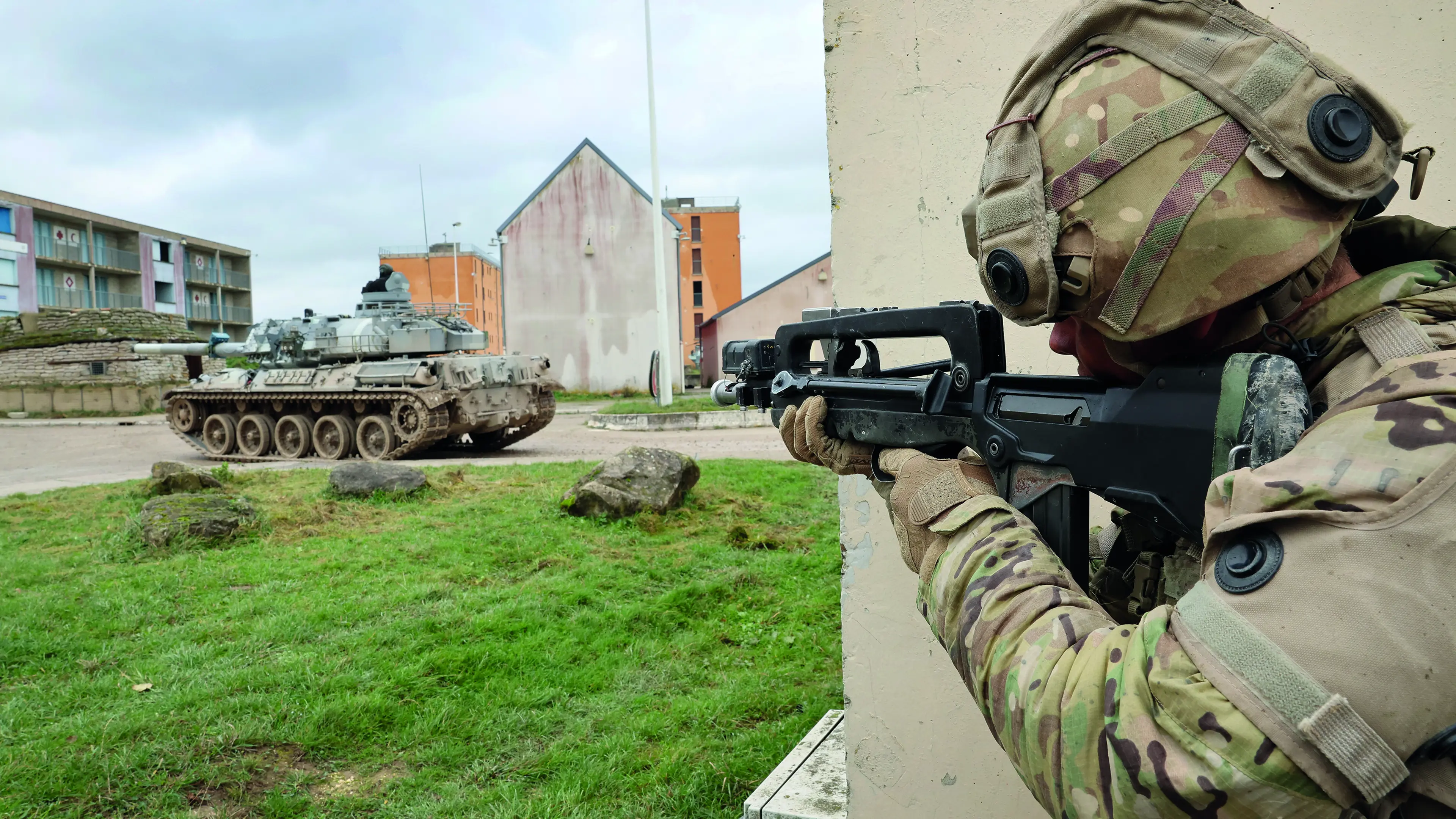
“This has given us an appreciation of the different way the French defend,” explained Cpl Harry Connell (R Yorks)
“We hold onto a position as long as we can, fight hard, and if we drop back we do it slowly with replenished sections rotating in to maintain the pressure on the enemy.
“But the French, through operations in places such as Mali, only conduct a light defence of the building they are holding and then pull back because they can then watch the enemy clear it and gather intel to increase their chances of a successful counter-attack.
“They also believe if you fight too hard the enemy will withdraw, call in fires on you and then come again.”
Working under the host nation’s command, the joint force was given a shake-out during the final phase of the exercise, focusing on assaults on two urban conurbations – Beausejour, a small rural training village, and Jeoffrecourt, a town five kilometres up the road featuring a mock main square, train station, canal, residential housing, industrial area and high-rises.
The British contingent coordinated attacks and defensive manoeuvres with their parent Foreign Legion battlegroup against an in-house ‘enemy’ who knew Cenzub intimately and were furnished with superior equipment. And it was here that the failures started to mount up while the learning curve steepened.
“Being light mech, we’re usually expected to fight against dismounts so we have a natural advantage,” said LCpl Alfie Keep (R Yorks). “But we were up against an opfor equipped with light armoured vehicles and even tanks.
“Not only that, but we were using old French Famas rifles with just iron sights, while they had the newer HK416 weapons and thermal and optical sights.
“We wouldn’t normally be put up against such an opponent without more support, so you could argue this is an unlikely scenario, but things will go wrong in a real war and this has been an important experience for us.
“What would we do in a future battle if command mismatched us against an enemy formation due to failures in intelligence or planning? How would we cope?”
Royal Yorks personnel now know the answer to that a lot better than before.
As their sections were pushed back through the streets of Jeoffrecourt, they practised tactics for neutralising armour in confined areas using the French weaponry they’d been issued with.
“We’d normally operate with anti-tank and reconnaissance screens in front of us but we didn’t have those,” said Cpl Connell. “So we adapted and explored how to use the French AT4 anti-armour weapons, getting them into the correct places and working out how to create kill boxes using the buildings as cover.
“It worked well, although we’d normally have engineers with us creating the obstacles to channel the armoured vehicles.
“But even so, as a light mech outfit we rarely get to do this sort of thing so it’s been great for expanding our knowledge of this type of warfare despite losing the battle.
“We’ve learnt a lot.”
The Brits did enjoy the taste of victory at the smaller training village of Beausejour where, amid a mock CBRN attack, intense house-to-house battles played to the strengths of the visitors, who’d earlier prepared well at Whinny Hill’s close quarters combat hangar.
“We went into Beausejour aggressively because the intelligence picture was good and suggested we could do that,” said LCpl Keep.
“We’d been pushed out of the village initially, got gassed and were then tasked with retaking it.
“Doing this sort of thing in full CBRN gear is very rare – I’ve only done it once before.
“It’s difficult to see with masks on, and comms are challenging but once inside buildings, we did well, checking corners and entering rooms in a good way.
“For most of the soldiers it was the first time they’d tried to conduct an urban fight with respirators on so, in light of what’s currently going on in the world, it was a hugely valuable experience.”
The sheer size and quality of Cenzub tested other aspects of their urban skills too, noted Maj Loudon.
“The scale of the place allows you to practise assessing situational awareness in large and complex areas, gauge what capabilities are coming to face you, and test how you deal with them,” he added. “It’s hard to do that in the UK. The facilities we have are not as good as this and we have been busy with Op Interflex, among other things.
“Communications across such a large area was a challenge – the company defensive plan requiring sections and platoons to be interlinked to provide mutual support.
“Then on attacks, we need to maintain momentum and this exercise reinforced just how important having good comms is for that as well.
“We need to know which sections are approaching which buildings and sections must provide detailed descriptions of buildings and streets so fire support can be provided where it’s needed.
“That was really good practice as it’s hard enough to do during the day, but we’ve also been doing it at night and that makes it even more challenging.”
As demanding as Exercise Gaulish was on several fronts, the Yorkshiremen wrung every last ounce of training value out, adapting and learning from their mistakes, honing urban fighting skills and increasing their knowledge of a major allied nation’s tactics and techniques.
If the balloon ever goes up, it is just this kind of knowhow that will make a vital difference for British troops against a foe that has already shown itself to be almost impossible to predict.
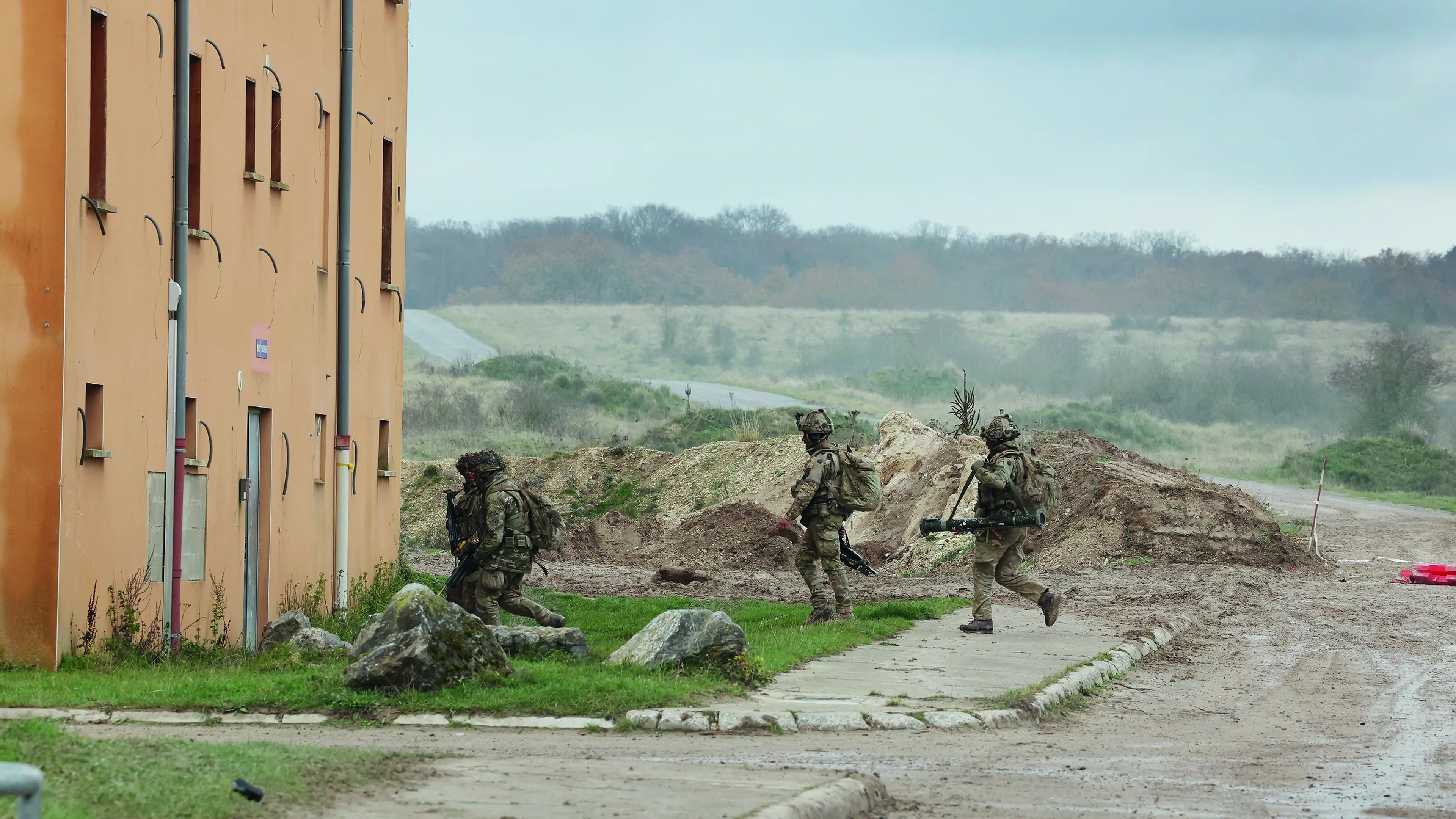
Cenzub is the largest and best equipped urban warfare facility in Europe.
Regular exercises there are the result of a special Franco-British agreement called the Lancaster House Treaty, which celebrated its 15th birthday last year.
Under this accord, two British companies are invited to train at the facility every year to share skills and knowledge as well as strengthening bilateral relations and combined warfighting capabilities.
Inside, its buildings are rigged with sound effects, smoke machines on every floor and sensors and cameras for producing detailed after-action reviews.
Hundreds of soldiers and civilians are employed there, with in-house opposing forces structured as a mixed company kitted out with engineers, infantry and platforms such as Griffon, BTR and AMX-30 tanks. This unit is able to play the role of a combat formation, militia or civilian refugees, depending on what’s required.
