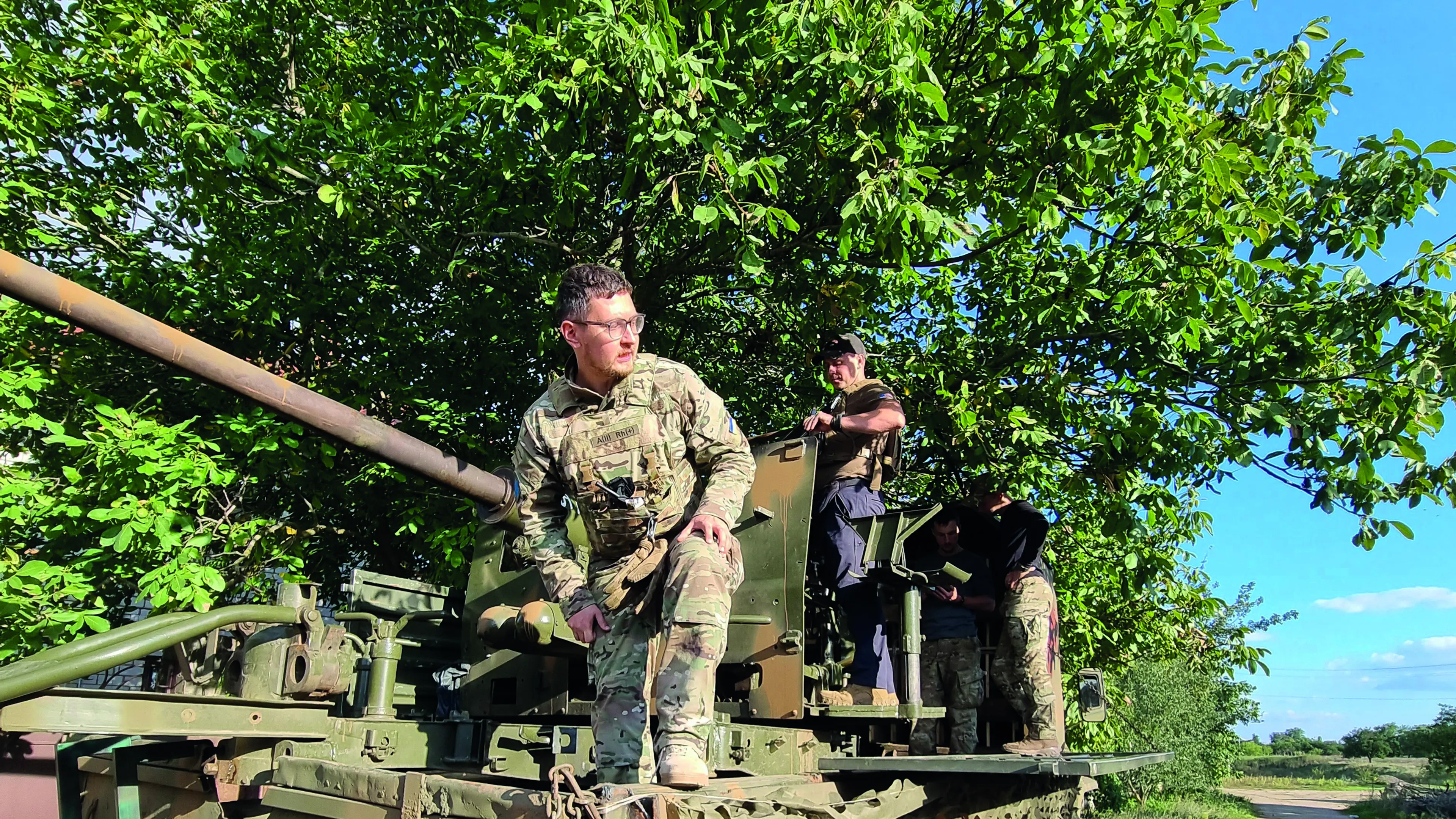
Ukrainian born but a naturalised Canadian, Illya Sekirin volunteered to fight against the Russian aggressors attacking his homeland as war broke out in 2022.
Originally serving as an infantryman, he later became a tactical drone operator before going on to act as a translator and unofficial adviser to the Ukrainian High Command.
Last month, he was among the guest speakers at the Centre for Historical Analysis and Conflict Research conference at the Royal Military Academy Sandhurst, where he addressed an audience that included the chief of the general staff on the nature of drone warfare in Ukraine and its future development.
Afterwards, he sat down with Soldier to reflect on his experiences in the conflict…
Tell us about your background
I was born in Ukraine, but my father went to study in Canada. I started spending time there and got my citizenship – that’s how I became a Canadian and it’s where I learnt English. At the time of the war, I had been living back in Ukraine for a couple of years – I ran an IT business and had a degree in cybernetics and while I was not in the military, I was kind of connected to drones.
What was your reaction to the outbreak of war?
I took my then girlfriend and drove to central Ukraine. I couldn’t sit at home while my country, and that of my ancestors, was being invaded. For example, if somebody attacks your mother you don’t consider if he is stronger than you, or if there are several of them and whether they may have knives – you protect your mother.
How did your military journey start?
I joined a volunteer battalion that accepted foreigners. I remember as I was driving into Kyiv and clearing the checkpoints I was told ‘it’s dangerous, don’t come here’. I said, ‘that’s exactly where I need to go’. I was the first foreigner to arrive at the unit, and we initially stayed in a university building. Then other volunteers started turning up and soon we were up to 30.
Describe life in the battalion
It wasn’t a battalion of like 500 people – it was 100, maybe 120. There were guys from English-speaking countries like America and the UK, as well as Germany, Finland, Estonia, the Czech Republic and Poland. The language of communication was English, but not everybody had combat experience. We had several guys from the French Foreign Legion and some who had served in Iraq and Afghanistan.
What training did you receive?
There was no real infantry training. There were some medical drills, like how to apply a tourniquet and first aid, but it was basic level stuff. Because I spoke three languages – Russian, Ukrainian and English – I became kind of a fixer for this group, as well as an interpreter and fighter. I became the second in command. During all my volunteering in Ukraine I never signed a contract. They gave me a rifle; that was it. I sold my car and bought my own helmet and body armour with protective plates.
What ops were you involved with?
We were about to enter combat in early April 2022. We went to a front-line village, but the Russians had already gone. We found some machine guns and just did some practice instead. We were used as an auxiliary force; if a platoon attacked a village, we would clear the streets after the army had moved through and find any stragglers.
So how did the move to becoming a drone operator happen?
I went with a couple of foreign fighters to a national guard special operations detachment. We were going to be responsible for evacuating the wounded and picking up the bodies of dead soldiers. There was a short drone course, and some Ukrainian pilots showed us the videos they had made. At that time I didn’t have any combat experience. I saw the videos those guys made – they were spotting artillery with their Mavic 3 drones – and got excited, so I decided to sign up for the course.
How did things progress from there?
At that time, there was a lack of pilots and instructors, and they offered a more intensive course that would see me become an instructor on civilian quadcopters. I could then go out to army units at the front line and teach them by example; how to do reconnaissance and artillery spotting. I was also trained on how to drop fragmentation grenades, although they didn’t work against armoured targets.
What were drones being deployed for at this stage?
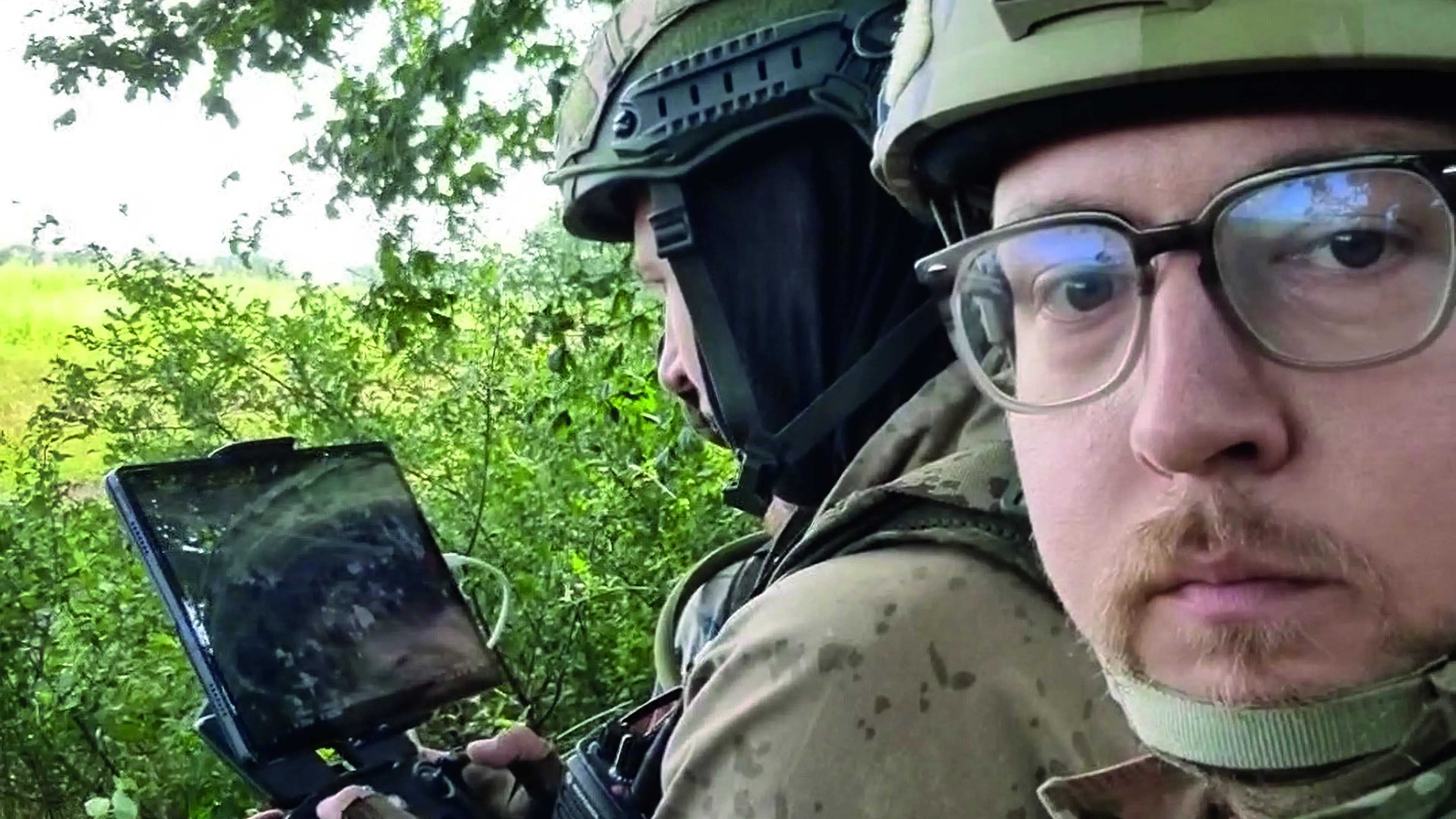
The main use was for reconnaissance, surveillance and target acquisition. We could get to know where the enemy was and what he’s doing. If we had some artillery pieces nearby, we could use civilian technology to stream the video feed for the guys at the headquarters. I would use the coordinates to see where the artillery shells landed and then correct them if needed. We started seeing tangible results. I was making trips to the front and was engaging the Russians as a drone pilot myself and teaching others.
When did you realise the advantage drones could deliver?
The Russians had the idea of doing a pincer movement – using their armour to surround Ukrainian forces in the Donbas. So my unit was primarily hitting tanks from one of the elite Russian formations. It then dawned on me that if we were effective, we could easily blow up their fighting vehicles, and the war could potentially be over as they would have none left. I also understood that the use of drones could provide tactical advances. For example, if we had 100 drone pilots we could advance on a narrow front, like 100km, and easily break through. However, we had limited resources and it was not possibile.
How long would you deploy for?
I would be at the front for a week and then go home, maybe for two weeks. I would then come back for another two weeks. As a drone pilot, if you’re involved in small-arms fire contact with the enemy you’re doing something wrong. Normally you don’t come up close, but of course at times I experienced contact. I didn’t shoot back because I didn’t want to unmask my position. I was focused on flying my drone, as that is what I do best. I had bullets hitting all around me, plus shrapnel, mortars and multiple rocket launchers. I had a British medic, Adam, and thought it was good to pair up with him in case something went wrong.
The Mavic 3 was the main drone being used. Why was it so popular?
It’s easy to operate and many pilots preferred it to any other drone. You can buy it for like two hundred dollars at the supermarket. At the start of the war the range was much smaller; it had a theoretical range and communication link of up to 15 kilometres. My own front-line record was ten, but most would go up to three, four or five kilometres. They also have the 3T; this is the thermo variant that comes with infrared sensors, which you can use at night.
How did things evolve from there?
The first-person view (FPV) drone came in 2023, and this is when we were able to engage Russian armour. I focused more on surveillance and artillery direction, but I worked with FPV teams and we supported each other. They were more vulnerable to electronic warfare (EW) so their imagery and video feed was not as good. The Mavic 3 would give directions to enemy targets, then the FPV would attack.
And how does the situation now compare to the start of the war?
There has been an exponential rise in the quantity of drones. The battlefield is much more saturated than when I first started flying. Previously, we were often trying to find the Russian drone operators. It was always a priority, and they were trying to find us. Ukrainian and Russian commanders realised that drones are so effective, and they started to put resources in and committed to enlarging the capability. Both now produce more than one million drones a year and the range has increased greatly.
Tell us about the initial Russian drone threat
Theirs could go further, but there weren’t too many of them. And because they were flying higher, they couldn’t see a very detailed picture. They were also easier to hide from – if you stood behind a tree, you’d be okay. The troops called them chainsaws because the motors were so loud. The Russians used them in conjunction with artillery, and they were pretty fast to fire. I think they had some kind of link established with self-propelled howitzers, so they engaged targets quickly.
You then started advising the Ukrainian high command and deputy prime minister, among others. Did they embrace the potential of UAS?
Unfortunately, some generals were not too receptive to the idea of drone warfare and my proposals. That has changed now obviously, when you see the capability and what it can achieve. I said they needed to form large drone formations on a brigade level to make operational manoeuvres, whether that is defending a section of the front line or making a penetration. But they said they had UAS companies and didn’t need anything larger. It took them a year to say ‘let’s do brigades’. Had they immediately listened, they could have overwhelmed the enemy and had the advantage.
Where do things stand now?
The Ukrainians are making small steps, but so are the Russians, and it’s difficult to find a breakthrough solution. The Russians are coming up with things themselves, like the use of fibre-optic cables. The Ukrainians had created a sophisticated system of EW and blinded the Russians with the FPV interceptors. But their fibre-optic drones are immune to those, and we didn’t expect a lot of the destruction that was caused by them.
Is it possible to predict the future use of drones in the war?
This is something that is constantly evolving, so I don’t know where it will be in one year from now. I think we’re going towards a drone blitz, where you surround the enemy on a narrow section and try to envelop them from the rear. The Russians have the Rubicon, a specialised drone unit, and their main idea is to destroy Ukrainian pilots. They’re trying to gain UAS superiority over the battlefield so they can then do whatever they like with the Ukrainian defenders without facing a drone threat. They are also trying to cut logistics, so they have the facility to operate at longer ranges and isolate the battlefield. With UAS superiority they can then support the ground troops moving in.
What impact have UAS had on troops on the ground?
The situation in the kill zone is changing. Take medical evacuation: now, because drones are omnipresent, it’s very difficult to get a wounded soldier out. There’s no golden hour rule – it’s just impossible. A wounded soldier often has to stay in position for six or seven hours. You apply the tourniquet and get them out as soon as you can. Medical training of soldiers needs updating so they know how to stop the bleeding, pack a wound, maintain circulation or give antibiotics.
How important have drones become to an army, do you think?
They are the main striking power of a land army, for sure. The drone is the new king of the battlefield, and all other weapons systems are subordinate to it. If you are planning military operations, whether offensive or defensive, the first thing you need to think about is how to deploy drone forces. The strength of Ukrainian combat brigades is down to 20 to 30 per cent. In a normal conflict, without drones, the Russians would have already captured Kyiv. It’s not effective for a formation to perform even a defence if it is 30 per cent manned. But the drone saved the situation because Russian infantry and tanks could not get through the kill zone.
Does this mean the role of the front-line infantryman is redundant?
There is the idea of a ‘line of drones’ project, making a continuous kill zone for the whole of the front and then to try to push it forward, from 20 to 40 kilometres, etc. Some commentators say if you do this you don’t really need infantry. Of course, that is not true, and you will need some to take strongholds. But you probably need less than you did at the beginning of the war. So you may have five guys holding a kilometre of front line, which is a necessity, but you don’t need more than that. The Russians have more, but because it’s difficult to supply them and take out the wounded, they are getting people killed for no reason – it makes them a target. You must try to conceal and disperse your positions and try to have the human line as low as possible.
So what impact will this have on the soldier in future?
Their role is to survive; this is number one. And second, of course, will be to help the drone. Small groups of infantry will not attack without a drone above them. At the same time, this requires less training for personnel because a lieutenant can make all the decisions remotely. They will be told what to do over the radio with the commander sitting at the screen and directing the battle.
What can personnel do to have the best chance of surviving against a drone?
Deploy drone detector frequency scanners. These use the radio spectrum and while you don’t always know if they have found a drone or not, at least they start beeping. It’s dangerous to move in the open in vehicles without these detectors, so they are a must-have. And, of course, be on the lookout. If you’re driving and hear the detector beeping, stop and seek cover because the drone is probably trying to detect the vehicle, not the individual soldier.
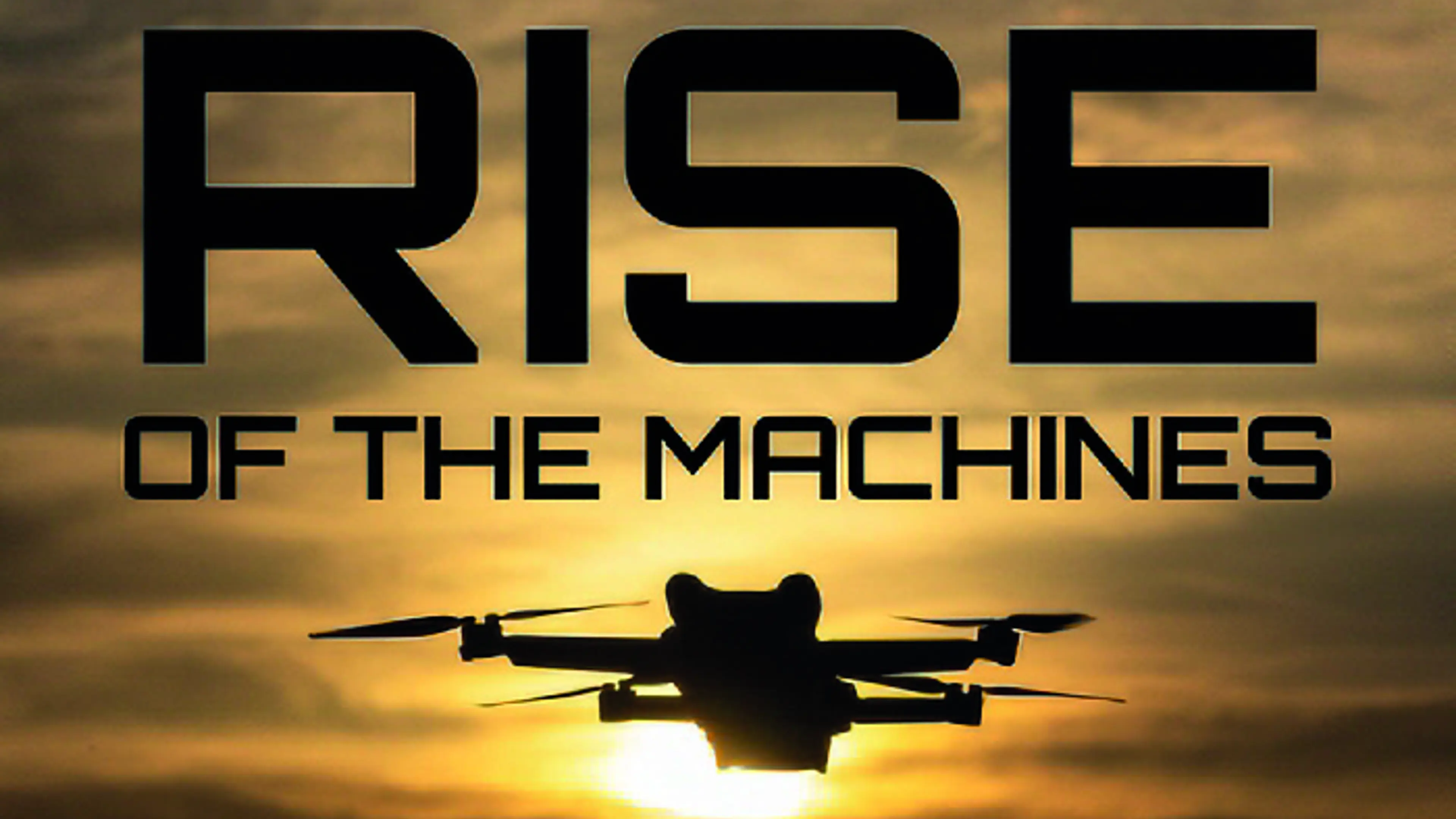
Your book Rise of the Machines –Drone Warfare in the Russia-Ukraine War is out this month. What was the motivation for writing it?
I wanted to share with the Western reader – not only armies, but the wider public as well – the importance of drones and to raise their awareness of a possible confrontation with Russia. I also wanted to tell my own story about how I served on the front line. There is a focus on my personal deployments, a couple of which I describe in detail.