
The frozen lakes and snow-dusted Scots pine trees of Rovaniemi formed a memorable backdrop as troops pushed to within the cusp of the Arctic Circle for a deep winter deployment in Finland.
It proved a landmark moment for the host nation’s military as Exercise Dynamic Front was the first time it had staged a training exercise on this scale since it joined Nato in 2023.
As has become the norm with such drills, it was a truly multinational affair with more than 5,000 troops from 28 countries collaborating on joint live fires.
Among those braving the sub-zero frontier were the Scottish Gunners of 19th Regiment, Royal Artillery, who were achieving a notable milestone of their own as they fired the Archer 155mm gun in a tactical setting for the first time.
Additionally, soldiers from 5th Regiment, Royal Artillery gave a debut outing to the new Taipan weapon-locating radar system, which worked in tandem with the platform.
“This was a fantastic opportunity to showcase our modernised artillery capability in front of our Nato partners and alongside guns such as the French Caesar, the Swedish Archer, the Finnish K9 and the American multi-launch rocket systems (MLRS),” said Maj David Mortimer, 2iC of 19 Regt.
“One of the key things we wanted to practise was getting the find and strike elements of Taipan and Archer in sync, which then cuts the time it takes to make an acquisition with the radar and engage with MLRS and Archer.
“This reduces the kill chain, therefore increasing our lethality within our find-and-strike system.”
Following the gifting of 32 AS90 guns to Ukraine in 2023, the Army procured Archer from the Swedish government as an interim replacement, with a long-term successor not expected until the end of the decade.
Boasting a 6x6 chassis, it can fire eight rounds a minute – compared to the AS90’s six – at a range of 50 kilometres.
Capable of discharging all types of 155mm ammo, including extended range and precision anti-armour shells, it can also be fitted with a remote-controlled weapon station – mounting either a 40mm grenade launcher, a 12.7mm heavy machine gun, or a 7.62mm general purpose machine gun.
And representing the next generation in wheeled artillery vehicles, it can travel some 200km further than its tracked predecessor.
“Archer has been introduced very quickly,” Maj Mortimer continued.
“Our first train-the-trainer instructors were deployed out to Sweden in late 2023 to learn and then cascade their knowledge to our batteries in the first half of last year and it’s incredible that, alongside such training progress, we were ready to put this equipment into use so quickly.
“It represents a switch from a tracked self-propelled gun to a wheeled one and rather than using what we would call ‘dumb’ high-explosive rounds we are now firing smart munitions – these increase our lethality with anti-armour and extended-range capabilities.
“This has been a fantastic opportunity for our regiment for so many reasons, including being more expeditionary, and it has enabled us to go through the full deployment process, mounting through the air and ship component.
“It was exciting to fire Archer for the first time out in Finland, along with the first Taipan live acquisitions, and it shows that we are a modernising artillery that is continually advancing.”
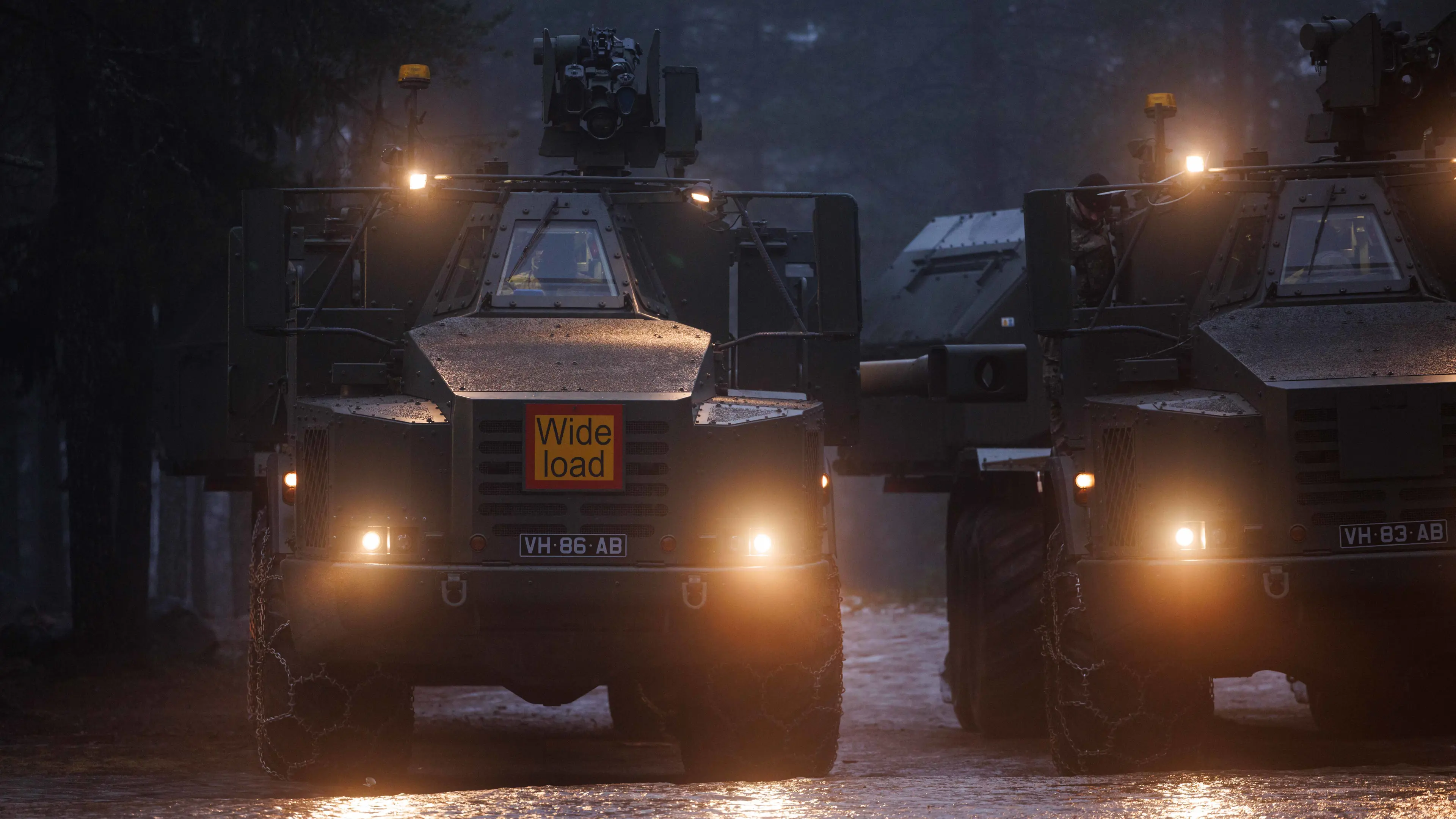
Exercise Dynamic Front had more than 5,000 troops from 28 countries collaborating on joint live fires.
To complement its three gun batteries, 19 Regt uses fire support teams mounted in Warrior mechanised artillery observation vehicles equipped with man-portable surveillance and target acquisition radar. The majority of the 250 British personnel involved in the manoeuvres hailed from the unit.
As well as the Taipan operators of 5 Regt, the gunners of 26 Regt also played a supporting role with their MLRS.
Maj Mortimer added: “We arrived amid a snowstorm with temperatures as low as minus 15 degrees and it was quite a culture shock to a lot of our personnel to be up here in testing conditions.
“Even though it warmed up a bit it was still challenging, but we addressed those challenges beforehand by completing the cold-weather operator course and some snow and ice driver training.
“Arctic warfare instructors, both from the UK and the Finnish Jaeger Brigade, helped us learn some techniques to survive and we had all the usual cold-weather kit.”
While Ex Dynamic Front was organised by the United States Army’s 56th Artillery Command it proved to be a big tick in the box for Finland – coming in the year after the country formally joined Nato.
The Army’s performance impressed Finnish exercise director Col Janne Makitalo, who said his military had been eager to learn lessons from having such cutting-edge artillery assets on home ground for the first time.
“Archer is impressive and can change firing positions in a fast manner, while the range of the cannon is very good,” he said.
“This obviously added much more firepower on the Finnish terrain, which is not very well known to foreign units, and it offered a terrific experience.
“Our personnel enjoyed engaging with their allies and it was not just about using English – every soldier here is an artillery expert and there’s a common understanding within that alone.
“There was great interest in comparing skills. The British fire units usually exercise in different surroundings, so the Rovajarvi ranges provided a learning opportunity.
“The shape of the range allowed us to change the firing positions and exercise artillery tactics, and we have lots of target areas. We were very proud to host this.”
Dynamic Front:
Size of the Rovajarvi Ranges in square kilometres - Finland's biggest military training area: 1,200
Different weapon systems used by the multination troops: 130
Length, in days, of the exercise: 12
Archer's top speed, in kilometres, per hour, compared to the AS90's 53: 70
Maximum number of crew required to operate Archer: 4
