
Soldiers from 3rd Battalion, The Rifles had the Army’s goal of doubling lethality by 2027 firmly in their minds on a recent exercise in Kuwait.
Chief of the General Staff, Gen Sir Roly Walker, has declared the ambition be achieved not by deploying extra resources but, among other things, the clever use of drone technology.
On Exercise Iron Shield, 60 Riflemen put his words into practice training alongside a mechanised regiment from long-time strategic partner Kuwait (the package marked 125 years of diplomatic relations between the two nations).
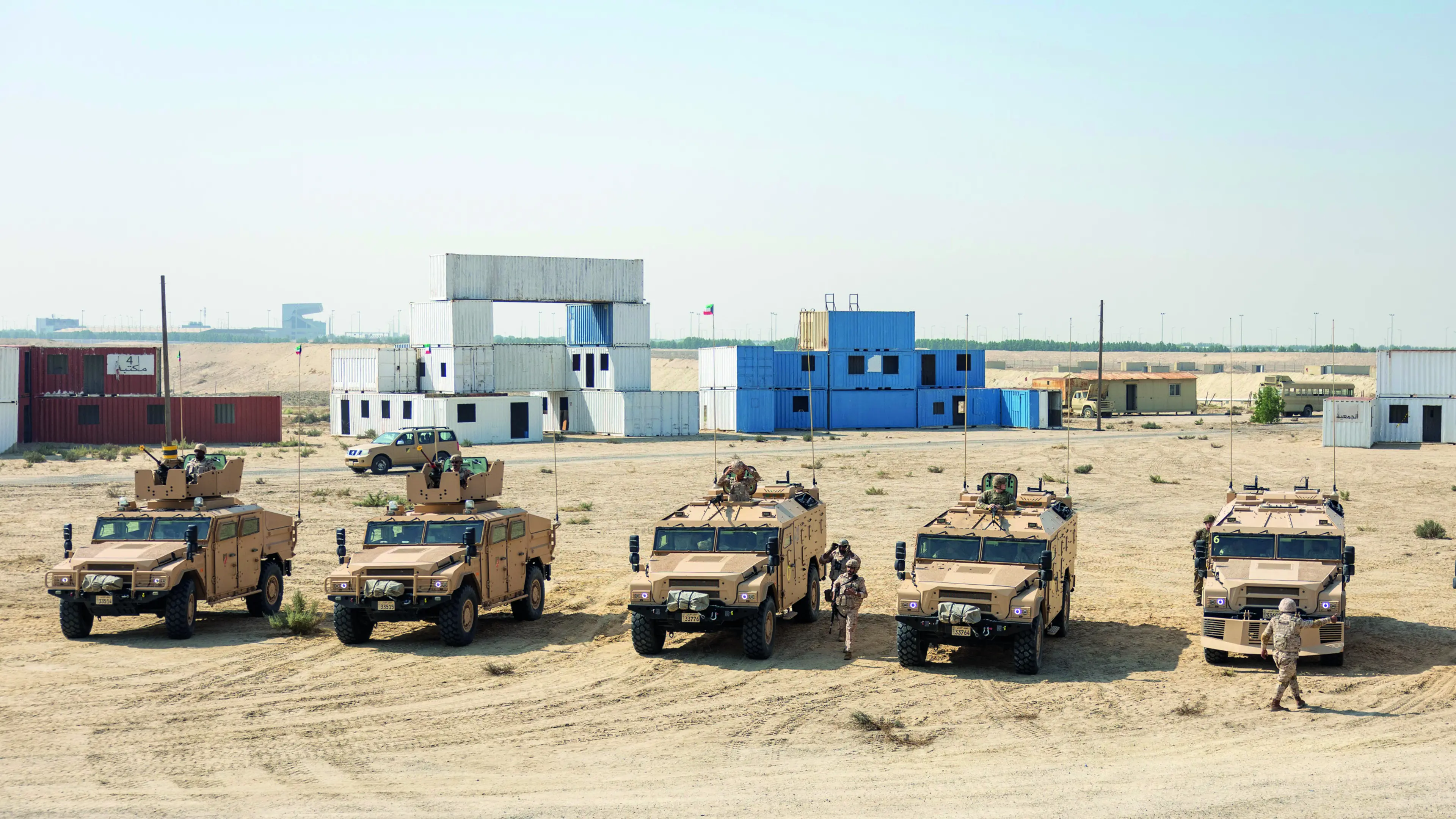
Exercise Iron Shield
The Brits used their time in the Middle Eastern desert to enhance how they use small unmanned aircraft systems (UAS) in the close-quarter fight.
Building clearances dominated the training agenda, with a focus on how drones could support ground elements during the manoeuvres.
“An urban landscape can be full of hazards, so we used small UAS to look inside buildings and identify if the enemy was inside,” CSjt Matt Davies told Soldier. “It really helped build the battle picture.
“We practised hard and enjoyed using the set-up they provided, which included lots of little passageways that we couldn’t always cover on foot, and small egress points the enemy could exit from.
“We employed some of the tactics honed at Cenzub in France a short time ago when I was trawled as a drone pilot for an exercise there involving 4 Scots.
“French units formed our opposing force, and their ploy was to let us bust into a building while they would exit from the rear and then bomb it. But our drones overhead kept spotting this and we’d order our guys to quickly bug out so the French ended up bombing empty buildings.
“We did the same in Kuwait. It’s a great example of the real-time picture we now enjoy through the smart use of small UAS. And it clearly demonstrates why having this kit at sub-unit level is proving such a game changer.”
It was a message that 3 Rifles, a unit blessed with some of the most experienced drone operators in the Service passed on to the Kuwaiti military, who are still looking at how they should use such assets on the battlefield.
“Our tactics are more developed than theirs,” explained OC Maj Stephen Watts.
“This region has its problems and upstream defence engagement exercises like this, where you bring their armed forces alongside ours in a realistic context, is important.
“We taught them not only how to fly small UAS but how best to use them in an urban environment. They were really keen to understand how we can increase our find using this kit – and combining that with low-level tactics was a critical part of the package.”
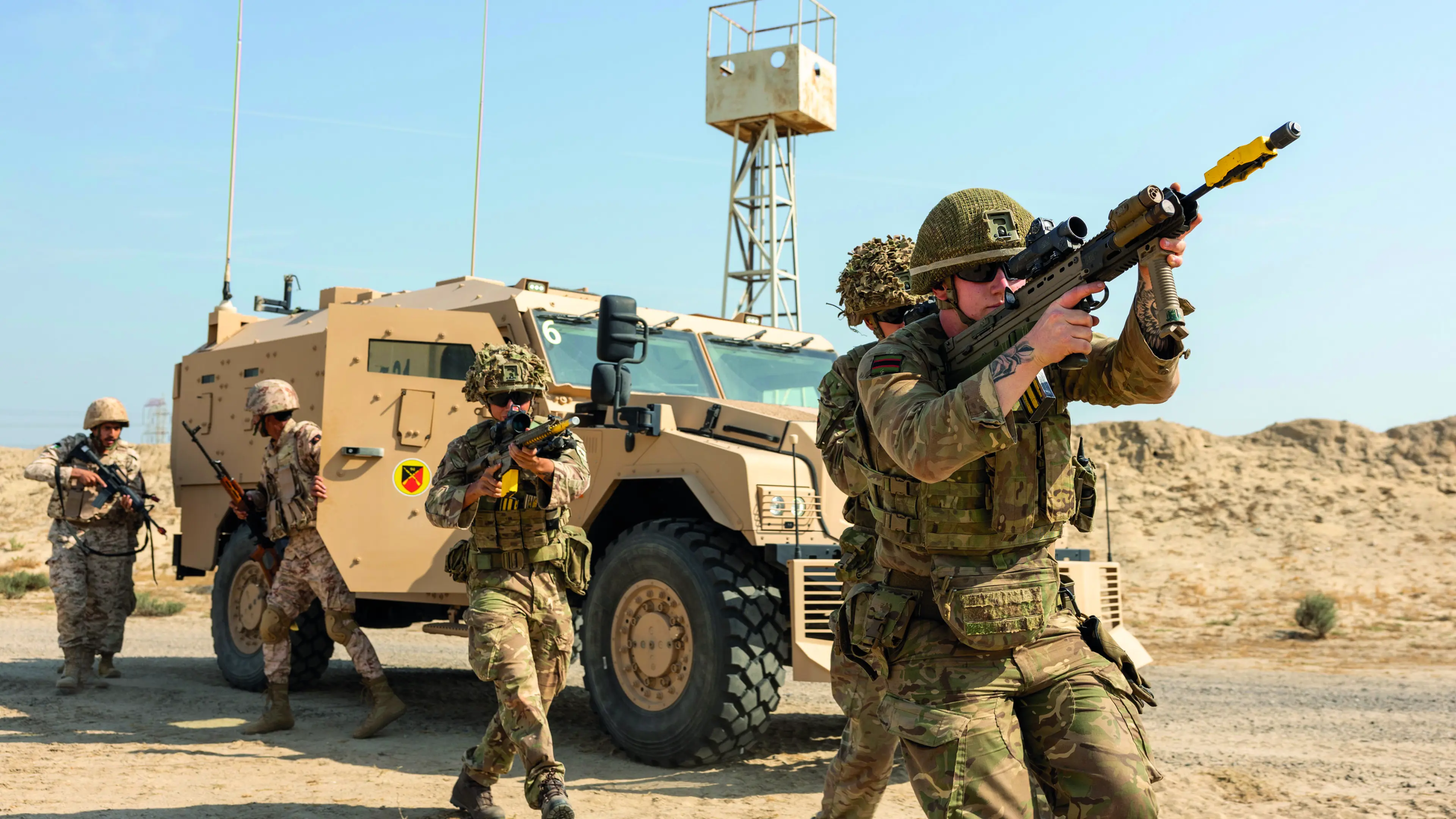
Riflemen in Kuwait
Eyes in the sky can undoubtedly offer a huge situational awareness advantage and 3 Rifles are continuing to push the boundaries in this area now they have been moved from a security force assistance role to tactical recce strike as part of 11th Brigade’s recent reassignment to the Land Special Operations Force.
“We’ve learned a lot in recent years and that should certainly bear fruit in our new role,” explained CSjt Davies.
“In Estonia last year, for example, we did lots of fighting-in-woods-and-forests drills.
“We were cutting around in Mastiffs, which aren’t the most manoeuvrable, so you really don’t want to go the wrong way down a narrow track.
“When we broke into clearings in the huge wood blocks, we’d send drones out to look for other routes.
“The enemy had to put their vehicles and armour down those tracks too so from above the trees our drones could spot their dust clouds in the distance, then we could identify their route in and if we were in the wrong place we’d quickly move out. It gave us a distinct advantage.”
Like many other units, the battalion has also kept a constant eye on Ukraine, where tactics seem to be evolving almost daily.
“When I first started using small UAS we flew them quite low, we didn’t consider the backdrops or how to use the wind,” continued CSjt Davies. “Now, we tend to approach the enemy against the breeze so the noise from the drone doesn’t blow on.
“Also, we’ve been speaking to trained Ukrainian soldiers on Op Interflex who told us GPS blocking is becoming a regular problem. We’ve realised that flying the drone upwind of the target also means if the GPS is cut, the device will drift back towards us.”
Ironically, this last point highlights another valuable piece of advice 3 Rifles personnel passed on to their Kuwaiti military colleagues – don’t become over reliant on UAS.
“You still need the traditional skills and can’t afford to be dependent on drones,” emphasised CSjt Davies.
The Serviceman listed some of the many scenarios, in addition to GPS denial, where this type of kit is simply not up to the job. They include the platforms being too loud for a particular mission and being vulnerable, or even inoperable, in high winds, heavy rain and conditions of extreme cold or heat.
“It’s why we still must have the lead section sending a sketch back, air phots, patrol reports and a J2 brief,” added the senior NCO.
“That intel can become out of date because the situation can change in the hours or even days it sometimes takes for reports to come in and get collated and briefed. That’s where having a real-time Istar asset complementing our other data becomes so valuable – and why we now always have a small UAS pilot on the shoulder of our platoon commanders.
“The trick, though, is to not get fixated on the drone and have everyone only looking at the screen.
“You need to remember it’s a great asset, but it shouldn’t be the main focus.”
