
Imagine a British Army infantry platoon attacking an enemy position with wave upon wave of first-person view (FPV) suicide drones.
During the battle the troops get through not just ten or 20 of these deadly little devices, but hundreds – battering their foes with a lethal and sustained assault. And what’s more, they didn’t have to rely on a single resupply mission.
If you think this scenario sounds far-fetched, think again. A recent experiment on the plains of Kenya proved it could be a reality in the very near future.
In a probable first for the service, FPV devices were manufactured in the field and deployed on attack missions.
They were made in a workshop fashioned from a cam net attached to a Land Rover.
The bodies of the drones were produced on a portable 3D printer powered by a lightweight field generator. Meanwhile, REME technicians at two trestle tables attached small batteries, cameras and circuit boards to complete the assembly.
The self-made devices were used on Exercise Bull Storm, 11 Brigade’s major test of recce strike tactics, staged near Nanyuki.
“I can’t be 100 per cent certain but I believe it’s the first time anyone in the army has done this,” says Maj Steve Watts, Officer Commanding F Company, 3rd Battalion, The Rifles. “We obtained what’s called special purpose clearance from the Military Aviation Authority to build and fly our self-made drones during this training.
“It was a big deal because previously they’d only allowed the army to build drones and race them inside the wire, under civilian aviation rules, or fly off-the-shelf platforms if the operators had the right qualifications and permissions.”
The serials in Kenya saw 3 Rifles personnel and reconnaissance and surveillance specialists from 2nd Battalion, The Royal Yorkshire Regiment assume the opfor role against troops from 3rd Battalion, The Royal Regiment of Scotland and 1st Battalion, The Royal Anglian Regiment.
Around 1,400 soldiers were involved in total and both sides used a range of drones, sensors and surveillance kit to try and steal a march on the other.
The self-made FPV drones were not being used specifically to influence outcomes on this occasion, but rather to prove the viability of producing such equipment in the field. Five whole devices plus spare parts were produced and deployed – and a lot was learnt in the process, says Maj Watts.
“Manufacturing your own equipment in austere field conditions has its challenges – when you do this in camp it’s a lot easier,” he adds. “But we wanted to understand the impact of running power from a field generator to a 3D printer and how the environment impacts the whole process.
“For example, we found if it was too hot or too cold the printer didn’t operate well so we had to learn to manage its temperature carefully, making sure we kept it in the shade during the day.”
What the exercise also taught the officer and his colleagues was that the potential returns on investing in this technology are too significant to ignore.
During the training, much of what would have been artillery and mortar fire was replaced with FPV drone attacks using Tes simulation technology to track results. The success rate was significant.
“They are only part of our one-way effector capability but they proved their worth,” explains Maj Watts. “Imagine if we had whole platoons trained to use these weapons on operations, armed with a virtually endless supply of them. That would increase the army’s fighting power many times over.
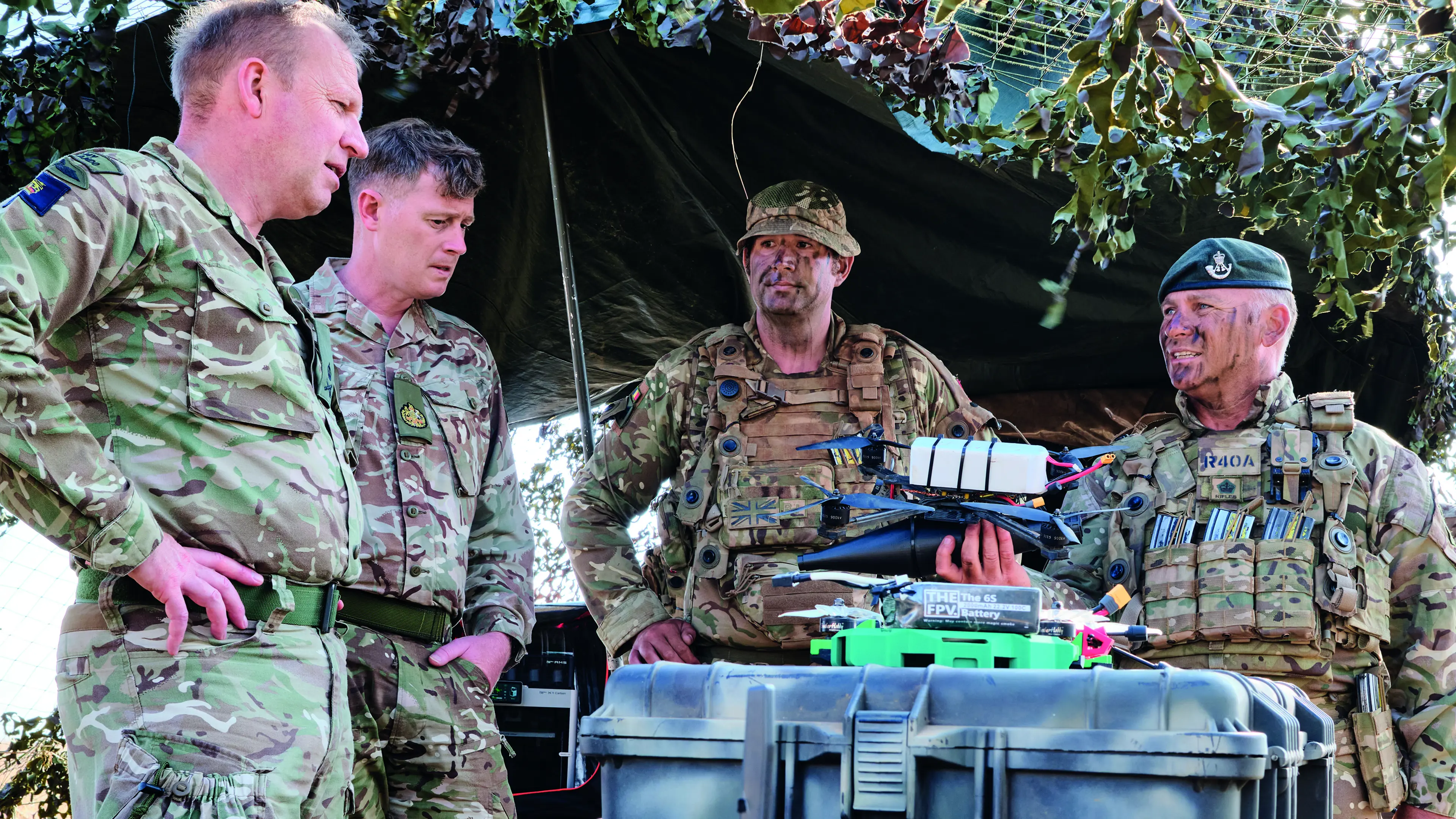
Commander Field Army, Lt Gen Mike Elviss (left) talks to the drone builders
“We only used our self-made platforms sparingly, but they are potent, flying at 190mph for three-and-a-half minutes, which means they can cover 15 miles and are very hard to intercept.
“By Exercise Bull Storm 26 I’d like to have tens – if not hundreds – of self-built FPVs flying, which will make the formation extremely lethal.”
There’s also a tactical edge to be gained by 3D printing the weapons, as conflicts abroad have already demonstrated.
“I follow developments in drone tech and its military application all the time,” says the officer, who developed his expertise in small UAS during a previous role at the Combat Manoeuvre Centre.
“In Ukraine they are printing and building them on the front line as well as back in their factories and they’ll design and assemble them to a spec determined by the type of mission that’s required. It might need a certain range or load capacity, or to be wire-guided and have specific sensors.
“It took about three-and-a-half hours for us to print one drone in Kenya and another hour to put it together, so if we have this capacity in the British Army and I’m a platoon commander planning a mission I could print off some bespoke FPVs now and fly them on the same day.”
The team also unearthed logistical and economic advantages during the trial. Shipping out boxes of electronic parts, batteries and small ordnance saves on space compared to containers full of assembled drones. And the production cost of each device was significantly lower than buying off the shelf.
“If we go larger in future we could have just one truck full of 3D printers, generators, parts, cameras and small ordnance and our build capacity would be huge,” says Maj Watts. “Off-the-shelf FPV drones suitable for army purposes are roughly £2,000 each, but we are assembling these for about £400 a pop, so if we build hundreds the economic argument is very strong.”
With small UAS gaining an ever-increasing foothold in military strike capability and this exercise throwing up some fascinating potential solutions around the supply of such kit for even the most protracted of battles, who’d bet against swarms of 3D-printed platforms dominating the near surface environment at the army’s major exercises in the near future? 3D printing: how it works Maj Watts used the Commander Field Army’s Innovation Fund to get the 3D printing trial off the ground and the venture attracted the attention of CFA himself, Lt Gen Mike Elviss (pictured below), during his visit to the exercise in Kenya.
The officer teamed up with a firm called the Edinburgh Drone Company to source the hardware and the outfit also taught technicians how to print the parts.
“The body is made from a special type of plastic,” he explains. “Five reels of plastic wire sit on top and feed the 3D printer. It then prints the bodies in incredible detail – even the thread in the tiny holes that the technicians put their screws in during assembly.
“The platforms we manufactured in Kenya are based on the company’s Dirk 5 design and they emailed us the printing programme after we’d arrived in country.
“We loaded it into the 3D printer and a few hours later the first FPV drones were ready to fly.
“At the next exercise I intend to have a larger printing base located back in the echelon spitting out drones all day and night, and sending them forward to sub-units with their ammo and rations, to see how that works.
“The army’s priority right now is increasing its fighting power and there can be few more effective ways of achieving that than printing our own attack drones in the field at the point of need.”
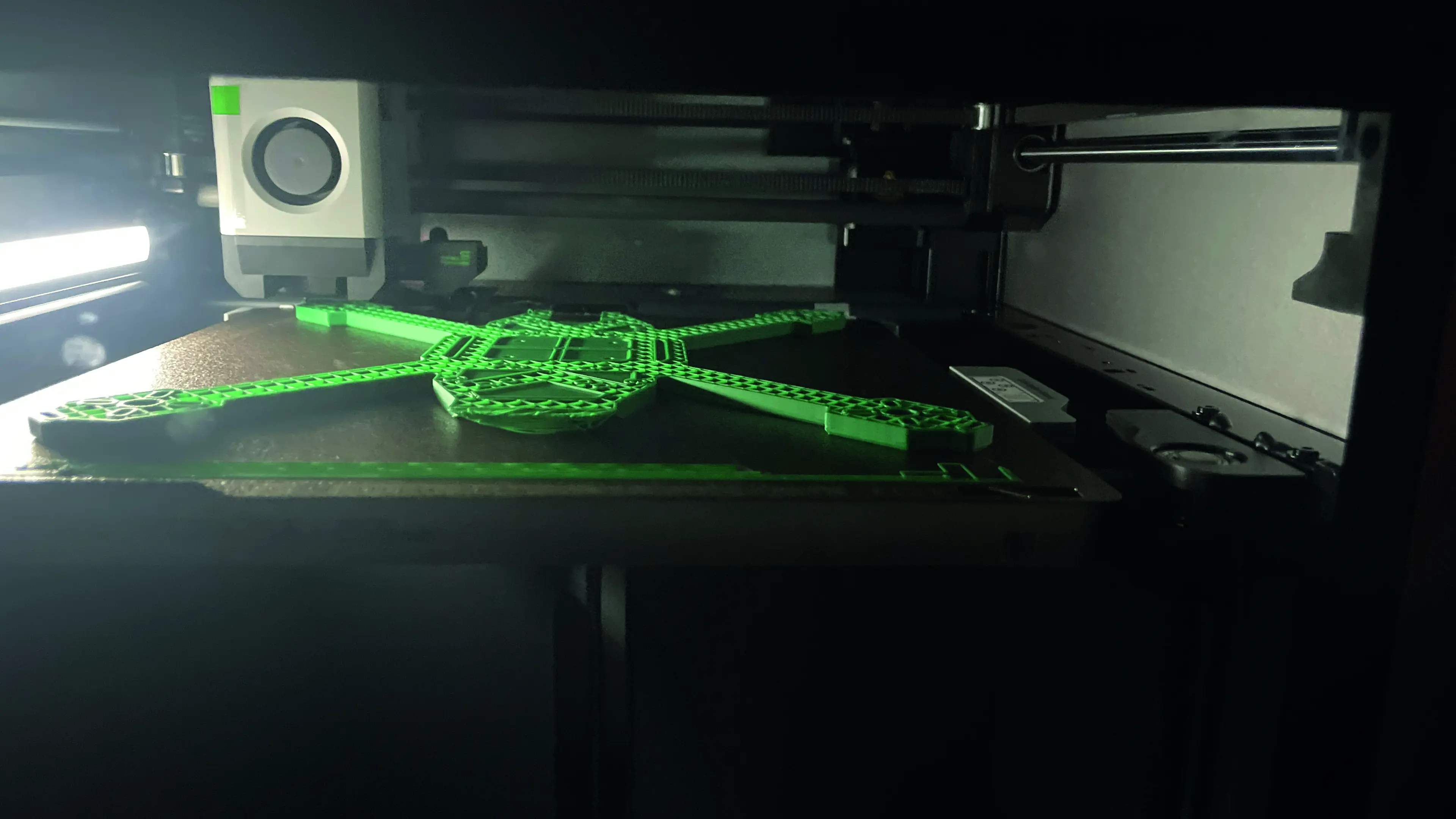
An FPV drone body being printed during the exercise
