
The tension is palpable throughout the dark, cavernous space.
Small spotlights are casting faint glows across swathes of concrete and steel while on an elevated gantry two directing staff stand rock still, peering into the gloom below. The sound of shuffling footsteps grows and a flash accompanied by the ear-splitting crack from a grenade slice through the air followed by the rapid pop of small arms fire.
We are situated in the bowels of one of the army’s newest training facilities, located in a corner of Rollestone Camp near Larkhill. From the outside, the structure could be mistaken for a run-of-the-mill storage depot but the interior is anything but humdrum. Built in collaboration with industry partner 4GD under the army’s collective training transformation programme, it contains a labyrinth of walls, windows and stairwells concealing reams of cutting-edge technology.
Opened earlier this year, it is one of just three garrison urban skills centres (the others are in Catterick and Colchester). All of them are equipped with socalled “simwalls”, which allow for an almost infinite number of configurations to be created inside. They also come with integrated special effects such as smoke, light and sound, as well as state-of-the-art after-action video monitoring systems.
The facilities have been developed as part of a major push to boost fighting skills across the army, including through the Infantry Battle School (IBS). A week’s worth of training at the Rollestone facility is now a fixture on the school’s close quarters battle instructors (CQBI) course, which itself was revamped as part of the service’s renewed emphasis on close quarters and urban warfare.
“With the army’s focus now on increasing fighting power the decision was taken to open up this course to the whole Infantry after previously being reserved for The Ranger Regiment,” explains CQBI course supervisor CSgt Gavin Dillon (R Yorks).
“All the personnel here will return to their units and cascade advanced skills back to their teams, so it is having a really positive ripple effect.”
Part of the revamp involved IBS staff examining what was being taught and ensuring the best facilities available were being employed.
“Back when this was for The Rangers only, the syllabus focused on room combat and was made up of two weeks of marksmanship and two weeks of tactics,”
CSgt Dillon adds. “We decided to redefine what was commonly understood as the close quarters battle and we now include fighting in woods and forests, trench and subterranean warfare, as well as room combat.
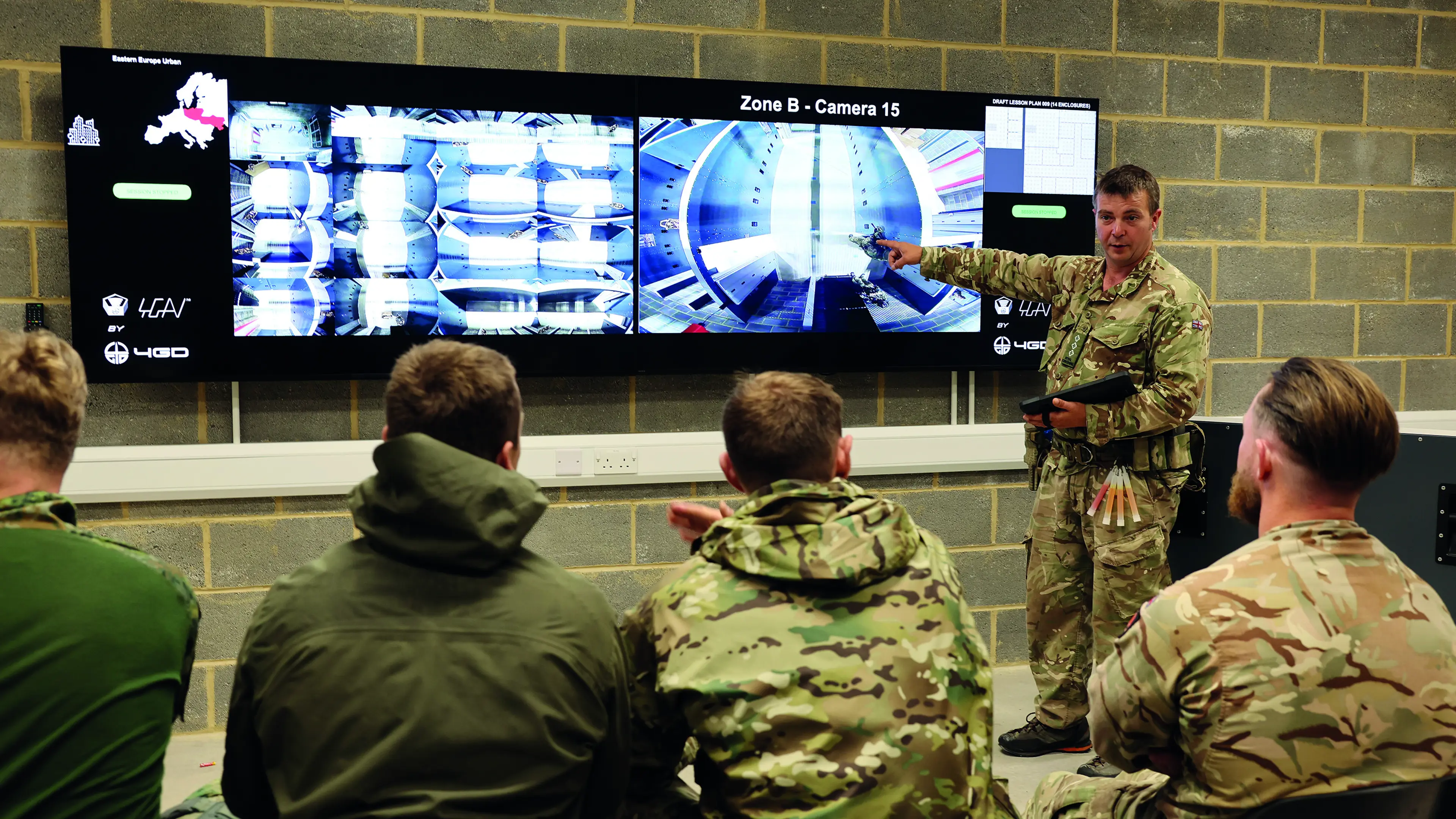
The state-of-the-art after-action video monitoring system
“Many skills are transferrable between these environments so it made sense,” he continues. “The mechanics of Fiwaf, for example, are similar to those of an underground or multi-storey car park, where pillars can be treated in a similar way to trees.”
Having a flexible and technically advanced facility at their disposal has improved the training experience too, says the senior NCO. “If we put a low ceiling over this area it becomes subterranean; if we put in shop windows it becomes a high street; or if we make the corridors zigzag we have a trench environment. We can even insert lots of doorways to imitate a hotel complex,” CSgt Dillon adds.
“The facilities we were using at Caerwent were quite good but there’s a lot of damage there now and it needs quite a bit of investment,” he continues. “We also used Cellini Village in Brecon but that was built for a different era – every door and window is open for example.
“Rollestone is not only really flexible, we can also create confusion and stress by quickly introducing smoke and noise.
“We could do that at Caerwent too, but we had to improvise by connecting Bluetooth speakers to smartphones. Here it’s all integrated by design and the effects are so much better.”
The gantries above the training floor allow the directing staff to observe proceedings with an uncluttered bird’s eye view – and that helps them spot even the smallest mistake, which ultimately helps to raise standards. “The culmination of this week is a tactical evaluation exercise where there is a fourperson team made up of three directing staff and one student, with supervisors up above observing as well,” explains the NCO.
“That puts a lot of additional pressure on the students, and that’s what we want. “We also employ the integrated cameras to conduct really detailed after-action reviews that can be displayed and dissected on large screens, so I feel we now are really maximising our training time.”
However, CSgt Dillon, who joined the army in 1998 and has deployed to Northern Ireland and Iraq, says more refinements will undoubtedly be in the pipeline.
“We’re learning about how technology is being employed, reaching back to DSTL among others to keep ourselves informed about what’s been going on in other places around the world,” he says. “We’ve been keeping an eye on developments in the Middle East.
“Interestingly, Israeli forces do things a bit differently; they tend to advance down a street leading with a light machine gun, and when breaking into buildings they use an underslung grenade launcher to hit the doorway and detonate any booby traps attached to it.
“We don’t have that capability on the course yet and it’s the same with firstperson view drones, which we know are being used by other armies on urban ops to help clear buildings for example.
“Overall though, this facility is amazing and everything we do here is designed to be passed on by these personnel to junior soldiers so they can safely turn that corner and kill the enemy without being killed themselves.”
Two NCOs relay their views of the CQBI course and the urban skills facility at Rollestone
Cpl Jack Aberdeen, 1 RRF: “I’d heard good things about this course and you definitely learn a lot but it’s not a massive leap in terms of physical skills and drills. The focus is more on how you should be thinking through problems and the decisions you then make as a result.
Rollestone is one of the best facilities I’ve ever trained at due to its flexibility – you can manipulate it, change the structure and put obstacles in the rooms really easily.
The after-action review screens are brilliant, even if they are a double-edged sword at times. But that’s what we’re here for, to learn and it’s a really useful piece of kit with a slow-mo function that highlights any errors and helps get lessons across really quickly. The whole course is superb in fact.
Last week I took part in a rapid clearance of a wood block for the first time, entailing techniques such as cadence firing which I’ve hardly touched in the past. This week I’ve learnt about the transition drill for urban fighting – the seamless switch from the primary weapon to the secondary, our pistol, whilst engaging a target. So if your rifle gets a stoppage, instead of retreating or attempting to clear it, you sling it down and use your pistol to carry on firing.
I’ve also learnt from having different cap badges here and we have two Dutch army NCOs on the course which has been fascinating. Yesterday they showed us their standard room clearance drill and it was quite different from ours. That’s good knowledge to have for multinational exercises in the future.
Ultimately, I’ll also go back to my unit and pass on the knowledge and skills I’ve gained here. I’ve enjoyed the course a lot, I’d encourage any NCO or officer to do this if they have the opportunity.”
Cpl Jack Seymour, 2 Rifles: “I finished working as an instructor with an intake at ITC Catterick and my chain of command said I could do this course, which has earned itself a great reputation on the grapevine.
There was a lad in my last training team who’d just completed it. We let him own the urban phase of the training and the students enjoyed it. I really noticed the difference too. I’ve learnt some new tactics, but training here allows us to concentrate on how to prioritise, identify where the threat is and decide how to deal with it. One thing it’s improved in me is shot accountability.
When you use the marker round training system you get more points if you hit the target’s A zone – the head or centre of body – and that really focuses your marksmanship. Another thing I’ve not practised much before is oblique and lateral firing on the move, across open doorways for example, and we’ve been incorporating these techniques into our clearance drills.
You definitely get a lot better at pistol shooting too because we don’t do enough of that during normal training in my opinion. You are tested on this in week one and in order to progress on the course you need to score at least 80 per cent. We don’t shoot enough rounds as soldiers in general, in fact, and I’ve fired more on this course than in the last three or four years.
We don’t do enough urban or close quarters training either. This process churns out just 72 people a year, from corporal to captain, so it could easily be expanded and probably should be if we are to increase our fighting power significantly. Everyone here is like-minded and switched on and it’s good to work with your peers.
Hopefully there is enough scope in the future for us to use the knowledge we’ve gained to eventually teach more advanced urban drills back at our units and help increase the army’s lethality.”
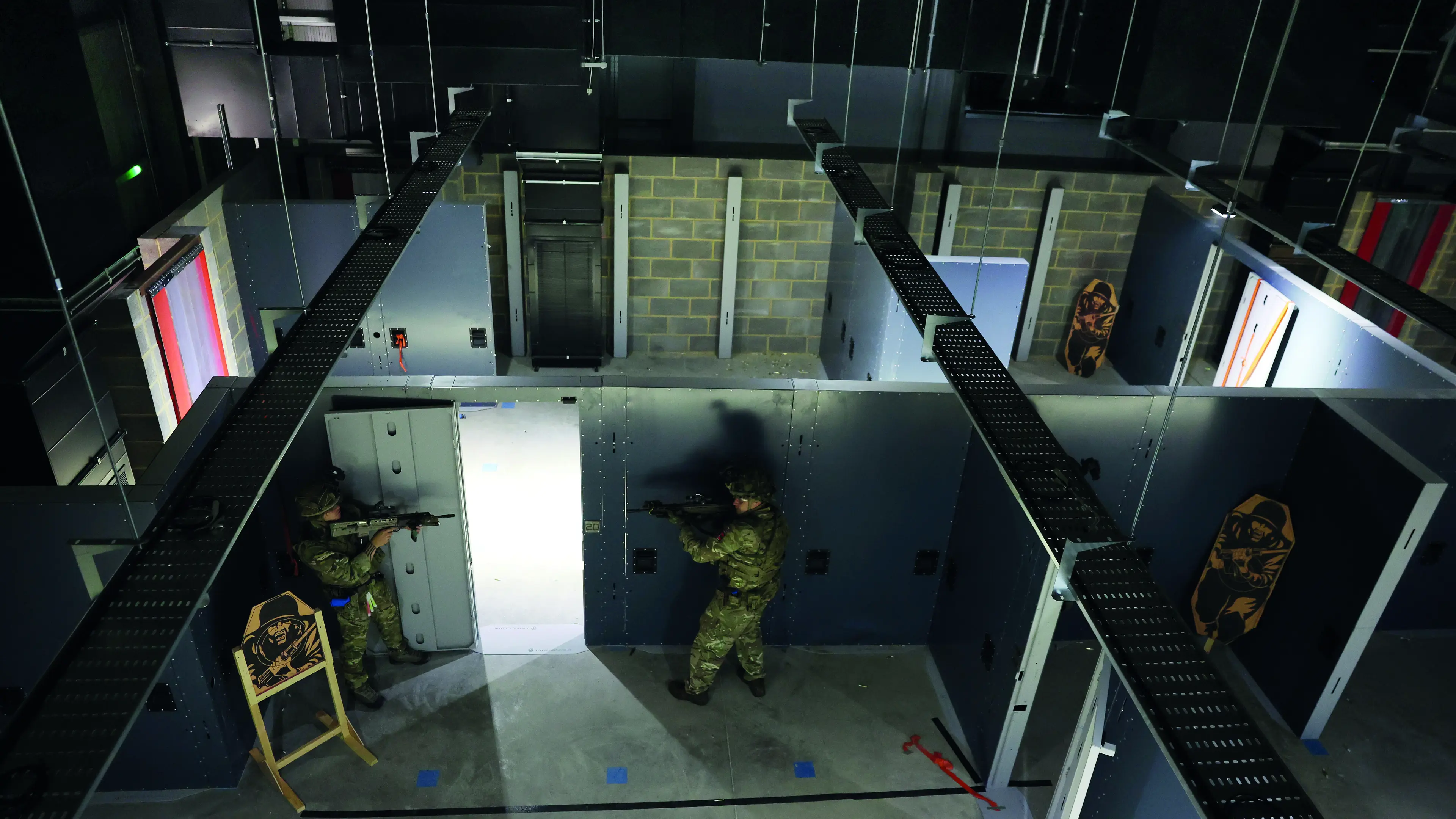
The “simwalls” allow for an almost infinite number of configurations to be created.
