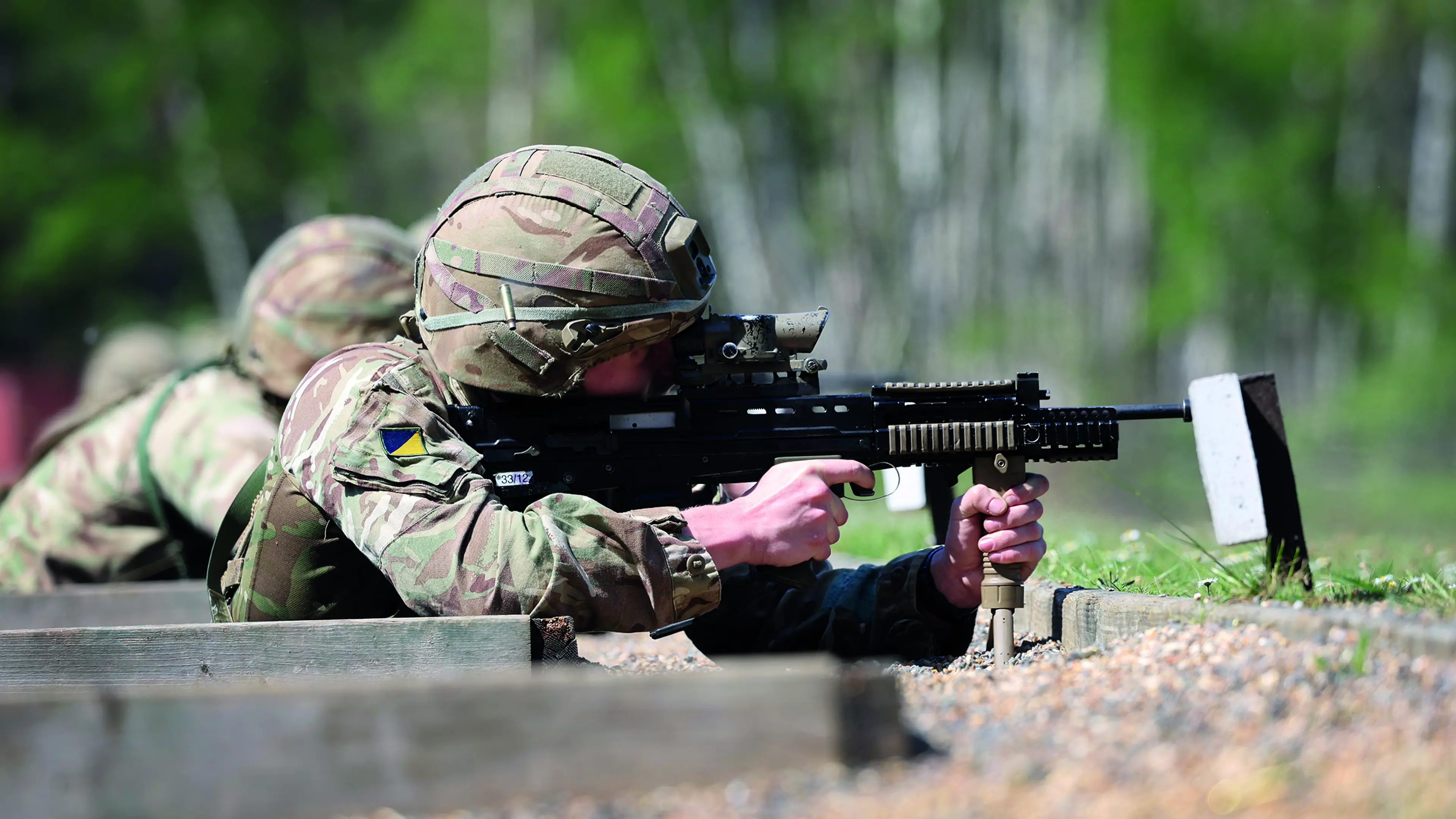
Legendary war leader Bernard Montgomery once said that an individual’s skill at arms – their ability to lay down accurate rounds – was the army’s defining asset.
“If a man can’t hit a target, he is of little use,” the field marshal added. “Training in marksmanship is the foundation of a soldier’s effectiveness.”
They are wise words indeed. Personnel of all roles – even those not considered to be at the sharp end of combat – could face a situation where they are required to fire on the enemy at some stage in their military career.
Take Op Pitting in 2021, when people of all arms and trades were given the task of assisting with the evacuation of Kabul in Afghanistan.
With an ever-present threat of insurgent attack – there was a suicide bombing that killed both civilians and US personnel – their skill with a rifle could have been critical.
The line touted by the civvy media that soldiers in supporting jobs are somehow exempt from the front line has always been a myth.
Yet the ability of troops to deliver accurate fire has been a recent talking point for leaders amid the chief of the general staff’s order that the army must treble its lethality by the end of this decade. If this is to be delivered, individuals across the board must up the ante in weapons handling.
“When people think of shooting they tend to picture someone prone and taking aim at a static target,” Maj Neil Whitewick (RLC), senior range officer at the Corps Operational Shooting Competition in Pirbright, told Soldier.
“But this is far removed from the reality of using your weapon on deployment – among other things, your effectiveness there depends on marksmanship intelligence matched with decent physical fitness and personal admin.”
The contest being overseen by Maj Whitewick last month tested this combination of skills and abilities. A far cry from a static range outing, it replicated the pressures that personnel will likely face if they need to use their weapon in anger.
Over five days, teams of eight were put through serials that included a simulated advance-to-contact, defending a position and fighting through urban environments.
Throughout, competitors were expected to deal with drills including ammunition resupply and casualty extraction plus team fire and manoeuvre. Maj Whitewick believed contests like this could prove an effective route to meeting the head of the army’s ask.
With shooting often viewed as a chore by units, carried out as part of the annual combat marksmanship tests, he said competitive events can bolster enthusiasm and instil a drive to improve.
“Picking up a rifle should be something that our soldiers are eager to do,” the officer, himself a marksman and veteran of elite competition, continued.
“But it is not something many enjoy – this is not surprising when their first experience of the ranges takes place while they are being thrashed through phase one training and later on in their careers when it is part of annual assessments.”
Maj Whitewick emphasised that shooting facilities can be secured by units with a little forward planning and preparation.
“Yes, there are pressures on range time but you can use the established Bams system to book a session,” he pointed out, urging troops to then consider competition as a way to further improve.
“This corps event is a test of shooting in the context of wider operational soldiering – participants will also move between their primary weapon in the SA80 and secondary 9mm Glock pistol in urban serials.”
The Pirbright competition – which returned in 2024 after a four-year pause during Covid – is certainly a sound way of honing good shooting discipline.
Preparation means a decent phys programme alongside time on the range and fostering good teamwork. There were more than 40 regular and reserve teams taking part this year, dealing with the rigours of simulated combat conditions and operating in unseasonably hot temperatures that saw the mercury climb towards 28 degrees.
While full kit is normally required, organisers decided to ditch body armour given the potential for heat injury. On the exercise area at the sharp end of the competition, marksman Cpl Shaun Manvell (REME), who was helping to supervise the event, was impressed with the overall standards.
Teams were working well and laying down accurate rounds, he said.
“At the end of the day, the focus here is not on shooting so much as preparing for ops,” the NCO continued. “Whatever your role in the army, everyone is a soldier first and you have to be able to kill the enemy.
“Some people do have a natural flair when it comes to shooting and you often notice this early on, but there are things that everyone can do to improve.
“For example, just following the marksmanship principles (far right) is a start, plus being familiar with the weapon type and maintaining your physical fitness.”
Sound phys is a definite must – the exertion was written all over the faces of the troops returning from the field as they sought refuge in the shade, knocked back water and talked tactics.
“There is definitely a hard learning curve with this event,” remarked Capt Shaun Stanley (AGC (SPS)), leading a mixed squad of loggies and members of his own corps.
“One of the big challenges is getting used to competing in kit – and on each serial there is quite a bit to take in.
“My advice to anybody wanting to enter is to do your preparation beforehand – you must apply yourself and cannot simply turn up and take part.”
Teammate LCpl Tom Wright (RLC) agreed, adding: “I’d say it is important to come with an open mind – this is a good opportunity to develop.”
Cfn Joshua Tonkinson (REME) said the competition had inspired him to work on his skill at arms. “This event could not be more different to shooting on a range,” the soldier – who is now a year into military life – explained.
“It is my first time doing anything like this and it is proving a great experience.”
Pte Precious Boateng (RLC), part of an all-female team fielded by her corps, shared the sentiment.
“I’d encourage others to put themselves forward,” she said.
Competing is certainly a good way of furthering both shooting and general military skills. In an army that is now smaller than it has ever been, bolstering fighting power to the levels expected by CGS is going to require a determined individual and collective approach.
Developing skill at arms means strengthening – as Monty said – the soldier’s very foundation.
But thankfully there is already a solid base on which to build. Speak to your chain of command for further information on the Corps Operational Shooting Competition and other contests.