
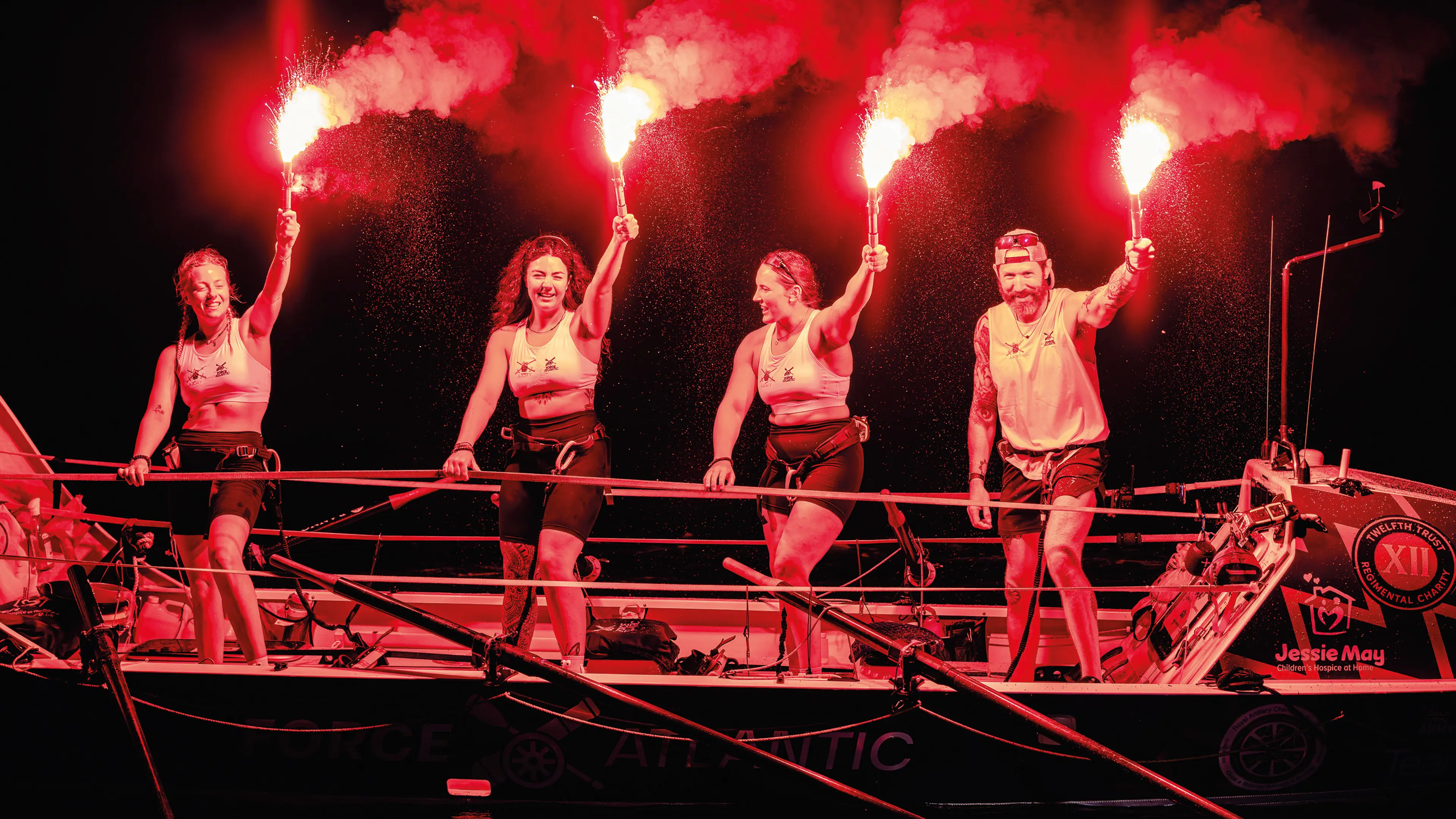
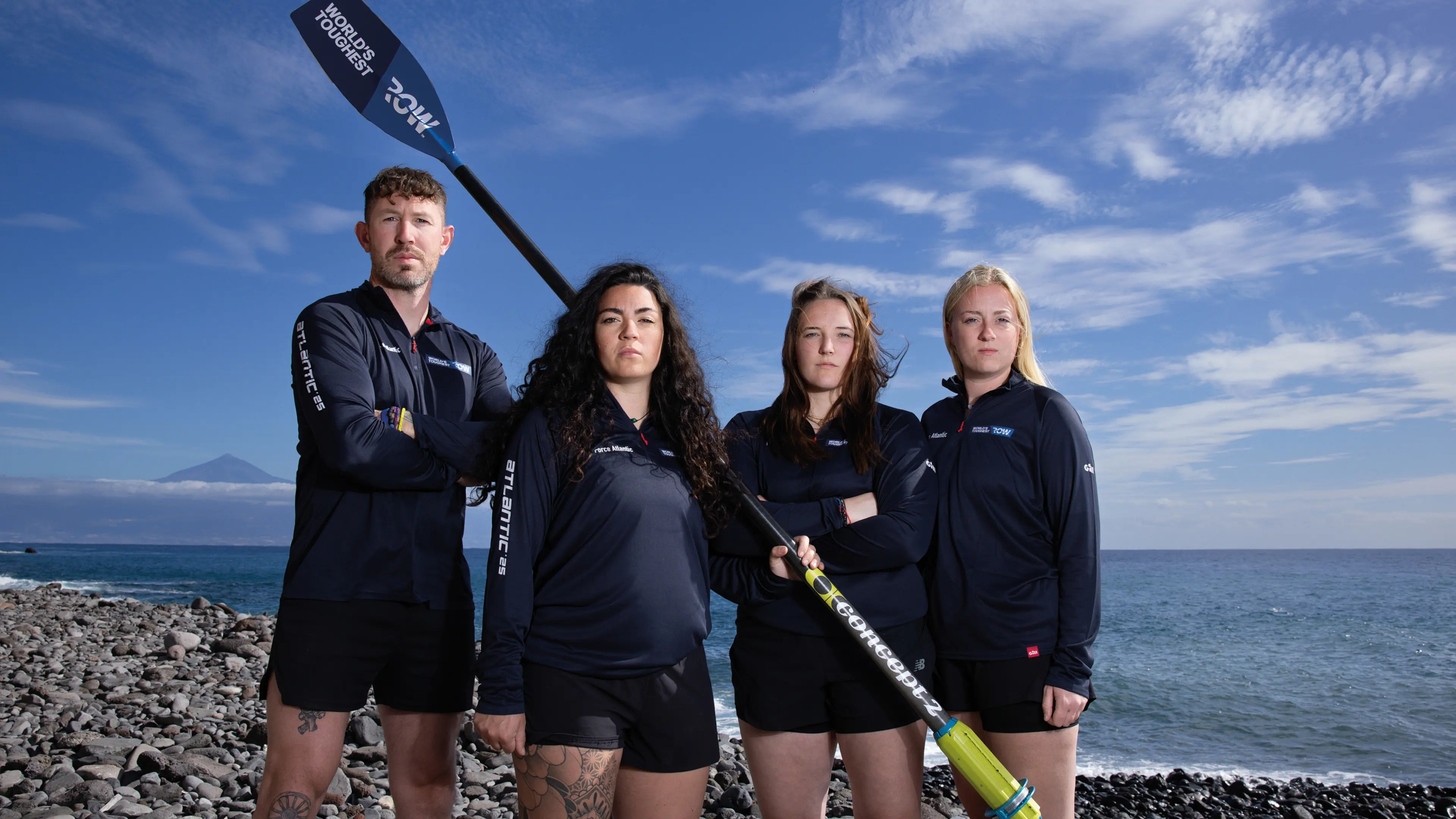
The Force Atlantic crew – Bombardiers (Bdr) Katie Devine, Vicki Wratten-Wood and Olie Cutting, plus Gunner Emma McKenzie, all of 12th Regiment, Royal Artillery – completed their 3,000-mile voyage from the Canary Islands to Antigua in just over 46 days.
They became the service’s first junior ranks team to master the gruelling race. Here, Bdr Cutting and skipper Bdr Devine share their experiences from a journey of a lifetime.
Bdr Cutting: The rowing was the easiest part; the crossing was more of a mental test. With a year of training our bodies were so conditioned that it was almost like sitting down and having a rest.
As a PTI I oversaw the training, but I had never heard of ocean rowing before this, let alone trained for it. We started with functional fitness followed by resilience training and then did a lot of specific rowing work on ergometers, while looking at technique.
Once we got on the water the PT tailed off and as soon as the boat was shipped the focus was on injury prevention before the start. The army gave us a year to train, so we knew our strengths and weaknesses.
Bdr Devine: We would have struggled had we not trained the way we did. Sometimes you would wake up, and it felt like you had a broken arm.
Then you’d go to sleep again, and it would go, but then there was a pain somewhere else. Because we were constantly overdoing it everyone got aches, but it was never anything too serious.
Being part of a team, you cannot think of yourself; you get in the cabin, do your stretches and look after your body – if not, you put others at risk.
Bdr Cutting: The first week was tough. I’ve been away with the army many times but had never felt homesick until now.
You saw the other boats for the first 12 hours or so and after that we were isolated. But instead of letting it eat me up, I accepted it and stayed present in what I was doing.
Eventually that feeling went away. You know there will be dark moments and being able to talk it through with other members of the team helped.
Bdr Devine: Having a good support system at home worked wonders for me. I could speak to my partner about everything, and it was good to have someone on the outside who could think about things with a clear head.
We had a satellite phone and Starlink so you could talk to whoever you wanted. I’m one of ten brothers and sisters so to not talk to them would be very strange.
Bdr Cutting: We headed out in big conditions that we had never seen before in terms of waves and wind. Experiencing that straight away really helped and when we got other bad weather, we knew what to expect.
We later faced huge waves with the wind blowing in the wrong direction, turning the boat sideways. We battened down the hatches for six hours and waited for it to ease.
I loved it in a way and in that moment, everyone knew exactly what to do. That reflected how good our training had been and how well we were working as a team.
Bdr Devine: We went through every single weather system the sea could offer. There were days when it was flat with no wind and rowing was like cutting glass.
You want the wind behind you, with the » waves pushing you along, and when the conditions were perfect, we were hitting more than three knots. When there was thunder and lightning, the whole sky was lit up and there were shooting stars that we had never seen before. But when there were 40-foot waves I remember thinking ‘this is the end’.
Bdr Cutting: It was really weird. The media boat turned up; we had not seen anyone for 46 days and there were lights everywhere.
I felt everything at that moment, there was massive relief and an overwhelming sense of pride in myself and the team.
There was also some apprehension at going back on land as I was so used to being on the boat with just three others – there were so many people there.
Bdr Devine: There was a huge sigh of relief. The whole campaign had been so stressful, and all that responsibility had suddenly gone. As the first junior ranks team we put pressure on ourselves to perform as we want to inspire other juniors to do things like this.
Bdr Cutting: The whole thing was led by us. Many people will see this as 46 days at sea, but that was just two per cent of it.
This was a three-year campaign, with so much work involved. When I went to the initial brief it was about pushing myself physically and mentally,
I also wanted to be a good role model to my kids and show the rewards of hard work and going out of your comfort zone. But as it went on my motivation changed and the focus was on junior leadership.
I’ve always been interested in leadership models, and this was a chance to show the next generation what can be achieved.
The army talks a lot about empowerment and for me that is junior leaders coming up with ideas and being supported by the officer cohort.
Bdr Devine: I have never experienced anything like this before and have learnt so much in the past couple of years. Whether that’s balancing workloads or simple things like sending emails properly.
I feel I have a better understanding of the army and what other ranks do to get you where you need to be. There has been a lot of work behind closed doors, and the hardest part was getting to the start line. Hopefully we have shown that no matter what your rank, age or sex, if you want to do something you can do it.
