
It is among the biggest hospitals in the UK and today personnel from the Royal Centre for Defence Medicine (RCDM) are running a ward here.
Trauma and orthopaedics is a hectic corner of Birmingham’s Queen Elizabeth Hospital – one that is currently running at capacity.
In the coming hours the tri-Service team could be dealing with anything from gunshot wounds to road smash injuries.
The military takeover is not a crisis response, though. It is a regular event at the city-centre site.
The day sees NHS staff step back from their front-line roles and leave the military in sole charge.
Likely treatments required from those on shift today will be fracture care, joint replacements, ligament repairs and the management of arthritis, sports injuries and joint instability.
Patients are predominantly civilian. But given the centre’s role is to provide medical support to operational deployments and specialist care for members of the Armed Forces, a small number of personnel are occupying bed spaces.
At the height of the Afghanistan campaign the military intake here was high. Today, one of the biggest causes of admissions is the Forces ski season.
A normal morning here sees NHS and defence care providers working side by side. But on a takeover, things run differently.
“These days are planned in advance to give our colleagues a break and allow them to catch up on things like training,” Maj Poppy Davies (RAMS), RCDM’s nursing clinical lead for wards, tells Soldier.
“It helps us plan together as a team, which is good when it comes to deployments – we can set the military nursing standards we want to see at home and overseas.
“Operating alongside the NHS can feel disjointed at times but on takeover days there is more structure.
“Some of us assume leadership roles and we are all on the same page.
“We always have a big nursing contingent, from those who are newly qualified to others who have been doing this for 20 years.
“It means we can give really good patient care and look after people holistically. We talk to patients and their families, and everything is not such a rush.
“There are some who specialise in trauma and orthopaedics and we also have healthcare assistants, physios, pharmacists, junior doctors and senior consultants.”
Support to exercises and operations is a key role of the RCDM, with personnel deploying as and when required.
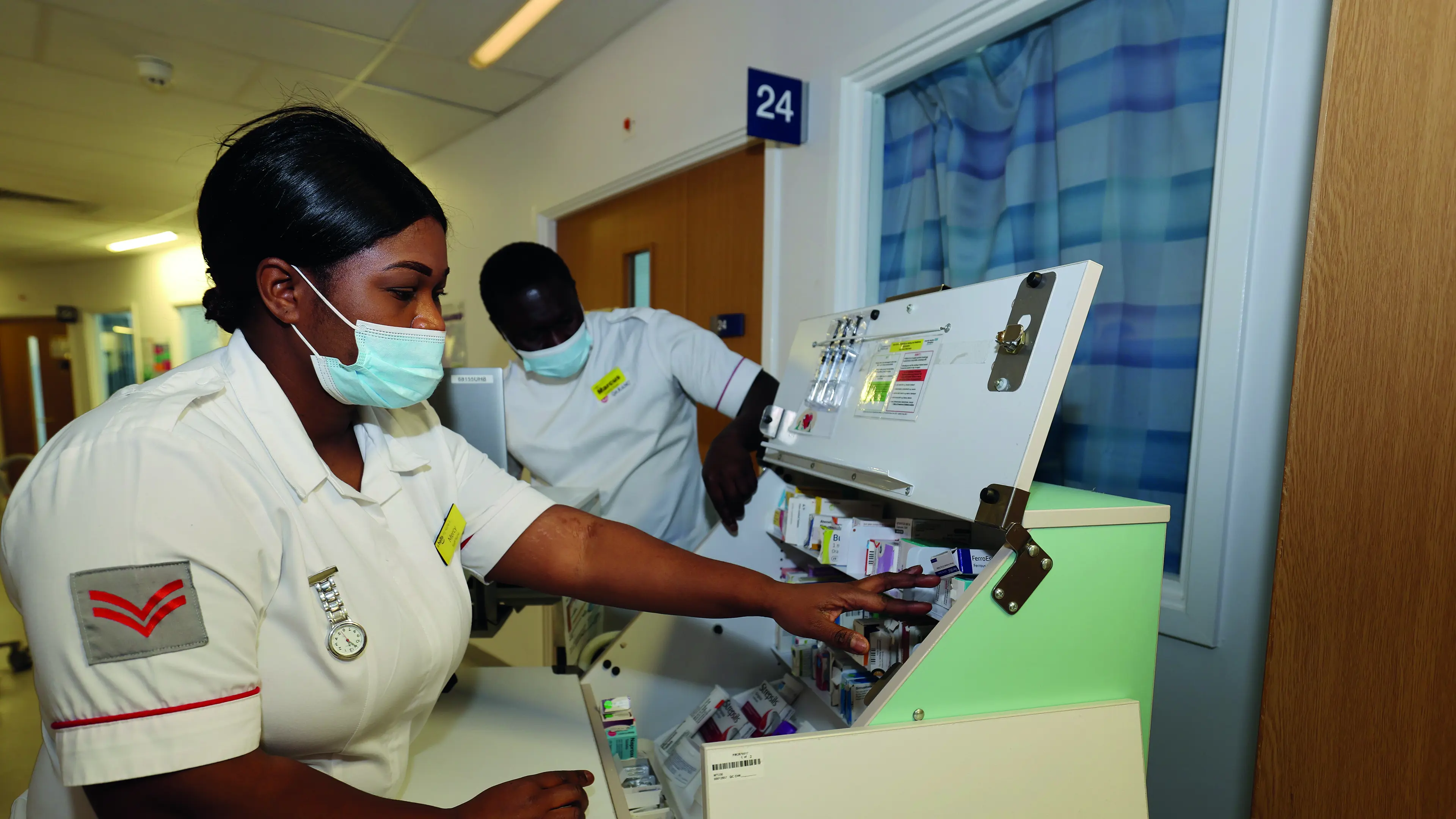
Sgt Anna McMahon
Takeover days help put in place the practices that will serve them well in the field, as trauma and orthopaedic specialist nurse Sgt Anna McMahon (RAMS, pictured) discovered on a military hospital exercise two years ago.
“Basically, we did everything we do here, just in tents – it was fantastic,” she explains.
“On a deployment you only have yourselves to rely on – there are no civvies – so today is brilliant.
“We do it every two months or so, and it really helps us understand how we would work in the field and builds a rapport between us.
“There are road traffic collisions, stabbings and gunshot wounds from local gangs and those experiences are transferable to the deployed environment.”
Sgt McMahon worked as a civilian nurse before joining the British Army after visiting a careers fair. And it is a decision she has not regretted.
“I have a personality where I always have to be challenged and that is what the Service gives me – I’m constantly doing things I never thought I would,” she continues.
“Trauma and orthopaedics is brilliant from that perspective. There are only three specialist trauma nurses in the Army, and it has been a great fit for me.”
But this is not the only ward covered on takeover days. Acute care, burns and plastics, as well as sections of the intensive therapy unit, all fall on the rotation, meaning the RCDM contingent spread skills far and wide.
And it is an arrangement that benefits parties on all fronts.
“It allows us to keep on top of our clinical skills, so we are current and competent for deployment,” Maj Davies concludes.
“NHS patients love it, and they feel like they are getting a great standard of care, while we are contributing to wider society.”
