
There are a few surprises in store for any soldier leaping into Japan’s unknown…
It was unfamiliar territory 6,000 miles from home alongside troops from a different culture. But this type of action has always been core business for the 16 Air Assault Brigade Combat Team.
From keeping the peace in a volatile Kosovo to the harrowing evacuation of Kabul four years ago, this formation has a proven reputation for rapid deployment on complex ops.
And a recent training outing to the unfamiliar highlands of Japan for 3rd Battalion, The Parachute Regiment again showed their mettle.
It is only the third time British troops have taken part in Exercise Vigilant Isles, and the participating personnel from B Company showed why their brigade is earmarked as the Army’s global response force, held at high readiness for deployment anywhere.
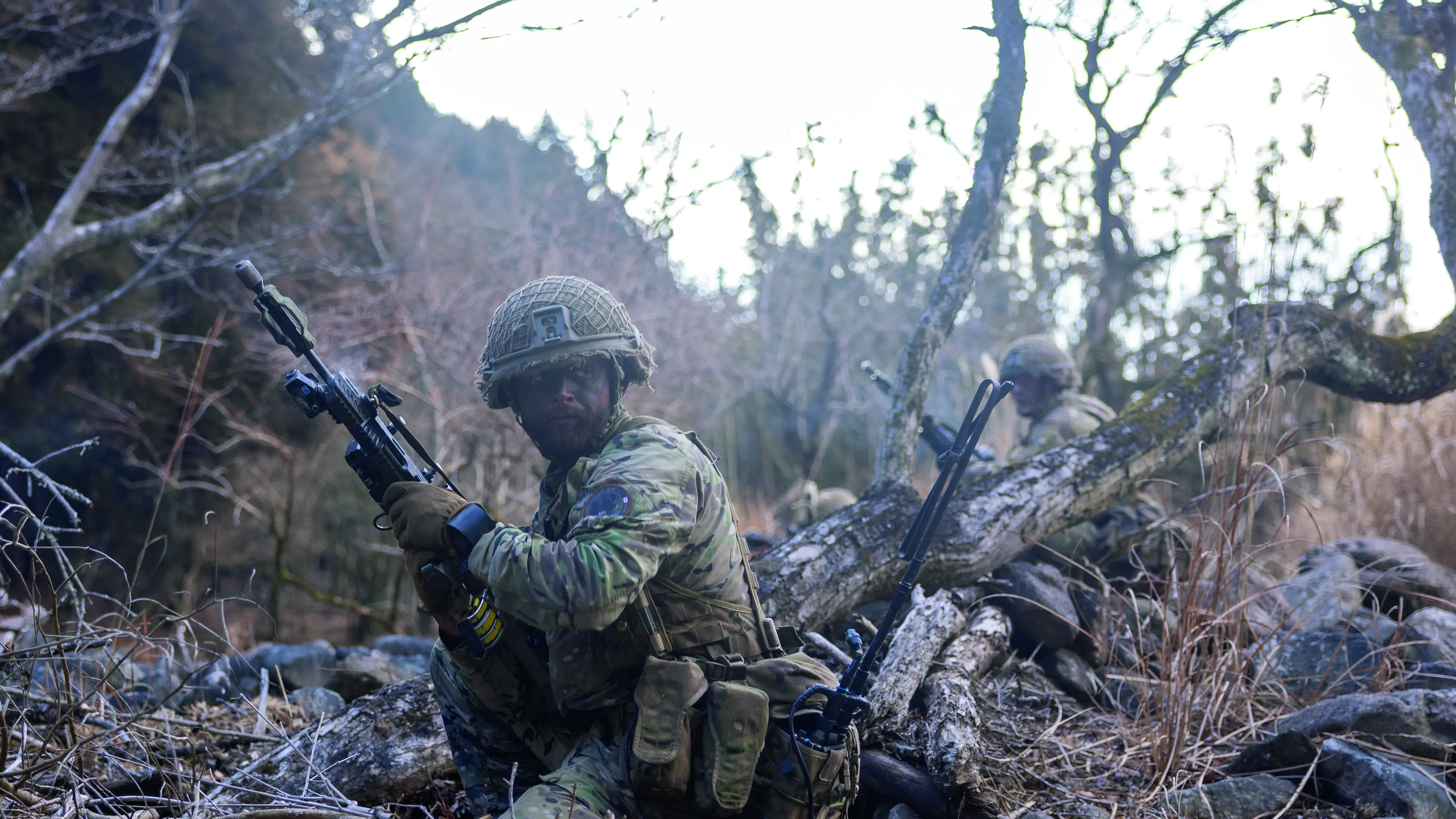
Fighting across the Hijyudai training area — known for its steep inclines and thick grasslands — on the island of Kyushu south-west of Tokyo, the soldiers worked with Japanese airborne and infantry counterparts in a rigorous test of skills.
“This place is honestly one of the most alien environments I’ve ever seen,” reveals Maj Iain Thompson, commander of the company-strength British contingent. “It’s a bit like Otterburn on steroids.
“As well as being geographically demanding, it’s one of the coldest places I’ve been for a while.
“People tend to think of Japan as a tropical paradise but we have seen temperatures of 14 or 15 degrees in the day, falling to minus ten with windchill at night.
“But the exercise has clearly made an impression because the soldiers out here are saying it’s the best thing they’ve ever done, which is great to hear.”
Troops began their two-week tenure by rehearsing low-level skills and drills as well as live-firing on the ranges.
There was also a command post exercise before the package ramped up to a full-on mock battle.
Focused on a scenario that involved re-taking territory from an invading power, the serials saw counterparts from the 1st Airborne Brigade of the Japanese Ground Self Defence Forces parachute in.
With landing areas secured, the Paras deployed by Chinook and Blackhawk helicopters, starting three days of simulated combat in which they also worked alongside seasoned infanteers from the Japanese 12th Brigade.
British specialists played a critical role throughout, using intelligence, surveillance, target acquisition, and reconnaissance systems to assist with mission planning and deliver results.
Notably, electronic warfare teams from 14 Signal Regiment tracked the enemy by monitoring their comms while gunners from 32 Regiment, Royal Artillery kept a close watch from the skies with Puma unmanned aerial systems.
Working with the host nation’s forces proved a particular highlight, with the armies learning a huge amount from each other, Maj Thompson adds.
“Soldier-wise, the Japanese are nails,” he continues. “They are physically tough and professionally adept at dealing with harsh conditions — while they do things differently to us, notably in terms of their command and control protocols, it doesn’t make them any less effective.”
Maj Thompson points out that the Japanese constitution — stemming from the Second World War — means their personnel have their own specific operating codes.
And this makes working with them quite different from NATO nations.
“It wasn’t like being with the Americans where you could fully integrate with their force as a company,” he explains. “But we had a valuable learning experience — in their downtime the soldiers have socialised too and got along well.
“This is only the third time the British have been involved in Exercise Vigilant Isles — it’s been worth it as both forces have a similar mindset and this in itself creates a natural partnership.”
The results speak for themselves.
With the Paras on a high from the opportunity to work in Japan, and closer defence ties between the UK and the Asian state on the cards, Vigilant Isles is poised to go from strength to strength.
Building relationships is vital in an unpredictable world, where new threats are continuing to evolve and flashpoints can quickly erupt.
In standing and working together, trouble is more likely to be headed off before it escalates into a full-blown conflict.
