
The number of people who go to church – and who identify as being Christian – has been in decline across the UK for as long as most of us can remember.
You only need to observe the rows of empty pews during most Sunday morning church services to know that.
But things are changing.
Described as a “quiet revival” by the church press, various data confirms that more young people are turning to Christianity.
And it is something the man in charge of army padres, Chaplain General Rev Canon Michael Parker, says is also starting to happen behind the wire – particularly at initial training establishments.
“We are certainly starting to see an uptick,” the senior clergyman tells this magazine.
“And gen z – often generalised as sceptical and transactional – are using more spiritual language in the way they talk about the world.
“They are using language the previous generation may have shied away from.”
He reflects: “I don’t know if we are just seeing this trend because we are looking for it – sometimes you only notice things when you’re looking for them.
“But if we think about where our newest soldiers are – Harrogate, for example – then yes, we are seeing a small increase. We are also seeing it at Pirbright and in Sandhurst.”
So what are the reasons for this? The chaplain general has a few theories.
“Is it something to come out of Covid?,” he ponders. “The Covid generation were impacted so much by isolation – are they looking for a new way to connect? Maybe that’s what’s going on.
“Or might it just be that here is a group of people who do not share the cynicism of those who have gone before.
“It could be that, as a cohort, they are fed up of being pigeonholed with the hangups of a previous generation. So is this a counter-cultural expression?
“Maybe if previous generations have been saying that religion has no place in society, they are saying ‘hang on, we will decide that for ourselves’.”
So what could it mean for soldiering on modern operations, to have more practising Christians? Especially at a time when the service is trying to increase diversity in the ranks.
“I see this as a good thing,” Rev Parker continues.
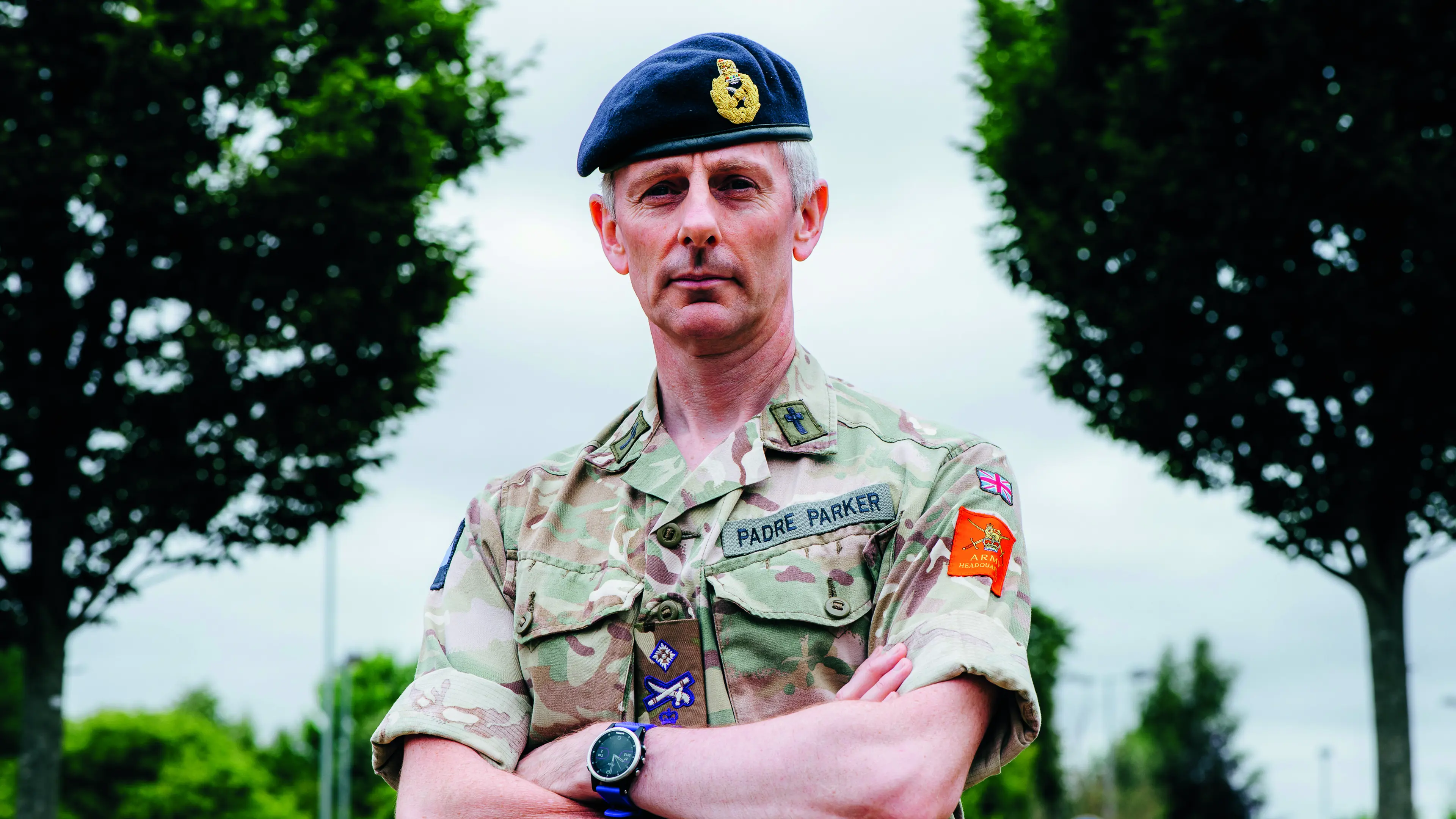
Chaplain General Rev Canon Michael Parker
“There’s long been a Western liberal tradition that is very dismissive of religion. But religion is so widely followed around the globe, that’s actually a minority approach.
“Soldiers are global citizens. And in the places we operate around the world, we encounter people whose religious identity is inseparable from their national identity.
“Having personnel who understand that, even if they don’t agree, is a good thing.
“I also think it’s good that our young people are exploring and looking for meaning.
“If you are interested in what is happening in the world, you will have a more informed connection with that world.”
Could the political turmoil across the globe be another reason younger British soldiers are turning to God – perhaps they sense difficult times ahead?
“I don’t know if young people feel the world to be a more dangerous place,” Rev Parker responds.
“But they might be looking at Ukraine, Gaza and asking themselves what it might mean to be a soldier in that moment.
“What’s your role in that?
“And you cannot talk about readiness without thinking about the moral component.
“That needs as much thought as the physical and conceptual components of war.
“How are we growing moral and ethical resilience in our young people, so that when they are asked to make difficult choices, they make ones they can live with?
“The job of chaplains is not to answer that – but to ask that question in a way leaders can think about.”
The current Land Training System – some of which is detailed on page 30 – includes serials that require chaplaincy interaction.
On the recent Exercise Rhino Heart, for example, where the army’s only fully reservist brigade rehearsed deploying across Europe, chaplains were tasked with talking to medics about the treatment of dead bodies in accordance with different faiths.
An unsettling thought, but a vital role for the service’s spiritual leaders in addition to the real-world welfare support they offer deployed reservists and help for those facing moral quandaries.
“We are one of the resources leaders can draw on to make decisions,” Rev Parker says. “Not because we have some sort of moral fairy dust, but because we look at things through a different lens.”
Whether religious or not – Christian or not – the chaplain general is clear the army’s band of padres continue to exist for all service personnel.
“They are there to care,” he says. “And that care can be whatever you need it to be; and it can be unequivocally confidential.
“It is really important to me that soldiers know that.”
