
It is impossible to appreciate the array of solid objects on an airfield until you are skimming the surface of a runway and watching assorted obstacles zip past.
There are the spikes of aerials poking up into the sky, engineering vehicles and runway control points, to single out a few. Adding to my dramas, there’s also the buzz of groundfire I’m starting to attract – the world is getting hectic.
“It’s a bonus if you manage to extract your drone from the Iso container at the start line,” one of the soldiers watching this PC-based exercise serial had joked. But to his astonishment, I managed to squeeze out.
The first-person view UAV under my control is now gaining height, the panorama of an enemy base appearing. Dodging around another radio mast, our targets are in sight – Cold War-era TU-95 bombers parked at dispersal points.
The monitor flickers irritatingly, maybe interference from the incoming small arms fire. But I am undeterred; I’ve picked out an aircraft and direct the controls accordingly, throttling up and slashing down on a collision course.
There is a burst of enemy tracer, but the gunner is ridiculously over-optimistic. The drone is now hurtling towards the bomber at about 80 knots. It takes two or three seconds before the device makes contact.
While it is not carrying a huge explosive payload, a strike between two of the aircraft’s four dual-propeller engines – and the fuel lines leading to them – will easily do the job. The monitor goes to static before another camera shows the target ablaze.
It might be a simulation, but this game is based on reality.
Launched by Ukrainians against five air bases in Russia during the summer, Operation Spiderweb saw 117 explosive-laden UAVs despatched from trucks slam into Vladimir Putin’s strategic bomber force as it sat on the ground – with ten platforms claimed destroyed.
As David killed Goliath with a slingshot stone, hundreds of millions of pounds of aviation hardware were smashed by machines sounding like mopeds, with a price tag of a few hundred quid each and flown by pilots miles away.
It was a strike concept that would have been unthinkable even a few years ago, and a massive humiliation for the Kremlin leadership.
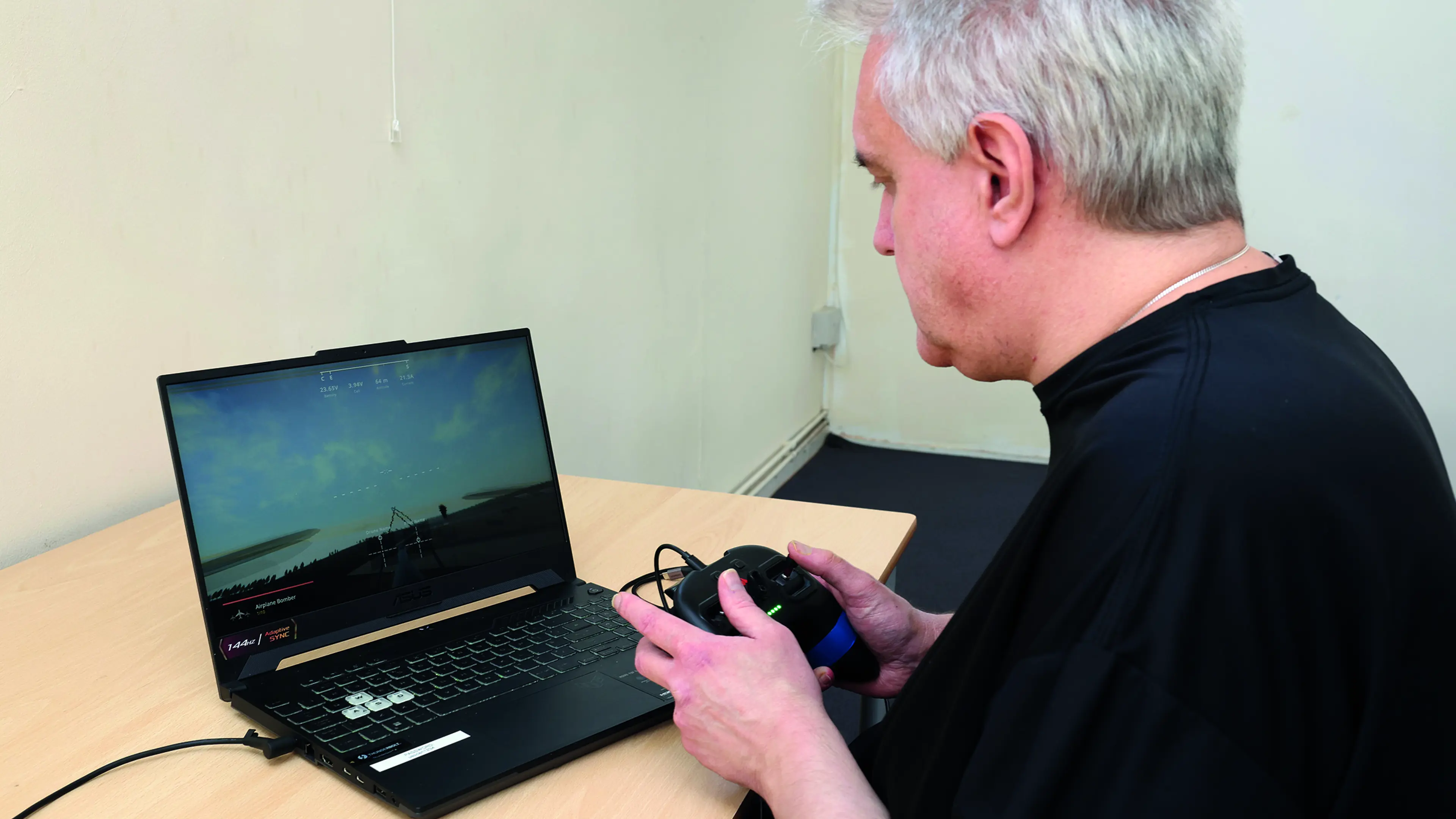
Cliff flying his 'mission'
The first-person view, one-way effect drone – a sacrificial UAV that is manually guided onto its target by an operator – has proved a nightmarish game-changer in modern warfare.
With the ability to prowl the battlespace with a lethal payload, it can wreak havoc on positions while operators work well beyond sight.
And for both better or worse, my experience on the PC suggests the kit is reasonably tactile to control. In fact, I had never flown an FPV drone, either simulated or real, until I arrived at the Unmanned Aerial Systems Centre in Lulworth earlier today.
My ability is entirely rooted in years of video-gaming using the standard dual-thumbstick controller. While chunkier, the drone handset behaves in the same way and, by this reckoning, there must be thousands of people out there who have the basic one-way effect skills to destroy enemy hardware. Army recruiters take note – gaming geeks are the way to go.
“This type of flying is all about honing fine motor skills rather than heavy movements,” the facility’s OC Maj Andy Crompton explains to Soldier.
“It’s a matter of individual preference but we tend to recommend holding each stick with a finger and thumb – slightly different to how you would use a PlayStation or Xbox controller – so you can have that level of accuracy.
“Operators also wear goggles that show the view from the UAV so they are not distracted by anything else in the world around them, which can take some getting used to.”
Maj Crompton adds that fine tuning is critical when, for example, a pilot is required to take their machine through a window into a building. It’s not a situation I’d thought of, although the prospect of sneaking my drone into an office meeting through the curtains – like an errant wasp – does have a certain mischievous appeal.
Back to reality, however, where it seems that learning to fly is just the tip of the iceberg where drone deployments are concerned. Fighting an effective guided bomb in a coordinated way is a complex business – and the reason why the UAS Centre was set up last year.
Aimed at showing infanteers, recce professionals and other sharp-end troops how to work these assets in the battlespace, the training on offer equips personnel with the skills and tactics they need to find and identify targets before following that up with strikes.
There is also a keen emphasis on pushing knowledge out to the wider army as quickly as possible. There are courses lasting between a week and a month for pilots and commanders; the latter qualification gives bosses a tick in the box to go back to units and conduct their own drone pilot training.
The importance of the work is certainly not lost on Maj Crompton and his 12-strong team. Operation Spiderweb might have been an exceptional action carried out at extreme range, but the war in Ukraine has seen the FPV drone become a regular feature in contacts – and the threat they present is continuing to evolve as the war enters its fourth year. The Lulworth training syllabus incorporates lessons from that conflict while fitting in with British Army protocols.
The one-way effect operating model is based around a group of personnel: a commander and three or four operators responsible for intelligence, surveillance and reconnaissance and working the business end of the attack drones. The courses feature both digital serials and hands-on time with equipment – and students are expected to have 30 hours of PC simulation time already logged before they turn up.
“In short, the call signs must learn to work as a team to identify targets and strike them,” says Cpl Fergus Williams-Tanton (RL), one of the instructors at the centre.
“Then it’s about building up to working with multiple call signs against multiple targets.
“While there is a lot of simulation involved, we also have an indoor course using a small drone called the Mini Whoop. Outdoors we use the larger DP8 and D10 FPV equipment built by a company called Viking Arms, with which crews learn how the kit handles with a payload and will strike at mock targets.”
While Civil Aviation Authority regs in the UK place restrictions on how far apart drone and operator can work, personnel can expect to use the kit beyond their visual range as they hone their lethal trade across exercise areas.
The concept of the centre – to act as a hub to create soldiers who will train others in the one-way effect skills – is already bearing fruit, with newly qualified commanders now cascading knowledge back through the ranks.
Recently, troops from 2nd Battalion, The Parachute Regiment’s UAS Platoon delivered a three-week workshop for operators across 1st (UK) Division at Bramley Ranges in Hampshire (see panel).
As a new crew cohort was brought online, many units are reorganising to bring FPV assets into the fold, adapting platoons to operate them as part of the support weapon mix or configuring them to assist with recce outings.
The rapid proliferation of these assets is a thought that resonates powerfully with Soldier as we hit the simulator again.
This time, we are above a more familiar countryside vista with a patchwork of fields and tasked with locating the enemy.
Tweaking the pitch, it is not long before we are thinking about how we might find some targets of opportunity. Following the road below will inevitably lead to traffic – maybe a military convoy?
And beyond the hedgerows of the near-distance there is something moving – it looks as if there could be tell-tale signs of a trench system. What about the group of buildings up ahead? Is there anything in there?
I’ve only been working with drones for a morning, but I would be lying if I said the job isn’t exciting.
Cpl Williams-Tanton shares the enthusiasm – the challenge of countering the hostile drone as well as taking the battle to the enemy is a test he relishes.
“The whole area of the UAS is about developing new skill sets that will increase our lethality as an army,” he adds. “We are right at the forefront of this capability; it is definitely something that has given me a new purpose. It drives me.”
Exactly where all this will lead is hard to predict; the potential crosses my mind briefly as I sit twiddling my thumbs.
This new battlespace, a sky full of odd machines, feels somewhat akin to the early days of air combat in the First World War, where pilots started using aeroplanes for reconnaissance, then shot at each other with pistols and dropped bombs by hand.
Within 50 years, their contemporaries were operating well beyond the speed of sound at the edge of space, downing each other with projectiles guided by radio waves and thermal signatures that were unstoppable without new countermeasures; some had weapons that could obliterate cities at a stroke.
I reach for the ‘off’ button on the monitor…
