
It's about changing mindset and building mental resilience – it’s no longer good enough to treat a casualty and then wait for an evacuation,” WO2 Levi Scarlett explains.
The squadron sergeant major of 23 Squadron, 16 Medical Regiment is hosting Soldier on Exercise Brave Cyclone – a ten-day test in which the sub-unit is supporting a notional battlegroup embroiled in a front-line screen against an invading, peer-on-peer enemy.
The scenario is an all-too familiar one for personnel deploying on contemporary exercises, and lessons from Ukraine are very much in mind as these soldiers dig in amid the heavy rain that is lashing down on Norfolk’s Stanford Training Area.
Delivering care is the prime focus, but thoughts of minimising thermal signatures, camouflaging vehicles, sharpening field skills and reducing footprint are more important as survivability is key.
Experimentation is also in the air, with an unmanned ground vehicle transporting casualties from the battle to treatment facilities and drones performing recce roles and assessing the soldiers’ powers of concealment.
As a squadron validation exercise, this has come at an important time.
The troops deploy to Kenya in the new year in support of 1st Battalion, The Royal Gurkha Rifles before taking over as air manoeuvre medical group one – a core component of the 16 Air Assault Brigade Combat Team.
“We will be at five days’ readiness to respond,” says 23 Sqn OC Maj Suzy Talbot.
“In recent times that has been hurricane and earthquake relief but what we are now trying to bear in mind is that, given the current threat, we could be part of an advance force.
“So this is about how we deliver the same level of healthcare and showing we can operate in a tactical situation.
“The threat can be anywhere, and it is all the time. We are learning the importance of not being seen and not being found.
“A lot of our equipment requires charging. We need power generators, but they obviously create a heat signature. We come with big vehicles – you cannot have a hospital without at least one of those – and we are required to move patients.
“All of our work makes us vulnerable, so there is a lot to think about, but our soldiers have been really good at understanding the threat.”
Innovative approach
23 Sqn deployed with everything from a role one facility delivering care at the point of injury through to a surgical capability and are facing serials including mass casualties from an ambush, road traffic collisions and drone strikes on an NGO camp.
And trialling how to implement the likes of UGVs and drones – as well as novel ways of delivering care – is at the fore.
Maj Talbot continues: “We are keen to innovate.
“In Ukraine, personnel cannot move in daylight – they must wait for the transition to night and when drones are unable to fly.
“If we really need to move a patient, we must think of a way that poses the least risk. A UGV with a single body onboard is unlikely to draw much attention.
“We have also been able to fly drones to test our counter-UAS TTPs and are working out how they can best be delivered in a medical regiment and who we use as pilots.”
Reflections from the front
At the role one facility, personnel are busily working on concealing their presence having just moved north from their previous location.
Moments later a UGV arrives with a casualty, and they spring into action.
With the situation under control, Lt Erin McLernon, troop commander of Role One Troop, says the change in approach is giving her soldiers plenty to think about.
Blast injuries, rather than small arms fire and gunshot wounds, are more prevalent, while communications is blending old with new via field phones and Atak data terminals.
“It has been quite difficult going from a clinical to a more tactical focus,” she continues.
“Comms has been the biggest test; it is about reducing signatures but still being able to reach back and contact the medical reception station and role two facility. Fortunately, we have established good lines between all three.
“We also faced a mass casualty scenario, where the combat medical technicians came across nine casualties. They had to quickly assess them on the ground while also considering how dangerous the situation was, where the threat is coming from and how it will impact them.
“The transition has been challenging, but we are adapting well.”
Nurse Cpl Abby Hinselwood is on her first exercise with 16 Med Regt having previously been posted at Frimley Park Hospital with Joint Hospital Group South East.
“It is very different to a ward,” she says. “You have to think about resupply, and if a patient is really poorly how many resources you use. There is a lot to consider.
“It makes you appreciate the NHS environment. There, if you miss a cannula it doesn’t matter, you just get another. Here, you are limited with things like fluids and oxygen.”
Combat medical technician Pte Fran Vickery is another relative newcomer to the unit, having joined in April, and is relishing the field test.
“Compared to basic and medical training, this is a lot more forward thinking with a warfighting mentality,” the 32-year-old explains.
“It comes down to the little things.
“On stag you are normally looking left and right, but you now look up as well. And in your bashers, you are constantly on the lookout and listening for different noises.
“It is also about how we can get to casualties quicker. Instead of going full steam ahead we must think about ourselves as well – if we get injured, we’re useless.
“Every couple of days we are packing up and moving to a different location; it is us having that soldier way of thinking, rather than being a standard medic.”
Medics on the move
In a further sign of innovation, doctor Capt Tom Vincent is delivering primary care as part of a pre-hospital treatment team.
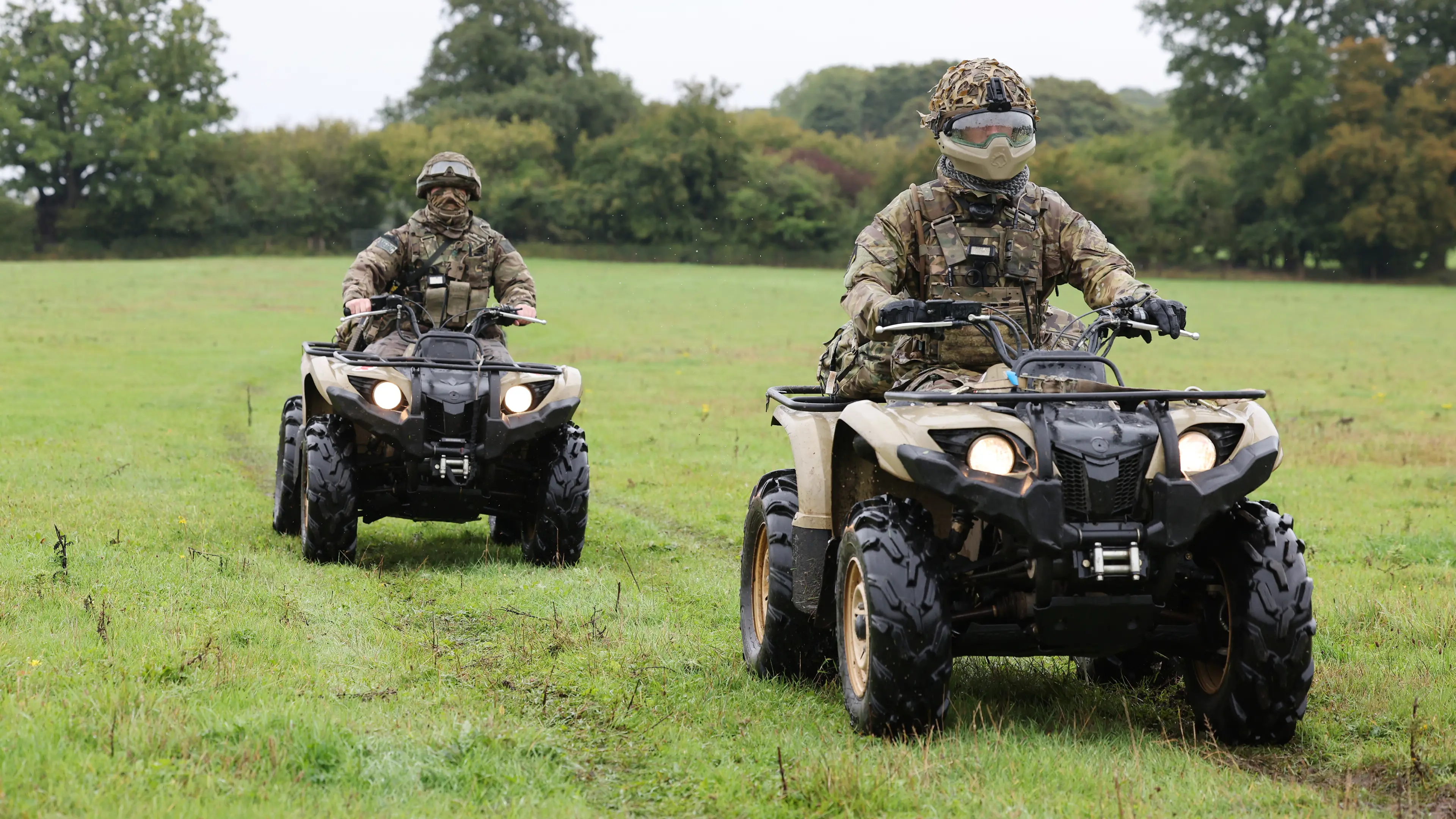
Medics on the move
A novel concept, it sees a doctor, nurse and medics punching out on quad bikes to administer care on the ground and then transfer patients for further treatment if required.
“We are still experimenting with the idea, but it allows us to be more mobile,” he explains.
“Obviously, our footprint is quite big, and this is a way of trying to shrink that.
“The biggest challenge comes in scaling down the equipment and figuring out what you might need and what you can get rid of.
“As a military doctor you must think on the fly, using the kit that is available and improvising where you can. You are not going to have access to everything you would in the NHS, so it is about getting as close to that as possible.
“But the quad bikes allow us to achieve a high turnover of patients and move casualties around.
“If we are identified as a medical facility that puts a huge bullseye on us – we are targets now.”
Another new capability on show is the ground Medical Emergency Response Team (Mert). Combining doctors, paramedics and nurses, they bring advanced pre-hospital care further forward and, most importantly, administer blood products.
This is their first time on exercise alongside a role one capability, with a focus on trialling what works best and how they could be used in future.
“Historically, Chinooks have been used for air Merts,” explains paramedic Cpl Melissa Duff.
“But airframes cannot be used in current warfighting. The ground Mert has a similar scope.
“The fact we are quite mobile puts us at risk and we have to think about when to do any road moves. It is about digging in and living under ponchos and cam nets. But we have a good background in green soldiering, and that is coming across here.”
Station switch
Usually one massed tent complex featuring dental care, mental health, physiotherapy, primary healthcare and pre-hospital emergency care, the medical reception station is assuming a new look on Ex Brave Cyclone.
Here, it is broken down into separate teams and spread across the area to make smaller targets and reduce heat signatures.
Previously taking around three hours to set up, the trial shows it can be completed in 45 minutes.
And personnel such as dentists and mental health professionals have been upskilled as drone operators, with the thinking that their primary roles will not be required in mass casualty scenarios.
So, in future, their secondary talents could be used to send blood from emergency donors forward by drones.
One of the newly qualified operators is Sgt Daniel Bond, but it is his skills in the day job that are being utilised in a new way.
Operating out of a Land Rover, he is deployed as a forward mounted radiographer capable of delivering x-rays in the field.
“It is the first time we have trialled this,” he comments. “Traditionally, x-rays are done in a role two facility, but this allows us to push forward and assess patients for relatively minor injuries. We need to get people back in the fight quicker.
“The first time I tried it took ten minutes to get the kit set up, do the x-ray, pack up and leave. I used a poncho on the side of the Land Rover with a couple of poles and did it there.
“The second time, in a more lifelike scenario, it took 16 minutes. You do not want to be hanging around for long.
“As radiographers we are super keen to develop this. We have been stuck at the barracks not doing a lot, so we are hoping the concept works.”
Once the exercise is complete, thoughts will turn to next year’s African assignment and what lies further ahead.
But 23 Sqn are proving their ability to adapt to the changing nature of conflict and will be fully prepared for their next challenge, wherever that may be.
