
The army is making an error in how it posts combat medical technicians (CMTs) into The Ranger Regiment.
They are exempted from the the unit’s own selection and training pipeline.
They post in as they would for any other army position, do not wear the Ranger tab, and then go on all the same deployments.
How can this be justified? An urgent need to get the units up and running is an excuse that only lasts for so many years.
It is corrosive for morale and those who haven’t completed the selection (they can volunteer for it) must surely be self conscious about it.
The medics are organic to each Ranger team and are the single most important cog in the ‘go or no-go’ process for exercises and operations.
Enhanced med cover is essential for operating at reach and at risk.
If it’s dangerous and difficult for the Rangers it will be for combat medics, too.
If the Royal Army Medical Service cannot supply enough suitable personnel they should allow Rangers to do CMT training.
This isn’t without precedent – many readers will remember regimental CMTs who were volunteers from battalions who attended specialist training and were employed as medics. – Name and address supplied
Brig Huw Thomas, Assistant Chief of Staff Medical, Field Army, replies: All Ranger medics are strongly encouraged to complete the Ranger qualification course (RQC).
We have created a unique, capable and Nato-accredited training pathway for our CMTs.
They attend the four-week Ranger medic qualification course on arrival at unit (held once a year).
This combines advanced medical training on pre-hospital trauma, prolonged and in-transit casualty care, telemedicine and advanced treatment, procedural and medication capability over and above their CMT training.
It also encompasses some physical elements from initial Ranger selection to ensure they’re at a minimum physical standard to work in the regiment’s teams.
Passing this qualifies them as ‘Ranger medics’ and ensures they are medically trained to Nato special operations forces (SOF) standards.
If these personnel also pass the RQC they are qualified as Nato special operations combat medics (NSOCMs), ensuring they are medically and tactically trained to Nato SOF standards.
This means we have a blend of CMTs, Ranger medics and NSOCMs providing medical cover for this unit.
On behalf of all members of T Battery, 12 Regiment, Royal Artillery I would like to extend our heartfelt thanks for the incredible care packages sent to us by the volunteers of the Wormhout Community Hub, Llandudno during our recent deployment in the Middle East.
Their thoughtfulness and kindness touched every one of us deeply.
We were especially moved to learn about Operation Welly, created in loving memory of LBdr Llywelyn Evans (RA), who tragically lost his life during the Iraq War in 2003.
To know that his family and friends continue to honour him by sending ‘Welly boxes’ to deployed personnel speaks volumes about the enduring spirit and support from home.
Although modestly described as small gifts, their impact was anything but small.
When I briefed the soldiers and explained who had sent them and why, their faces lit up with real joy.
The fact that they took the time and care to reach out to us, across the miles, is something we will never forget. – WO2 Mark Wright, RA
I found the article in last month’s edition on assault courses very illuminating.
I have three vivid memories of them from my time in the army.
In 1987 I did my reserve basic training at the Queen’s Division Depot in Bassingbourn. I went through the dry course, including the tall climbing
frame (and what a view from
the top!).
After passing out I went to see the film Full Metal Jacket and to my astonishment there was the same assault course.
The movie’s training scenes at ‘Marine Corps Recruit Depot Parris Island, South Carolina’ were in fact filmed at Bassingbourn Barracks.
I was told the assault course was built by the film company and the army liked it
so much it stayed, but I’m not sure if that is true.
A couple of years later, at my junior NCO cadre, we were ordered to parade in our passing-out dress, boots bulled thoroughly, everything else ironed to perfection. The staff then ordered us to undertake
the wet assault course – we were not happy bunnies.
Later, we were at Pirbright as part of a weekend competition and undertook the assault course with our full kit.
We were over the water pit when my mate’s self-loading rifle broke open and the working parts fell in.
He was told by the senior NCO to go in and retrieve them. It was so cold he had to break through the ice to get all the parts back!
There are many more experiences but I survived and now recount them with a smile. – Ian Lofting, ex-PWRR
When I enquired about the requirements to transfer into the Adjutant General’s Corps Educational and Training Services (AGC (ETS)) reserves, I was informed I had to hold a postgraduate certificate in education.
This is used to allow the holder to teach in secondary education.
But why is this a requirement of policy when to teach the post-16 age group you need a completely different qualification, which is far easier to attain?
Nobody I have asked has been able to answer this question.
For context, I work in a secondary school supervising classes and hold no teaching qualifications. – Name and address supplied
Lt Col Chris Prior, Army Personnel Directorate, replies: ETS officers are responsible for setting education policy and developing, delivering and assuring education, training and instructor and intellectual development.
The vast majority of ETS personnel, both regular and reserve, begin this journey as learning development officers in Army Education Centres, where they provide education, professional development opportunities and instructor capability.
In doing this, they undertake the full remit of teaching responsibilities and that’s why regular ETS officers undertake the post-compulsory education and training course on commissioning if they have not already done so.
This is a well-established and internationally recognised qualification that equips our people to teach in the further, adult and vocational education sectors with its solid foundation of teaching practices, educational research and theory.
Like many other parts of the army, the ETS is considering the potential effects of the Reserves Executive Committee’s decision to break reserve training equivalence in terms of the trade-specific professional development that we require our reservist ETS officers to complete.
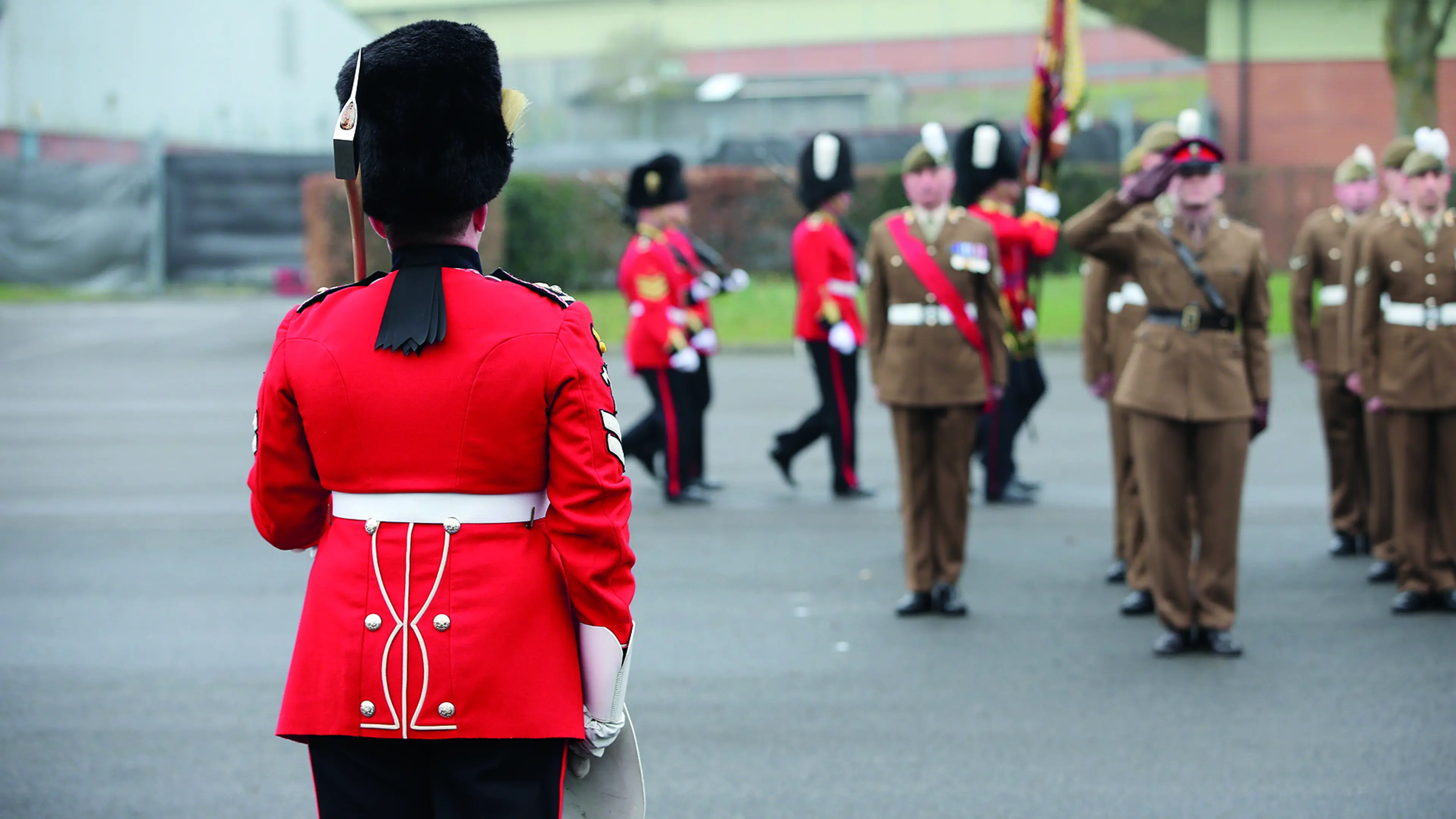
There is, or was, a regiment in the army whose troops wore a small black cloth on the neck and back of their uniform jacket. Can you please identify this unit and the reason behind the unusual garb being worn? – Peter Townsend, Honiton
Capt Harry Merriman, Regimental Adjutant, The Royal Welsh, replies: The black flash is a part of the uniform of The Royal Welsh that is shared with no other army unit.
It dates back to the early 18th century when soldiers wore their hair in a braid, known as a queue, which was held in a bag to avoid grease soiling the back of the uniform coat.
The wearing of the queue was abolished by 1808, yet The Royal Welch Fusiliers ignored the order to remove the five black ribbons from their collars.
Being stationed in Nova Scotia at the time, little notice was taken but on returning to England in 1834 an inspecting general directed that the ribbons be removed.
An appeal was made by the regiment to the King and in the same year they were granted the right to sport ‘The Flash’ as a regimental distinction. They have worn it ever since.
