
A growing number of troops say yes. But there are obstacles… and change may need to start with lower ranks.
To civvies, they are the definition of army life and the military mindset.
Obstacle courses – or assault courses, to give them the military name – require stamina, teamwork and the ability to face your fears head-on.
But glance around the defence estate and you may find this training tool surprisingly absent in 2025. And while all five of the service’s initial training establishments have courses they regularly deploy, the picture gets a little muddier thereafter.
Once recruits arrive at trade training – generally the only other time they are guaranteed to encounter the assault course – they are currently more likely to find the facility marked “out of bounds” and awaiting maintenance than they are functioning.
And at the time of going to press, one quarter of the defence estate’s 28 courses were not bookable, according to the Defence Infrastructure Organisation (DIO). Human performance expert Capt Matt Connelly (RAPTC) says the situation needs to change.
At the forefront of the army’s mission to increase lethality – in his case by overseeing dismounted close combat survivability training – the late-entry officer says he and his colleagues have been saddened to see the demise of this kind of activity over the last two decades.
“If you asked me for the one form of training that gives you the best bang for your buck, I would say assault courses every time,” he tells Soldier.
“It’s the stuff that it trains – balance, coordination, speed and agility. But also aggression and determination. “When you need to get people over a 12ft wall, that requires aggression. You need to attack your objective and work as a team to do it.
“But you can do an assault course with just two people and they don’t require a lot of space to build.” Decay The fitness expert continues: “As assault courses have been lost over the years, nothing has replaced them. “So a lot of the OCs today have never known things to be any other way.
“But when I was younger we did assault courses all the time, tabbed all the time, ran all the time. “The reality is that young people joining the army today still expect to be doing this sort of thing. “You go into basic training and get exposed to it quite a bit, but it stops soon afterwards.
“Then you lose the skill of being able to assault an obstacle altogether.”
In part, the serviceman blames a vicious cycle of dilapidated courses, units therefore not having the option to train on them, but the resulting drop in demand meaning that repair of the equipment becomes deprioritised by the DIO and any others who are responsible for its maintenance.
However, the officer says the army’s shift in mindset around physical training – namely a more clinical approach to exercise with heavy focus on reps, gym time and data above getting messy outside – may also have resulted in a loss of interest from some units.
“In a gym you are not getting wet or cold,” he says. "Being a soldier is about getting down and dirty. It’s important troops hone these green battlefield skills and experience on PT what they’re going to experience on ops.
“The assault course is exactly the kind of training we need to bring back at a time of wartime readiness – doing things that soldiers actually do.”
Real life Their use might go way back in time, but Capt Connelly says assault courses could not be more relevant to the modern battlefield and the conditions Ukrainian soldiers are currently experiencing on the front line.
“Let’s say you come under contact in battle,” the officer adds. “The first thing you need to do is get under cover. But to do that you must move your body, perhaps with tree roots underfoot and with your stress heightened and blood pumping. If your coordination and balance isn’t there in that situation, and you stumble or don’t get down quick enough, it could cost you your life.”
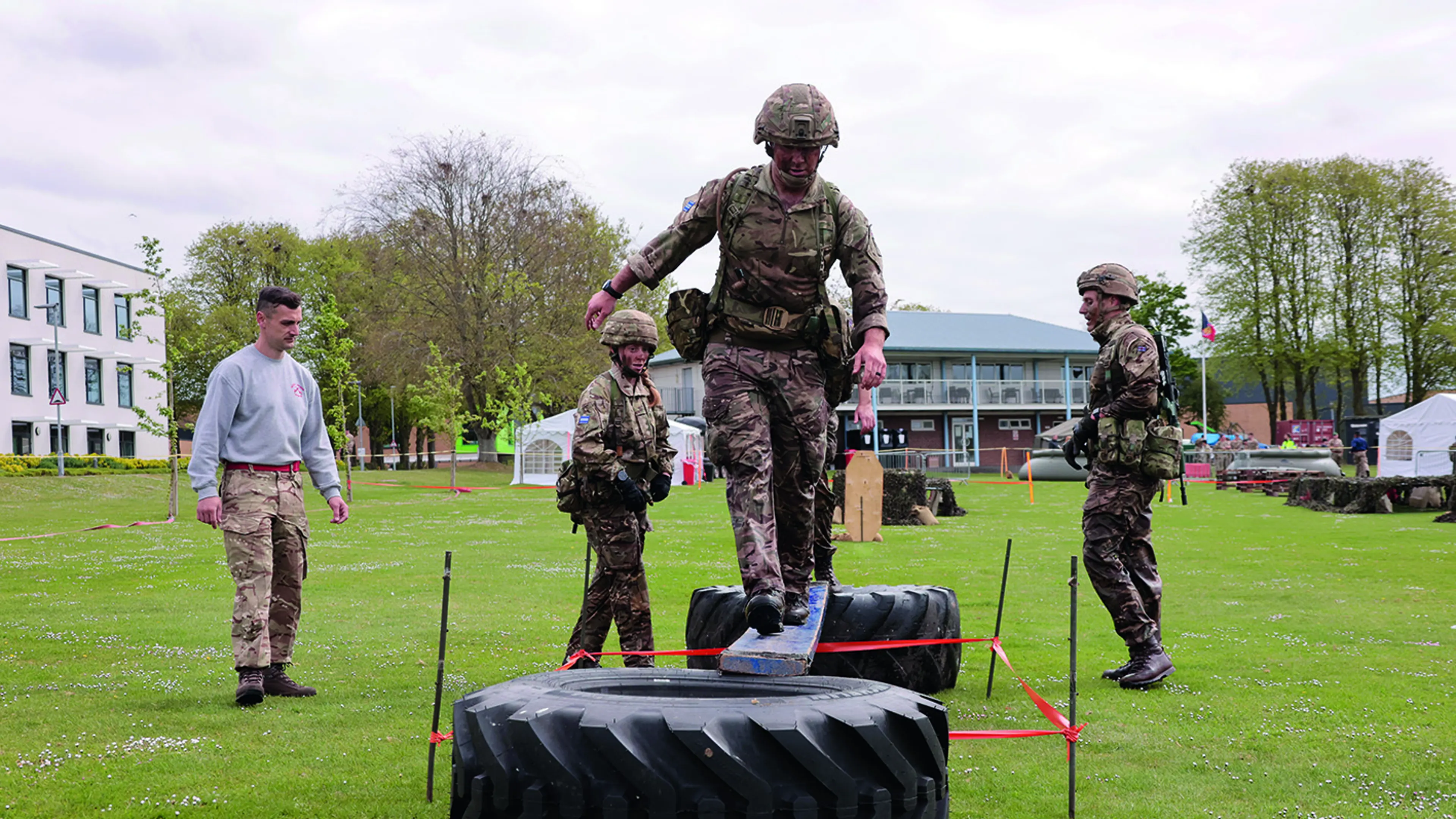
The Triple Crown, which is set up for the Adjutant General’s Corps annual challenge
Other military training might take care of some green skills, but it is the balance and coordination aspects of assault courses the officer believes are unique because they are largely missing from other types of phys.
Sporting chance
If commanders want to encourage a greater take-up of assault courses, however, there may be other obstacles to overcome besides dilapidated equipment.
But as any leader knows, if you want to drum up enthusiasm for just about anything among soldiers, a sure-fire way to do that is with some healthy competition. Obstacle course racing (OCR) may have quite a following across defence, but Army Command Standing Order 1209 states it must not be conducted as an authorised activity.
In effect, this means soldiers cannot do it while on duty and it is not recognised as an official army sport. However, OCR athlete Sgt Reece Sanders (REME) – who got into the pursuit four years ago after getting sick with Covid – hopes there could be change on the horizon.
“I lost a lot of weight and physical fitness,” the 30-year-old senior NCO recalls. “When I got back to normal unit PT after rehab, one of my friends had just done one of the Spartan races and I decided that kind of thing would be a good way to gauge my fitness level. “
I gave a 5km race a go to see how I went, and by the time I’d finished I was looking to book the next.
“I liked the competitive element of OCR, but also the fact you are doing it with a group of likeminded people.
“When you cross the obstacles you have that exercise head on – you’re in a hole, hating life but actually you want to do it again afterwards.
“Whether it’s monkey bars or cargo nets, when people think of the army this is the stuff they have in their head.”
Good recruiter?
It is a fact that isn’t lost on the army’s recruitment team, who attended one of the renowned Spartan obstacle course racing events at Belvoir Castle, Grantham in July at the request of the enthusiastic service personnel taking part.
When Soldier spoke to these troops, they said they were convinced more regular army participation in such civilian fitness events could open the doors to more people signing up to serve their country. Sgt Sanders agrees.
“It’s a shame it isn’t permitted,” he continues, “because the races are very safe. “I have been doing OCR for four years and – touch wood – have not had any injuries. And I do anywhere between 20 and 40 races per year.
“Even if you do get injured, every obstacle has a paramedic on hand.”
Determined that it should receive proper sporting status, the Germany-based soldier reveals that British Obstacle Sports – the national governing body for OCR – has now applied to Sport England for the discipline to be recognised. The process for approval will be slow, perhaps a couple of years, but if successful he hopes it could then pave the way for it to become an official army sport.
But what would the wider service gain from taking on a new sporting discipline, along with all the associated risk, in a sea of many?
“More resilient and adaptable soldiers,” Sgt Sanders replies. “In OCR you get to throw yourself out of your comfort zone and use leadership skills too – especially when you see others struggling with obstacles.
“When I did the Spartan World Championships in Greece last year, there were several people like that – and it just flicked a switch in me where I thought ‘I can help someone here’.”
Risk and reward
It is hardly a secret, however, that the British Army could scant afford to make any changes that could result in more armed forces compensation scheme payouts.
But like many, Capt Connelly believes risk-averse attitudes towards activity which supports green training need to be challenged if future targets relating to lethality are to be met.
“In risk management there is a term called ALARP. People often think that stands for ‘as low as reasonably possible’ but actually it’s ‘as low as reasonably practicable’.
“You can always make risk lower and lower – but eventually that stops being valuable training.”
Soldiers unite
As decision-makers ponder the future of the sporting side of assault courses, what can personnel do to try and ramp up the use of facilities for phys and other training?
“I think like most things, this needs to get driven from the bottom up,” Capt Connelly says. “Soldiers join the army to do assault courses. When you go to recruitment shows you see that cargo net, then you get to take part in basic and initial trade training… but once you’re in the field army, where arguably this kind of thing is needed even more, you just don’t see them; they don’t get utilised.
“We can be, and should be, better at this. Assault courses need to be seen as a steadfast training mechanism.
“There are people contracted to repair them, but it’s often not prioritised.
“If we start to see a rise in requests to use assault courses, when they are out of use it will get highlighted to the right people quicker. If OCR then gets approved as an official sport, that could create even more interest in rejuvenating their use as a fundamental PT medium.
“They really do generate such a positive impression of military life.”
