
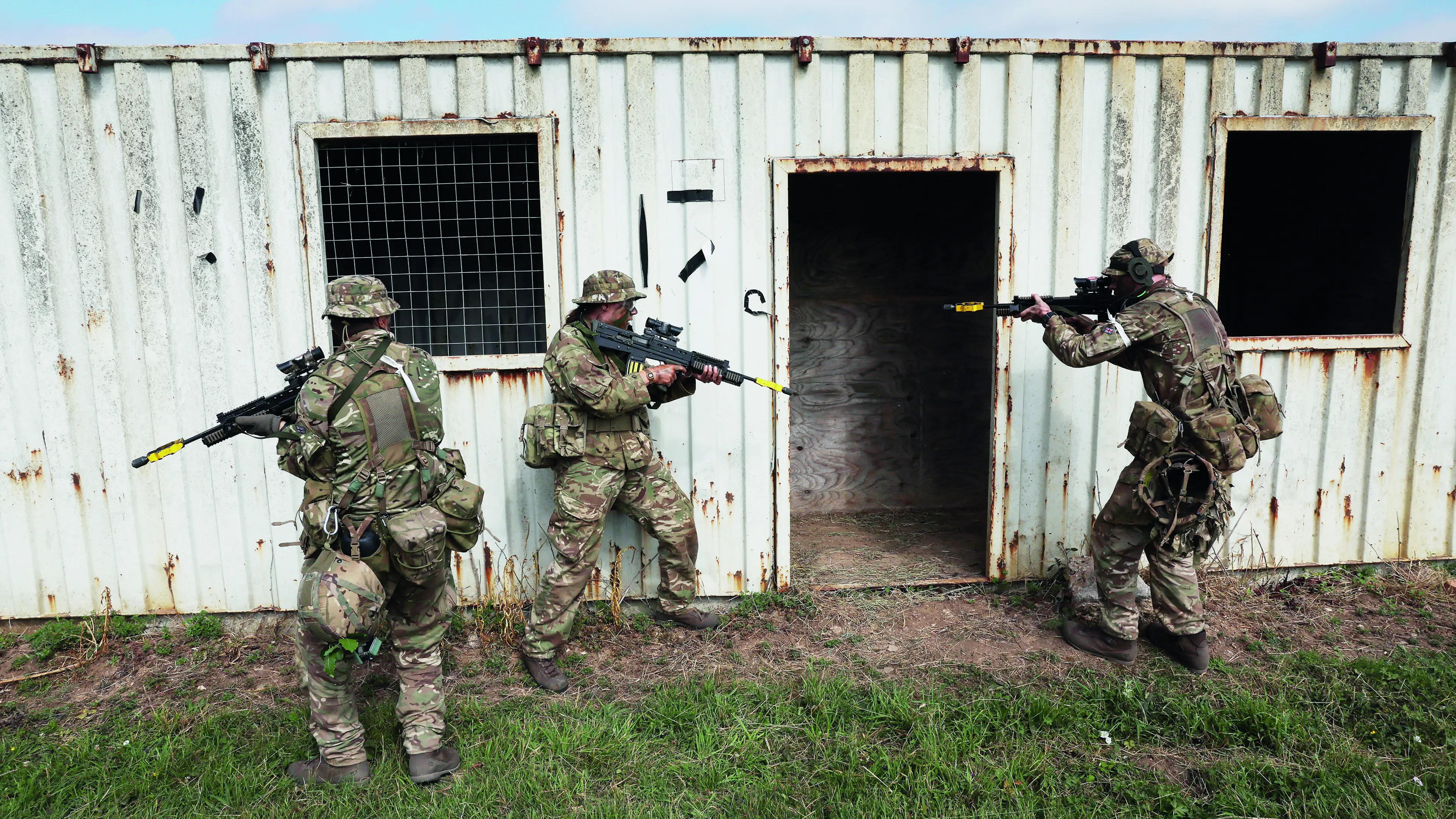
Lydia Ridgway has the typical face of any soldier on summer exercise – sweat has smeared her cam-cream and she has a near-hoarse voice from the rigours of continuous close-quarters combat.
With ice-white eyeballs stark against her dulled face, the 20-year-old’s pupils expose a laser-sharpness – as if she is still tracking the world for threats.
It is unsurprising given that her urban serial with the North West Officers’ Training Regiment on Salisbury Plain has required an all-consuming focus.
It is impressive, too, considering OCdt Ridgway was sitting in a comfortable lecture theatre at the University of Salford just a few weeks ago. Now her higher education crew, from institutions stretching from Manchester to Liverpool, have packed their Bergans and headed several hundred miles south for a two-week camp that is centred on the art of military command.
“I only joined because my brother told me I couldn’t cut it,” the midwifery student confides to Soldier as her platoon sprawls out and unpacks their foil-wrapped butties at Copehill Down village.
“He did this before me when he was at university and told me I’d never make the grade – how wrong he was. “The subject I’m studying doesn’t have a huge profile within the army – although it’s definitely there in the medical field of the service – so there’s a lot for me to think about moving forward.”
This conversation is interesting given that student life has always had its stereotypes, usually involving vast quantities of subsidised booze and boisterous fresher parties.
The picture of OCdt Ridgway and her platoon talking tactics, however, is completely divorced from all that. While troops from the 15 officers’ training corps and regiment units across the UK are paid in the same way as reservists – which might be an attraction at a time in life when finances are tight – meeting the military requirement is no easy task, especially given the studying they have to do. And their commitment has not been lost on senior command, who are looking to grow the university cohort.
There is also a deeper interest for Col Tony Gawthorpe, who is overseeing the army’s renewed push into higher education.
“I joined the UOTC and have served for 30 years,” he recalls. “But whatever you go on and do in life, this experience helps you develop confidence – and importantly, it doesn’t matter what experience you’ve had beforehand.” Col Gawthorpe’s team are aiming to bolster the numbers of student officer cadets by around ten per cent over the coming months – from 3,000 to 3,300.
The training programme, which essentially steps the participants up from leadership at platoon-level to larger infanteer cohorts, is also being adjusted to fit more neatly around a typical three-year degree schedule. “These are things we can do with current levels of staffing and the resources already in place,” the officer – who served in The Royal Regiment of Fusiliers and has been on ops in both the Balkans and Iraq – added. “We want a stronger proposition for the students, showing them that they can be a part of military life – and be paid for it – while they are at university.”
Col Gawthorpe is confident that bolstering student opportunities will also strengthen bonds between civvy and armed forces communities – an aspiration of the chief of the general staff.
While many joining will have an interest in a career in uniform – with some here accepted on defence sponsorship programmes – there is no commitment to service. The leadership experience and skills accrued can easily be applied to any job.
He clarifies that the offer is different, however, to the cadet forces – organisations open to younger people and aimed squarely at promoting good citizenship.
The higher education students are classed as non-deployable soldiers and must accordingly meet stringent armed forces medical standards.
Maj Alec McKenzie (QoY), 2iC of the North West Officer Training Regiment, echoes the colonel’s sentiments. Surveying a second urban serial from a high vantage point on the training area, he attests to the high quality of the volunteers.
“The people coming forward are certainly very self-aware,” the reservist who deployed to Afghanistan during Op Herrick, adds. “They have a good level of emotional intelligence and are committed to their service here. “We have about 150 officer cadets out on Salisbury Plain for this package, ten of whom have army bursaries and others are looking at armed forces careers of one form or another.
“But all of them have good opportunities to develop themselves – at this camp, for example, we are allowing them to build confidence by learning to abseil.”
Most of the students at Copehill Down speaking to Soldier have definite designs on army life after leaving university, with both full- and part-time aspirations in evidence. “I’m actually between years in my studies at the moment – in civilian life I’m with aviation firm Airbus on a work placement,” says 21-year-old OCdt Ethan Ellis-Sixsmith from Sheffield Hallam University.
“I think a lot of us are going to be putting in our applications to become army officers.
“As for me, I’m looking at the airborne forces as a reservist – however, the training you do here does generally stand you in good stead for any career.” OCdt Ellis-Sixsmith points out that sampling military life can be a game changer and influence the trajectory of some career paths towards the services.
With the disconnect between military and civilian worlds higher than ever, more recruits might also be encouraged if the process of enlisting was faster and easier, the student adds.
OCdt Kit Jackson-Brown, studying at the University of Liverpool, agrees.
The 22-year-old accepts that a military life is not for everyone, but believes the student route offers a “useful taster” for a potential career in uniform. The ancient history undergrad also has aspirations in the airborne forces.
Service has changed the outlook of OCdt Ridgway, who enlisted to prove a point and is now considering the reserve.
“I have been looking at available units,” the 20-year-old reveals. “But for now, I am loving the challenge of being with this regiment and my fellow students – there is more to army life than I realised.”
There have been many advertising campaigns and recruitment drives to bring in new blood over the past decades. The older generation will remember Frank in the 1990s, the recruit who lived a dream life, and more recently the You Belong Here initiative on TV and social media.
But nothing – it seems – is quite as good as giving a potential recruit the opportunity to sample the real thing. The chance to try before they buy, as the salesman says, provides an experience that shows a few realities and dispels many myths.
The army has a good offer – and with a test drive, that product might just sell itself.
