In keeping with the strong breeze of innovation that’s currently running through the service, Exercise Iron Storm on Salisbury Plain provided a perfect platform for The Queen’s Royal Hussars (QRH) Battlegroup to assess an array of new tactics, techniques and kit, all conducted with a certain potential foe that lies to the east in mind.
The headline objective of the package – the largest armoured exercise the British Army has staged in recent years – was to sign off the QRH for deployment as part of the service’s lead armoured brigade, while 3rd Armoured Close Support Battalion, REME and 1 Medical Regiment were to be validated at battlegroup level. With around 3,000 people and 35 sub-units deployed, including two squadrons of Challenger 2 main battle tanks, this was a demanding process involving a build-up through the Land Training System’s Cyclone stage at sub-unit level before moving on to the brigade environment and Iron Storm.
Behind the scenes, however, a fascinating sub-plot developed as planners and ground personnel took advantage of this major exercise to conduct a series of trials aimed at increasing the battlegroup’s fighting power.
The main barometer of success was performance measured against a highly organised and well-equipped Task Force Hannibal, led by 5th Battalion, The Rifles equipped with Warriors and near-surface effectors while employing Russian ground force tactics based on what has been seen in Ukraine.
“We used this exercise to maximise our understanding of what and how we need to modernise,” Brig Adam Foden, commander of 20th Armoured Brigade, told Soldier.
“We did that through a series of experiments covering a range of things we know armoured brigades need to be better at doing than they currently are.
“While we are beginning to field some of the army’s newest equipment, in other areas we recognise there are things we are currently not optimised to do – for example near-surface effectors or the proliferation of fires at range.
“Ukraine and other conflicts are demonstrating we need to rebuild and re-imagine what the close fight is and Iron Storm was the first chance we’ve had to conduct physical runouts of these ideas.
“It’s part of a concerted effort, working with partners such as the Land Warfare Centre and Defence Science and Technology Laboratory, to assess what armoured warfare might involve in the future.”
One of the main concepts piloted was an “armoured brigade in a box”, which exercised the full formation through a blend of real life and simulated domains.
“We came here and trialled some of that in live and virtual arenas to see what it told us and then went back and wargamed it again,” added Brig Foden.
“Crucial to the whole activity was having a proper understanding of the enemy and one of our experiments here is called Project Zimmer, which is instilling a tactical understanding of our adversary right down to the very lowest level inside all of our organisations and units.
“We have driven all our tactics not just to make them generically good but to counter our potential adversary, Russia. For me this is the biggest thing we are doing to generate a better understanding of the foe we might have to face.”
On the ground
For the troops out in the field the experimentation meant an occasional stop, pause and repeat of a mission with a reorganisation and change in approach the second time around.
“In one scenario we looked at how we could bolt in anti-tank weapons and mortars into an armoured battlegroup – what impact did it have and could we fight differently?,” explained Maj Rory Williams (R Yorks), an exercise planning officer in the brigade’s headquarters.
“We used the data we collected to analyse whether lethality was enhanced or not while we also compared some of the data collected from Batus over the last 20 years or so.
“In the end this will help us rewrite doctrine with some scientific evidence behind it.
“We also started looking at remote autonomous systems which give us greater reach,” he continued.
“We have used the Eagle UAS for the first time, which meant we could call for fires from a medium-weight platform in a way that we weren’t able to do before.
“We’re heading in the right direction but there’s loads more work to do in this area and we recognise that.”
The focus on drones and the near surface threat was a major change for many participants, partly because it was the first properly resourced brigade-level exercise staged for some time and partly because of the arrival of new kit, such as Ajax.
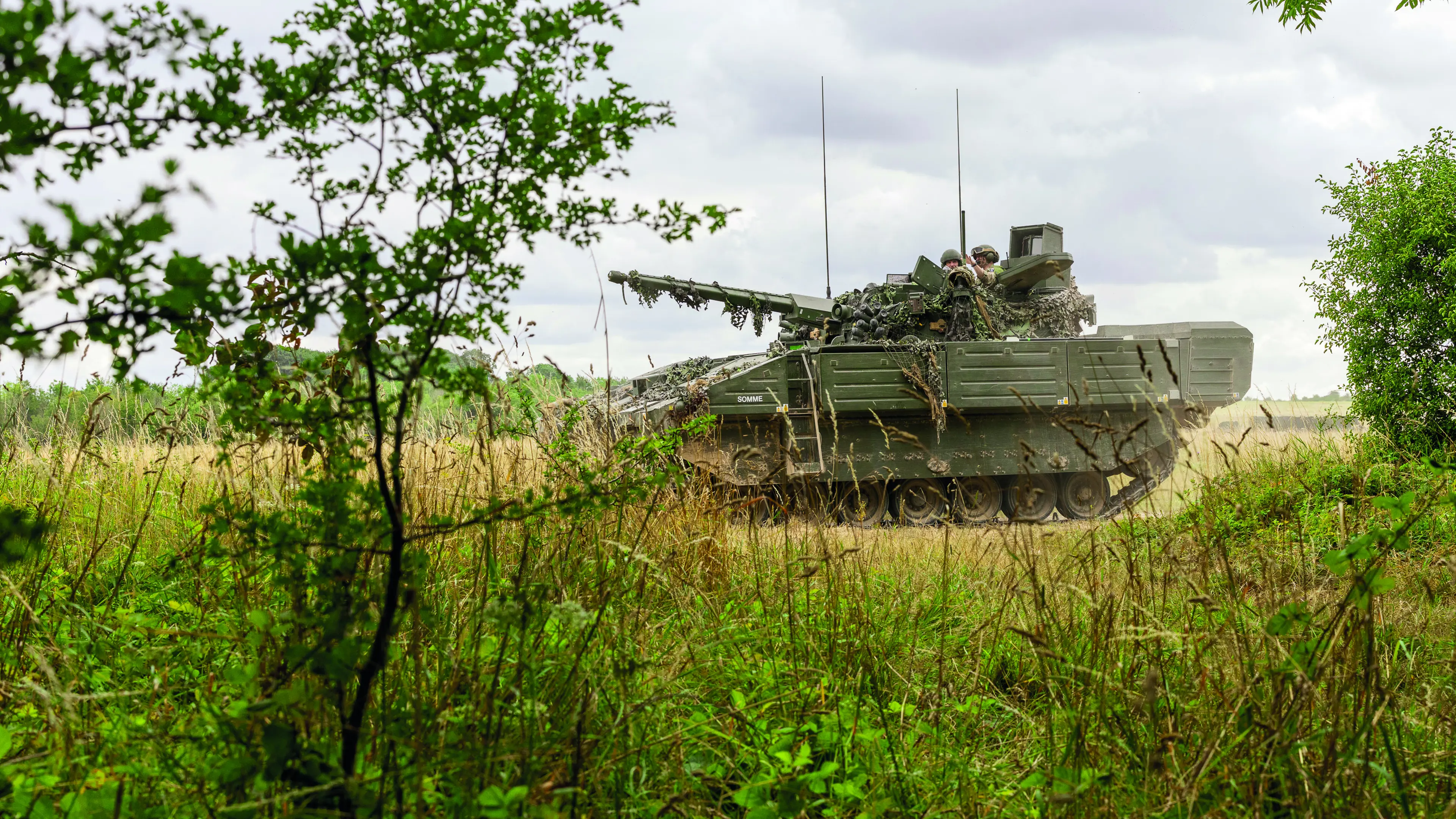
Eight of the platforms, including an Ares and one Argus engineering variant, were deployed during the package.
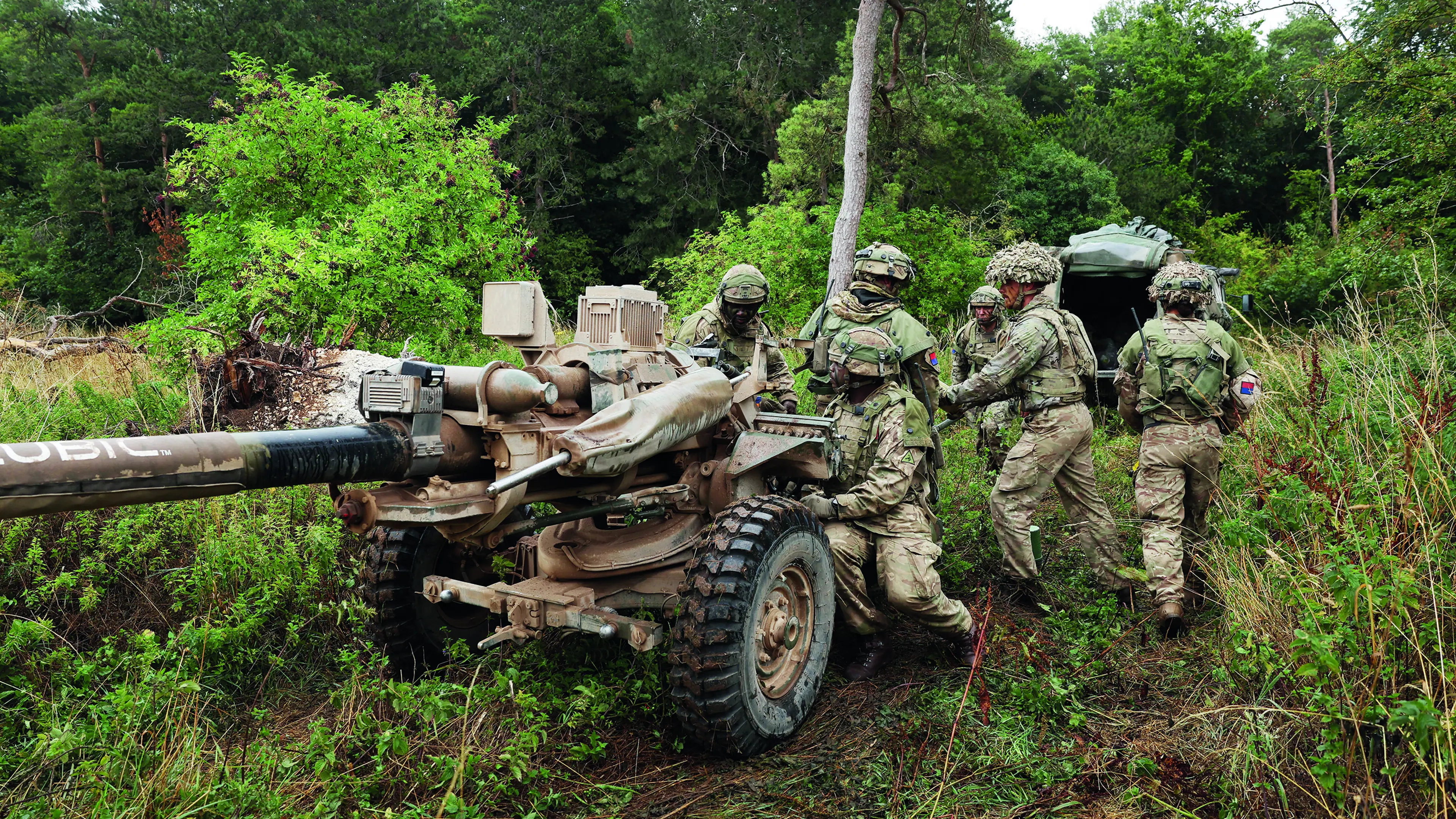
“This is our first time out in the new vehicle and as a result we’ve been learning how to work with small UAS for the first time,” said Bdr Jacob Dawson (RHA), 2iC for a fire support team attached to the QRH.
“Last night the call sign we’ve been working with put up drones to spot the enemy, sent over the coordinates to us and we typed up the mission, sent it digitally to the command post and then it was quickly relayed to the guns without any use of voice to avoid detection.
“We couldn’t do that when we had Warrior, and with Ajax we also have acoustic and infra-red sensors, hunter-killer sights and a really sensitive chemical detection system. If we went back to Warrior now it would feel like we had a blindfold and ear coverings on.”
Drone threat
Counter drone measures were also a major priority thanks to Task Force Hannibal operating as a contemporary Russian force.
“We knew a UAS threat was out there so the preparations for that, such as dispersion and camouflage, were taken very seriously and occupied a lot more of our time than previously,” noted Maj Neil Rudd (QRH).
“As a battlegroup 2iC and late-entry officer I’ve not been out on an exercise of this size for about ten years. “Getting back in the field and going through low-level skills and drills, digging holes, putting camouflage up and administering ourselves is invaluable – it can’t be simulated in a classroom.
“One major change from the past is that we have two drone teams out with us.
“We have been attaching them wherever we feel is best suited at the time, so they were often forward with our recce troop because we wanted to get eyes on the enemy as soon as they came into our area.
“We linked them with our gun battery so we can prosecute early and that is something we have been experimenting with.
“They are not standard assets of our battlegroup as it stands – we repurposed a number of personnel from our D Squadron and put them out in Bulldogs.
“Thankfully, we have far more resources here than for our low-level squadron exercises and we are really appreciative of that. It’s not often we get to do things in a full battlegroup context where we are supported by guns, anti-air or engineers building our obstacles and clearing the enemy’s.”
Happy sappers
Iron Storm provided an invaluable opportunity to bed in new engineers as well as test fresh techniques and procedures that have been learned from Ukraine.
“This was the first armoured exercise our guys have done since they trained for Cabrit two and a half years ago and we also have lots of faces straight out of phase two training,” said Capt William Evans (RE), a battlegroup engineer with 22 Engineer Regiment’s 3 Armoured Engineer Squadron.
“It’s been a busy and stressful period, with all our main clearance and bridging assets – Trojan, Terrier and Titan – out at the same time,” he continued.
“We had an Argus out there as well and we’re still learning how to fight that. It’s been with the Household Cavalry to reach initial operating capability but this is its first time with an armoured engineer squadron. “We’re getting used to its size and weight compared with the CVRT but its sights are superb and having thermal imaging and laser distance finders is a step change for us.
“It also has impressive protection for the crew, a remote weapon system on top as well as a rack for NLAWs in the back.
“All our engineers are now being trained to use those – when we attacked recce screens in the past we had GPMGs coming up against BRDMs (Soviet-era armoured reconnaissance vehicles) but now the regiment has its own NLAW and instructors, our lethality has stepped up significantly.”
That fighting power will be sorely needed on the battlefields of the future – as the war in Ukraine continues to starkly demonstrate.
“We’ve been working out how to adjust our TTPs to overcome defences such as minefields and obstacles while dealing with persistent drone threats,” added Capt Evans.
“During Iron Storm we had a Royal Marine detachment in BV206 vehicles armed with shoulder launched anti-air rockets that can take out UAS, such as Russia’s Orlan 10, which could attack us at range.”
Being able to operate freely to clear mines is more vital than ever. Reports from Ukraine say the Russians are now burying mines much deeper and double stacking or using devices with different fuses so some are triggered by a specific resonance of vehicle or presence of heavy metal, while others are programmed to spring up and then attack from height.
Platforms like Trojan, Titan and Terrier that can negate these threats have become high-value targets as a result, and the enemy will know where these vehicles are likely to be deployed in the area of operations.
“There are so many obstacles and minefields we have to prioritise which ones we try to breach because every time we do it we risk the asset,” explained Capt Evans.
“During this exercise we cleared a main defensive position which had all sorts of stuff lying on it and by trying out some new tactics our teams – and platforms – survived, which is a key objective.
“We’re assessing the use of remote-controlled obstacle and mine clearance equipment too – why would you risk personnel in that role if you could do it with an unmanned ground vehicle?”
Why indeed. Which just goes to show what a valuable test bed Exercise Iron Storm has been for 20th Armoured Brigade.
The ability to experiment with new techniques, tactics, procedures and equipment against a relevant and formidable opposition has provided reams of valuable data – and has undoubtedly accelerated the development of this already highly potent warfighting formation into a force that should be feared by anyone.